




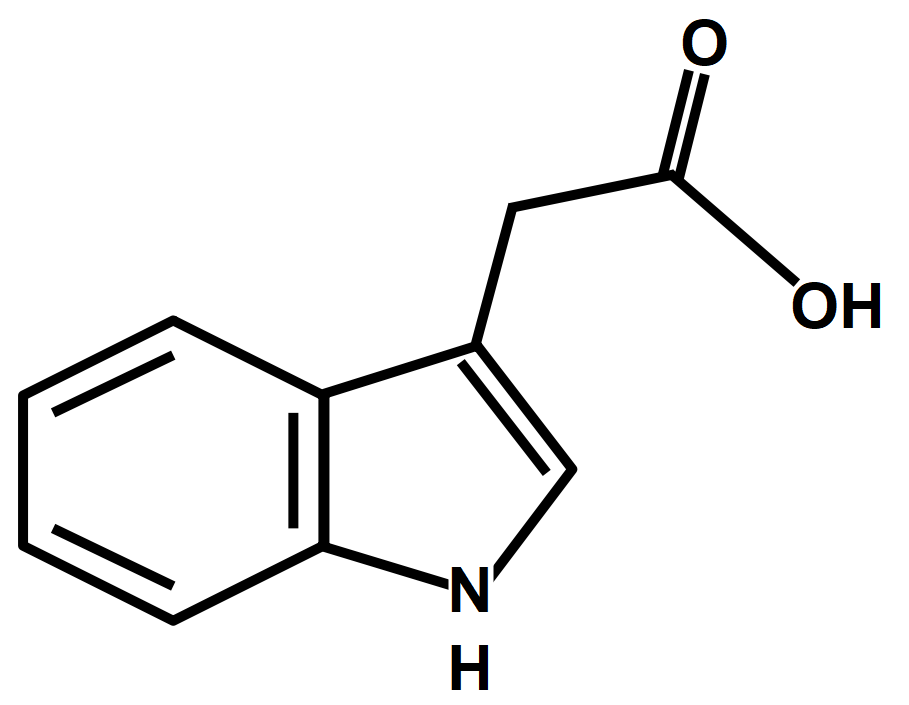
What is the chemical name of auxin?
Answer
 Verified
523.2k+ views
Hint: We know that the auxin word is taken from the Greek word auxein, which means to grow. Auxins were first isolated from human urine. The term auxin is applied to the \[indole-3-acetic\] acid (IAA), and to other natural and synthetic compounds having certain growth-regulating properties.
Complete answer:
As we know that the Auxins are a powerful growth hormone produced naturally by the plant. They are seen in the shoot and the root tips and promote cell division, stem and root growth. Auxins are the plant hormones that are produced naturally by plants. When sun rays fall on the plant the auxin helps in growth of the plant. Auxins can also be manufactured artificially. Such auxins are known as synthetic auxins. Auxins promote elongation of the stem. Auxins stimulate gibberellins which results in elongation of cells. This increases the length of the plant. Auxins along with gibberellins are responsible for increasing the distance between nodes.
Auxins control the growth of seedlings by controlling the growth of cells. Auxins are affected by light and they have the tendency to concentrate in plant parts that are away from the light. More growth of cells occurs in those parts of the plant which show high concentration of auxins. As auxins are found in more concentration in the shaded side of the plant, the shaded side of the plant shows more growth than parts exposed to light. An example of artificially synthesized Auxin is \[2,4-\] dichloro phenoxy acetic acid.
Note:
Remember that the natural auxins are produced by plants, while synthetic auxins are prepared in laboratories. Both natural and synthetic auxins perform various functions in plants such as elongation of stem, branching of roots, development of fruit, and growth of seedlings.
Complete answer:
As we know that the Auxins are a powerful growth hormone produced naturally by the plant. They are seen in the shoot and the root tips and promote cell division, stem and root growth. Auxins are the plant hormones that are produced naturally by plants. When sun rays fall on the plant the auxin helps in growth of the plant. Auxins can also be manufactured artificially. Such auxins are known as synthetic auxins. Auxins promote elongation of the stem. Auxins stimulate gibberellins which results in elongation of cells. This increases the length of the plant. Auxins along with gibberellins are responsible for increasing the distance between nodes.
Auxins control the growth of seedlings by controlling the growth of cells. Auxins are affected by light and they have the tendency to concentrate in plant parts that are away from the light. More growth of cells occurs in those parts of the plant which show high concentration of auxins. As auxins are found in more concentration in the shaded side of the plant, the shaded side of the plant shows more growth than parts exposed to light. An example of artificially synthesized Auxin is \[2,4-\] dichloro phenoxy acetic acid.
Note:
Remember that the natural auxins are produced by plants, while synthetic auxins are prepared in laboratories. Both natural and synthetic auxins perform various functions in plants such as elongation of stem, branching of roots, development of fruit, and growth of seedlings.
Recently Updated Pages
Master Class 11 Social Science: Engaging Questions & Answers for Success

Master Class 11 Physics: Engaging Questions & Answers for Success
Master Class 11 Maths: Engaging Questions & Answers for Success
Master Class 11 Economics: Engaging Questions & Answers for Success
Master Class 11 Computer Science: Engaging Questions & Answers for Success
Master Class 11 Chemistry: Engaging Questions & Answers for Success
Trending doubts
One Metric ton is equal to kg A 10000 B 1000 C 100 class 11 physics CBSE
There are 720 permutations of the digits 1 2 3 4 5 class 11 maths CBSE
1 Quintal is equal to a 110 kg b 10 kg c 100kg d 1000 class 11 physics CBSE
State and prove Bernoullis theorem class 11 physics CBSE
Difference Between Prokaryotic Cells and Eukaryotic Cells
Which among the following are examples of coming together class 11 social science CBSE