




What is Polyculture?
Answer
 Verified
503.7k+ views
Hint: Multiple cropping is a farming practice in which farmers plant two or more crops on the same field at the same time in the same calendar year. Arable crops, vegetables, fibre crops, and fodder crops are all grown in succession. After the primary crop is harvested, the next crop is usually planted, and so on until the year is over.
Complete answer:
Polyculture is a type of agriculture that mimics the diversity of natural ecosystems by growing multiple species at the same time and in the same place. Monoculture, in which only members of one plant or animal species are cultivated together, is the polar opposite of polyculture.
Polyculture is a type of agriculture that mimics the diversity of natural ecosystems by growing multiple species at the same time and in the same place. Monoculture, in which only members of one plant or animal species are cultivated together, is the polar opposite of polyculture. Polyculture has long been the most common type of agriculture in most regions of the world, and its popularity is expanding due to its environmental and health benefits. Annual polycultures like intercropping and cover cropping, permaculture, and integrated aquaculture are all examples of polyculture.
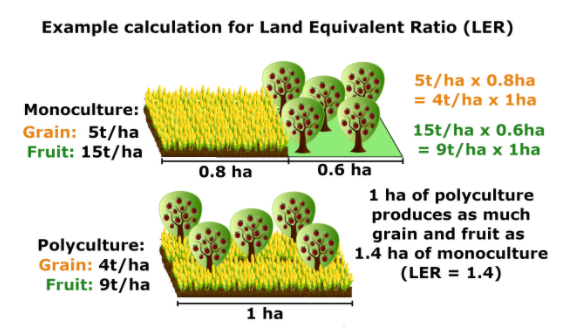
Polyculture has the advantage of being able to control pests, weeds, and diseases without using a lot of chemicals. As a result, polyculture is seen as a long-term farming strategy. However, due to crop production concerns and biological competition, many current major industrial food producers have reverted to monoculture.
Smallholder farmers' most common farm method is multiple cropping. This style of cropping makes efficient use of land, water, and fertiliser, resulting in more crops and more profitable farm operations.
Intercropping:- Intercropping is a type of multiple cropping when two or more crops are grown in the same field at the same time. In this approach, an additional crop is planted in the unoccupied gaps in the field between the main crop and the second crop. Intercropping allows a farmer to grow more than one crop at the same time on the same piece of land. At least two types of crops are planted, which can be done in a systematic or haphazard manner.
Because tiny crops are grown beneath larger crops, intercropping is commonly referred to as an agroforestry system. Pineapples and bananas, for example, are intercropped with a date or coconut palms.
Crop rotation:- Crop rotation is a method of producing multiple crops on the same field, one after the other. Crop rotation is good for the soil as well as the plant. In general, it improves plant growth circumstances, resulting in larger and higher-quality yields while also safeguarding the environment.
Note: Farmers use polyculture crop production to reduce production risks and, as a result, provide a reliable source of revenue and nutrition while maximising economic and energy returns using mostly indigenous agricultural technology. Become a part of the team that manages sustainable farming to ensure a brighter future for future generations.
Complete answer:
Polyculture is a type of agriculture that mimics the diversity of natural ecosystems by growing multiple species at the same time and in the same place. Monoculture, in which only members of one plant or animal species are cultivated together, is the polar opposite of polyculture.
Polyculture is a type of agriculture that mimics the diversity of natural ecosystems by growing multiple species at the same time and in the same place. Monoculture, in which only members of one plant or animal species are cultivated together, is the polar opposite of polyculture. Polyculture has long been the most common type of agriculture in most regions of the world, and its popularity is expanding due to its environmental and health benefits. Annual polycultures like intercropping and cover cropping, permaculture, and integrated aquaculture are all examples of polyculture.
Polyculture has the advantage of being able to control pests, weeds, and diseases without using a lot of chemicals. As a result, polyculture is seen as a long-term farming strategy. However, due to crop production concerns and biological competition, many current major industrial food producers have reverted to monoculture.
Smallholder farmers' most common farm method is multiple cropping. This style of cropping makes efficient use of land, water, and fertiliser, resulting in more crops and more profitable farm operations.
Intercropping:- Intercropping is a type of multiple cropping when two or more crops are grown in the same field at the same time. In this approach, an additional crop is planted in the unoccupied gaps in the field between the main crop and the second crop. Intercropping allows a farmer to grow more than one crop at the same time on the same piece of land. At least two types of crops are planted, which can be done in a systematic or haphazard manner.
Because tiny crops are grown beneath larger crops, intercropping is commonly referred to as an agroforestry system. Pineapples and bananas, for example, are intercropped with a date or coconut palms.
Crop rotation:- Crop rotation is a method of producing multiple crops on the same field, one after the other. Crop rotation is good for the soil as well as the plant. In general, it improves plant growth circumstances, resulting in larger and higher-quality yields while also safeguarding the environment.
Note: Farmers use polyculture crop production to reduce production risks and, as a result, provide a reliable source of revenue and nutrition while maximising economic and energy returns using mostly indigenous agricultural technology. Become a part of the team that manages sustainable farming to ensure a brighter future for future generations.
Recently Updated Pages
Master Class 12 Business Studies: Engaging Questions & Answers for Success

Master Class 12 Biology: Engaging Questions & Answers for Success
Master Class 12 Chemistry: Engaging Questions & Answers for Success
Class 12 Question and Answer - Your Ultimate Solutions Guide
Master Class 11 Social Science: Engaging Questions & Answers for Success
Master Class 11 English: Engaging Questions & Answers for Success
Trending doubts
What is BLO What is the full form of BLO class 8 social science CBSE
Citizens of India can vote at the age of A 18 years class 8 social science CBSE
Right to vote is a AFundamental Right BFundamental class 8 social science CBSE
Advantages and disadvantages of science
10 slogans on organ donation class 8 english CBSE
Name the states through which the Tropic of Cancer class 8 social science CBSE