




What is \[k\] in the pendulum?
Answer
 Verified
562.2k+ views
Hint:A pendulum is a hung object or weight from a pivot point. When a pendulum is set in motion, gravity acts as a restorative force, accelerating it toward the center point and causing it to swing back and forth. The word "pendulum" comes from the Latin word "pendulum," which means "hanging." Pendulums have been employed in a variety of scientific applications throughout history.
Complete step by step solution:
\[k\] - Spring constant.
The pendulum is an \[k\] of spring constant harmonic oscillator.
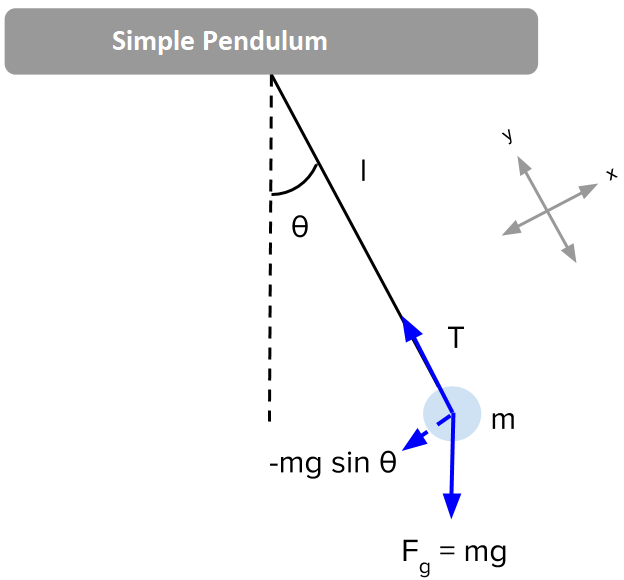
Basic Harmonic Motion is quite similar to the motion of a simple pendulum (SHM). When applied to springs, SHM occurs when the restoring force is proportionate to the displacement, a relationship known as Hooke's Law.
\[F = - kx\]
The restoring force is \[F\], the spring constant is \[k\], and the displacement is \[x\].
When Newton's Second Law is applied, the resulting acceleration when no other forces are present becomes,
$ma = F = - kx$
where m denotes mass and a denotes speed. As a result, the displacement vector is proportional to the acceleration vector (and in an opposite direction).
When an object is in SHM, it follows a Sine wave's course.
Additional information:
Linear Simple Harmonic Motion occurs when a particle moves back and forth along a straight line around a fixed point (called equilibrium position).
The pendulum swings in a single direction back and forth. It takes the form of a single oscillatory motion. As a result, even if the motion of a simple pendulum does not occur in a straight line, it is deemed simple harmonic.
Note: The pendulum has numerous applications in research and education. It is also at its disposal in everyday life. The most well-known application of pendulums is in clocks. The length at which the pendulum is suspended determines the exact intervals at which the pendulum swings back and forth. A pendulum clock must remain steady to accurately measure time.
Complete step by step solution:
\[k\] - Spring constant.
The pendulum is an \[k\] of spring constant harmonic oscillator.
Basic Harmonic Motion is quite similar to the motion of a simple pendulum (SHM). When applied to springs, SHM occurs when the restoring force is proportionate to the displacement, a relationship known as Hooke's Law.
\[F = - kx\]
The restoring force is \[F\], the spring constant is \[k\], and the displacement is \[x\].
When Newton's Second Law is applied, the resulting acceleration when no other forces are present becomes,
$ma = F = - kx$
where m denotes mass and a denotes speed. As a result, the displacement vector is proportional to the acceleration vector (and in an opposite direction).
When an object is in SHM, it follows a Sine wave's course.
Additional information:
Linear Simple Harmonic Motion occurs when a particle moves back and forth along a straight line around a fixed point (called equilibrium position).
The pendulum swings in a single direction back and forth. It takes the form of a single oscillatory motion. As a result, even if the motion of a simple pendulum does not occur in a straight line, it is deemed simple harmonic.
Note: The pendulum has numerous applications in research and education. It is also at its disposal in everyday life. The most well-known application of pendulums is in clocks. The length at which the pendulum is suspended determines the exact intervals at which the pendulum swings back and forth. A pendulum clock must remain steady to accurately measure time.
Recently Updated Pages
Which will be the least stable resonating structure class 11 chemistry CBSE

How many 5 digit telephone numbers can be construc-class-11-maths-CBSE
How do you find the angle of the resultant vector class 11 physics CBSE
Draw labelled diagram of the following i Gram seed class 11 biology CBSE
1 Quintal is equal to a 110 kg b 10 kg c 100kg d 1000 class 11 physics CBSE
What is the need and importance of classification class 11 biology CBSE
Trending doubts
One Metric ton is equal to kg A 10000 B 1000 C 100 class 11 physics CBSE
Find the value of the expression given below sin 30circ class 11 maths CBSE
Draw a diagram of nephron and explain its structur class 11 biology CBSE
10 examples of friction in our daily life
Proton was discovered by A Thomson B Rutherford C Chadwick class 11 chemistry CBSE
The teeth used for biting and cutting food are called class 11 biology CBSE