




What is hologamy?
Answer
 Verified
654.6k+ views
Hint: Fusion of the whole organism in the case of certain lower organisms and is the most simple type of sexual reproduction. In this case, the whole individuals fuse together to form a new organism.
Complete answer:
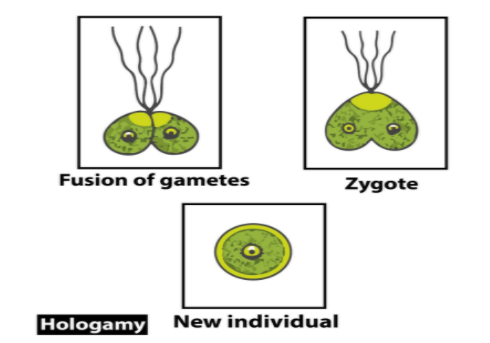
Hologamy is a specialized and simplest type of sexual reproduction in unicellular organisms. In these sex cells (gametes) are not formed, instead, the entire unicellular organisms get fused.
Hologamy is the characteristic feature of some green algae and lower fungi.
Additional Information: -In hologamy, the gametes are of the same size and structure as that of the somatic cells.
-It occurs in very lower algae which look alike and are haploid.
-Gametes are haploid having a single set of chromosomes that are produced by the organisms so that after fusion they can give rise to a new generation.
-Sexual reproduction is of various types:
(a)Allogamy – gametes join together during fertilization and they come from two different individuals.
(b)Internal fertilization – fertilization of the egg by the sperm within the body of one of the parents, usually in the female body through sexual intercourse.
(c)External fertilization – gametes join outside the body of an individual.
(d)Autogamy – a fusion of male and female gametes produced by single individuals. It is also known as self-fertilization.
Note: In fungi, sexual reproduction consists of three stages: Plasmogamy (fusion of two Protoplasts), Karyogamy (fusion of two haploid nuclei forming zygote), and Meiosis (cell division that reduces the chromosome number to one set per cell).
Complete answer:
Hologamy is a specialized and simplest type of sexual reproduction in unicellular organisms. In these sex cells (gametes) are not formed, instead, the entire unicellular organisms get fused.
Hologamy is the characteristic feature of some green algae and lower fungi.
Additional Information: -In hologamy, the gametes are of the same size and structure as that of the somatic cells.
-It occurs in very lower algae which look alike and are haploid.
-Gametes are haploid having a single set of chromosomes that are produced by the organisms so that after fusion they can give rise to a new generation.
-Sexual reproduction is of various types:
(a)Allogamy – gametes join together during fertilization and they come from two different individuals.
(b)Internal fertilization – fertilization of the egg by the sperm within the body of one of the parents, usually in the female body through sexual intercourse.
(c)External fertilization – gametes join outside the body of an individual.
(d)Autogamy – a fusion of male and female gametes produced by single individuals. It is also known as self-fertilization.
Note: In fungi, sexual reproduction consists of three stages: Plasmogamy (fusion of two Protoplasts), Karyogamy (fusion of two haploid nuclei forming zygote), and Meiosis (cell division that reduces the chromosome number to one set per cell).
Recently Updated Pages
Difference Between Prokaryotic Cells and Eukaryotic Cells

If x a + bt + ct2 where x is in meters and t is in class 11 physics CBSE
A car covers the first half distance between two places class 11 physics CBSE
The resultant of two vectors overrightarrow P and overrightarrow class 11 physics CBSE
Find the value of cos 135 class 11 maths CBSE
A mass M is held in place by an applied force F and class 11 physics CBSE
Trending doubts
One Metric ton is equal to kg A 10000 B 1000 C 100 class 11 physics CBSE
Find the value of the expression given below sin 30circ class 11 maths CBSE
Draw a diagram of nephron and explain its structur class 11 biology CBSE
10 examples of friction in our daily life
Proton was discovered by A Thomson B Rutherford C Chadwick class 11 chemistry CBSE
Bond order ofO2 O2+ O2 and O22 is in order A O2 langle class 11 chemistry CBSE