




What is epitope and paratope?
Answer
 Verified
641.1k+ views
Hint: Epitope and paratope take part in the antigen-antibody reaction and complex formation. These are small segments present on certain molecules which are mostly proteinaceous. One of them is produced by B-lymphocytes.
Complete answer
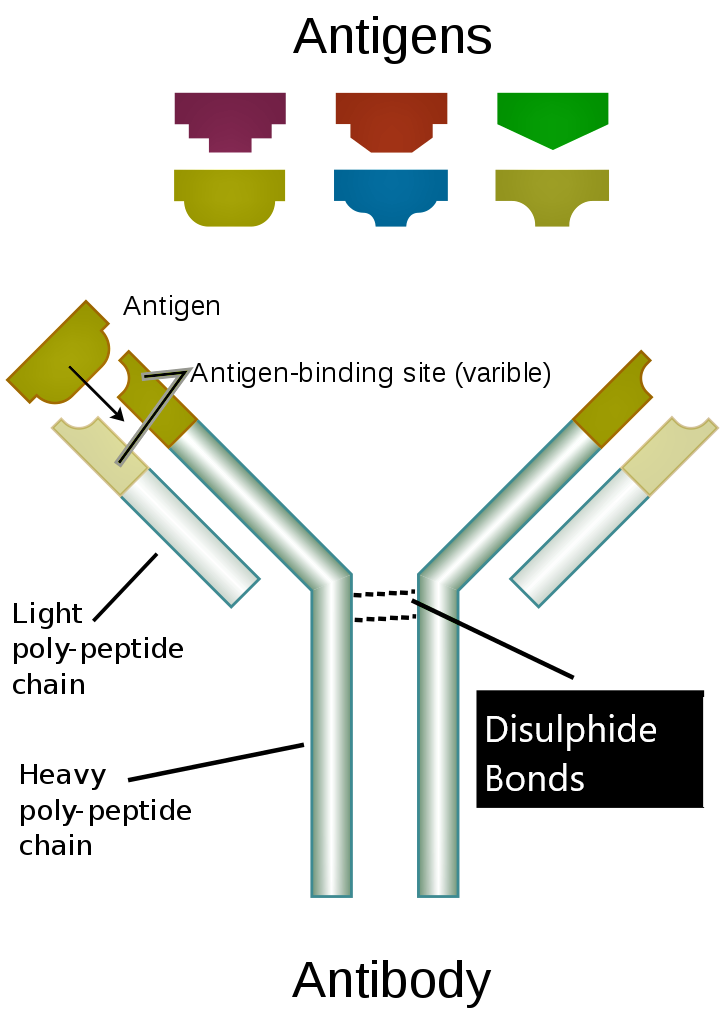
The epitope is a specific region that consists of a sequence of amino acids and is present on the antigen. This specific region is recognized by the antibodies present in our circulatory system, after which they bind to the antigen, which results in their inactivation. The region present on antibodies which binds to the epitope region present on the antigen is known as the paratope.
Additional Information:
Structure of Antibody -
-Antibody consists of four peptide chains, two small chains known as light chains or L- chains, and two large chains known as heavy chains or H-Chains. It is Y shaped in structure. They are represented by the formula H2L2. Antibodies can be either present on the cell membrane surface or remain freely suspended in blood plasma.
-There are five major types of antibodies that are produced in our body. They are known as immunoglobulins, namely IgG, IgA, IgM, IgD, and IgE. Almost 80% of the antibody fraction consists of IgG.
-Lymphocytes are responsible for the primary and secondary immune responses and the antibodies are produced by lymphocytes. Two types of lymphocytes are mainly present, B lymphocytes, and T lymphocytes. Out of these two B lymphocytes are responsible for the production of antibodies and T lymphocytes help in amplifying the production of antibodies.
Note:
>Different antibodies perform different functions in our body:
Complete answer
The epitope is a specific region that consists of a sequence of amino acids and is present on the antigen. This specific region is recognized by the antibodies present in our circulatory system, after which they bind to the antigen, which results in their inactivation. The region present on antibodies which binds to the epitope region present on the antigen is known as the paratope.
Additional Information:
Structure of Antibody -
-Antibody consists of four peptide chains, two small chains known as light chains or L- chains, and two large chains known as heavy chains or H-Chains. It is Y shaped in structure. They are represented by the formula H2L2. Antibodies can be either present on the cell membrane surface or remain freely suspended in blood plasma.
-There are five major types of antibodies that are produced in our body. They are known as immunoglobulins, namely IgG, IgA, IgM, IgD, and IgE. Almost 80% of the antibody fraction consists of IgG.
-Lymphocytes are responsible for the primary and secondary immune responses and the antibodies are produced by lymphocytes. Two types of lymphocytes are mainly present, B lymphocytes, and T lymphocytes. Out of these two B lymphocytes are responsible for the production of antibodies and T lymphocytes help in amplifying the production of antibodies.
Note:
>Different antibodies perform different functions in our body:
-IgG: Protection against pathogens like bacteria and viruses by improving phagocytosis.
-IgA: Helps in the protection of mucous membranes against viral and bacterial pathogens.
-IgM: It is a part of the complement system and causes agglutination and lysis of microbial cells.
-IgD: Helps in the activation of B-lymphocytes.
-IgE: Involved in allergic and hypersensitivity reactions.
Recently Updated Pages
Master Class 11 English: Engaging Questions & Answers for Success

Master Class 11 Social Science: Engaging Questions & Answers for Success
Master Class 11 Maths: Engaging Questions & Answers for Success
Master Class 11 Biology: Engaging Questions & Answers for Success
Master Class 11 Physics: Engaging Questions & Answers for Success
Master Class 11 Chemistry: Engaging Questions & Answers for Success
Trending doubts
Three particles each of mass M are situated at the class 1 physics CBSE
In Indian rupees 1 trillion is equal to how many c class 8 maths CBSE
Which are the Top 10 Largest Countries of the World?
One Metric ton is equal to kg A 10000 B 1000 C 100 class 11 physics CBSE
Explain the Treaty of Vienna of 1815 class 10 social science CBSE
Draw a labelled sketch of the human eye class 12 physics CBSE