




What is epigyny?
Answer
 Verified
628.8k+ views
Hint: Epigyny or epigynous flowers have an inferior ovary position. Ovaries are the female organs of a flower that bear the ovules. Based on the relative position of the ovaries concerning the other floral parts, such as the androecium and petals ovaries can be of three types.
Complete answer:
The terms used for the positions of ovaries is determined by the insertion point or the point of attachment of the other floral parts such as the perianth and androecium to the surface of the ovary. Based on this point of attachment and the relative position of the ovary, it can be of three types:
-Superior Ovary
-Half-inferior ovary
-Inferior ovary
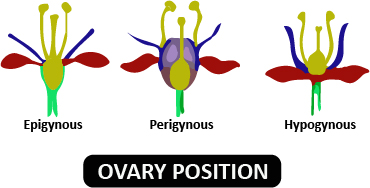
Of these types, flowers with inferior ovary are also known as epigynous flowers or the phenomenon is known as epigyny. In this type, the attachment of the floral parts is above the position of the ovary. It Is seen in flowers of the plants like fuchsia, banana, and orchids. It is commonly seen in the family Cucurbitaceae.
Additional Information: Superior ovary as the name suggests is the type of arrangement in which the ovary receptacle lies above the attachment points of other floral parts. Such types of flowers are also known as hypogynous flowers. It is seen in fleshy fruits such as drupes or berries. It is seen in the legume family.
Half-inferior or half-superior ovaries is the type of arrangement where there is an equal length of ovary below and above the point of attachment of the floral parts. This type of flower is also called a perigynous flower and is seen in the family Lythraceae.
Note: Ovaries can also be classified based on placentation. It is the arrangement of the ovules inside the ovaries. It is mainly classified based on the axes of ovule attachment and the number of compartments and placenta and the arrangement of ovules accordingly.
They can be superior, marginal, parietal, axial, free-central, or basal in the arrangement.
Complete answer:
The terms used for the positions of ovaries is determined by the insertion point or the point of attachment of the other floral parts such as the perianth and androecium to the surface of the ovary. Based on this point of attachment and the relative position of the ovary, it can be of three types:
-Superior Ovary
-Half-inferior ovary
-Inferior ovary
Of these types, flowers with inferior ovary are also known as epigynous flowers or the phenomenon is known as epigyny. In this type, the attachment of the floral parts is above the position of the ovary. It Is seen in flowers of the plants like fuchsia, banana, and orchids. It is commonly seen in the family Cucurbitaceae.
Additional Information: Superior ovary as the name suggests is the type of arrangement in which the ovary receptacle lies above the attachment points of other floral parts. Such types of flowers are also known as hypogynous flowers. It is seen in fleshy fruits such as drupes or berries. It is seen in the legume family.
Half-inferior or half-superior ovaries is the type of arrangement where there is an equal length of ovary below and above the point of attachment of the floral parts. This type of flower is also called a perigynous flower and is seen in the family Lythraceae.
Note: Ovaries can also be classified based on placentation. It is the arrangement of the ovules inside the ovaries. It is mainly classified based on the axes of ovule attachment and the number of compartments and placenta and the arrangement of ovules accordingly.
They can be superior, marginal, parietal, axial, free-central, or basal in the arrangement.
Recently Updated Pages
Master Class 11 English: Engaging Questions & Answers for Success

Master Class 11 Social Science: Engaging Questions & Answers for Success
Master Class 11 Maths: Engaging Questions & Answers for Success
Master Class 11 Biology: Engaging Questions & Answers for Success
Master Class 11 Physics: Engaging Questions & Answers for Success
Master Class 11 Chemistry: Engaging Questions & Answers for Success
Trending doubts
One Metric ton is equal to kg A 10000 B 1000 C 100 class 11 physics CBSE
Difference Between Prokaryotic Cells and Eukaryotic Cells
Find the value of the expression given below sin 30circ class 11 maths CBSE
Difference between physical and chemical change class 11 chemistry CBSE
Two of the body parts which do not appear in MRI are class 11 biology CBSE
Draw a diagram of a plant cell and label at least eight class 11 biology CBSE