




What is corpus callosum?
Answer
 Verified
540.6k+ views
Hint: Corpus callosum is a C shaped nerve fiber bundle found beneath the cerebral cortex. It stretches across the midline of the brain, connecting the left and right cerebral hemispheres and it makes the largest collection of white matter tissues in the brain.
Complete answer:
to answer this question you must know about parts of the brain.
The brain is divided into two cerebral hemispheres (right and left). These two hemispheres of the brain are connected by a thick bundle of nerve fibres called corpus callosum that ensures both sides of the brain can communicate and send signals to each other.
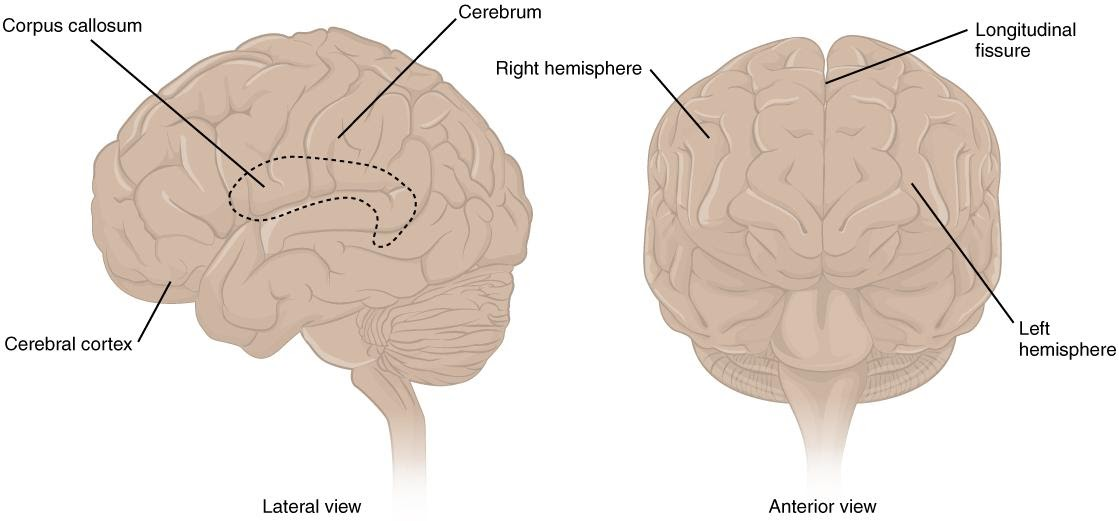
There are approximately 300 million axons (nerve fibres) in an average corpus callosum. It is located in the white matter of the cerebrum and is around 10 cm long at the midline. This neural bridge is the largest white matter structure in the brain and only evolved in placental mammals.
The corpus callosum is divided into four parts: rostrum, genu, body/trunk and splenium. Rostrum connect the orbital surface of the frontal lobes, genu connects the medial and lateral surfaces of the frontal lobes, it is a long section and its fibres pass through the corona radiata to reach the surface of hemisphere and splenium connects the two occipital lobes.
The main function of corpus callosum is the communication between two hemispheres. Besides its importance in communication, the corpus callosum is hypothesized to play a primary role in cognition. On the flip side, increase in colossal thickness in typical childhood
development correlates with intelligence, processing speed, and problem solving abilities.
Note :-
If the corpus callosum is severed, the brain’s hemisphere is not able to communicate properly, and the loss of range function can occur – for example, changes in visual perception, speech and memory. Surgical severing of the corpus callosum is a last –resort method for intractable epilepsy, to stop seizures spreading across the brain.
Complete answer:
to answer this question you must know about parts of the brain.
The brain is divided into two cerebral hemispheres (right and left). These two hemispheres of the brain are connected by a thick bundle of nerve fibres called corpus callosum that ensures both sides of the brain can communicate and send signals to each other.
There are approximately 300 million axons (nerve fibres) in an average corpus callosum. It is located in the white matter of the cerebrum and is around 10 cm long at the midline. This neural bridge is the largest white matter structure in the brain and only evolved in placental mammals.
The corpus callosum is divided into four parts: rostrum, genu, body/trunk and splenium. Rostrum connect the orbital surface of the frontal lobes, genu connects the medial and lateral surfaces of the frontal lobes, it is a long section and its fibres pass through the corona radiata to reach the surface of hemisphere and splenium connects the two occipital lobes.
The main function of corpus callosum is the communication between two hemispheres. Besides its importance in communication, the corpus callosum is hypothesized to play a primary role in cognition. On the flip side, increase in colossal thickness in typical childhood
development correlates with intelligence, processing speed, and problem solving abilities.
Note :-
If the corpus callosum is severed, the brain’s hemisphere is not able to communicate properly, and the loss of range function can occur – for example, changes in visual perception, speech and memory. Surgical severing of the corpus callosum is a last –resort method for intractable epilepsy, to stop seizures spreading across the brain.
Recently Updated Pages
Master Class 11 English: Engaging Questions & Answers for Success

Master Class 11 Physics: Engaging Questions & Answers for Success
Master Class 11 Computer Science: Engaging Questions & Answers for Success
Master Class 11 Chemistry: Engaging Questions & Answers for Success
Master Class 11 Social Science: Engaging Questions & Answers for Success
Master Class 11 Accountancy: Engaging Questions & Answers for Success
Trending doubts
Difference Between Prokaryotic Cells and Eukaryotic Cells
Two of the body parts which do not appear in MRI are class 11 biology CBSE
One Metric ton is equal to kg A 10000 B 1000 C 100 class 11 physics CBSE
10 examples of friction in our daily life
Draw a diagram of nephron and explain its structur class 11 biology CBSE
Draw a diagram of a plant cell and label at least eight class 11 biology CBSE