




What is breathing?
Answer
 Verified
601.2k+ views
Hint: Our body produces carbon dioxide as a waste product. The function of our lungs in our body is to provide oxygen from the outer atmosphere and to get rid of the waste gas, carbon dioxide. Our body requires oxygen for every single activity.
Complete step by step answer:
Breathing is the process of respiration, during which air is inhaled into the lungs through the nose (or mouth) due to muscle contraction, and then air is exhaled due to muscle relaxation. Breathing is also known as ventilation. It is the process of moving the air into and out of the lungs. This facilitates the gas exchange with the internal environment by bringing in oxygen and exhaling out carbon dioxide. All aerobic creatures require oxygen for cellular respiration. In this process, oxygen is used to break down foods for energy and carbon dioxide is produced as a waste product. Breathing, or external respiration, essentially brings the air into the lungs where the gas exchange takes place in the alveoli of the lungs by the process of diffusion. Then the circulatory system of the body transports these gases in and out of the cells, where cellular respiration occurs.
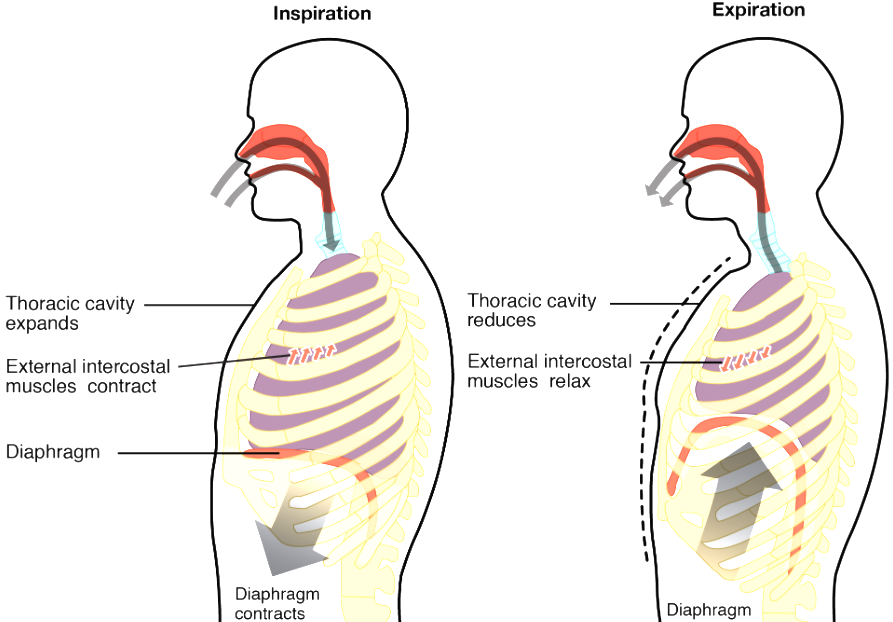
Additional Information: In humans, inhalation is primarily achieved through contraction of the diaphragm along with contraction of the intercostal muscles. The rib cage expands upwards and outwards. During inhalation, the accessory muscles of inhalation connecting the ribs and sternum to the cervical vertebrae and base of the skull bring about a greater change in the volume of the chest cavity.
During exhalation or breathing out, all the muscles of inhalation are relaxed and return to the resting position of the chest and abdomen.
Note: The diaphragm is the muscle, present below the lungs and above the abdomen, which helps you breathe. During inhalation, the diaphragm contracts and flattens which results in the enlargement of the chest cavity. This contraction of the diaphragm creates a vacuum, and the air is pulled into the lungs. During exhalation, the diaphragm is relaxed and returned to its original domelike shape, which forces the air out of the lungs.
Complete step by step answer:
Breathing is the process of respiration, during which air is inhaled into the lungs through the nose (or mouth) due to muscle contraction, and then air is exhaled due to muscle relaxation. Breathing is also known as ventilation. It is the process of moving the air into and out of the lungs. This facilitates the gas exchange with the internal environment by bringing in oxygen and exhaling out carbon dioxide. All aerobic creatures require oxygen for cellular respiration. In this process, oxygen is used to break down foods for energy and carbon dioxide is produced as a waste product. Breathing, or external respiration, essentially brings the air into the lungs where the gas exchange takes place in the alveoli of the lungs by the process of diffusion. Then the circulatory system of the body transports these gases in and out of the cells, where cellular respiration occurs.
Additional Information: In humans, inhalation is primarily achieved through contraction of the diaphragm along with contraction of the intercostal muscles. The rib cage expands upwards and outwards. During inhalation, the accessory muscles of inhalation connecting the ribs and sternum to the cervical vertebrae and base of the skull bring about a greater change in the volume of the chest cavity.
During exhalation or breathing out, all the muscles of inhalation are relaxed and return to the resting position of the chest and abdomen.
Note: The diaphragm is the muscle, present below the lungs and above the abdomen, which helps you breathe. During inhalation, the diaphragm contracts and flattens which results in the enlargement of the chest cavity. This contraction of the diaphragm creates a vacuum, and the air is pulled into the lungs. During exhalation, the diaphragm is relaxed and returned to its original domelike shape, which forces the air out of the lungs.
Recently Updated Pages
Master Class 11 English: Engaging Questions & Answers for Success

Master Class 11 Social Science: Engaging Questions & Answers for Success
Master Class 11 Maths: Engaging Questions & Answers for Success
Master Class 11 Biology: Engaging Questions & Answers for Success
Master Class 11 Physics: Engaging Questions & Answers for Success
Master Class 11 Chemistry: Engaging Questions & Answers for Success
Trending doubts
One Metric ton is equal to kg A 10000 B 1000 C 100 class 11 physics CBSE
Difference Between Prokaryotic Cells and Eukaryotic Cells
Find the value of the expression given below sin 30circ class 11 maths CBSE
1 ton equals to A 100 kg B 1000 kg C 10 kg D 10000 class 11 physics CBSE
Two of the body parts which do not appear in MRI are class 11 biology CBSE
What are hard magnetic materials class 11 physics CBSE