




What is Anther?
Answer
 Verified
541.2k+ views
Hint: A flower is a reproductive structure found in flowering plants that are also known as a bloom or blossom (plants of the division Magnoliophyta, also called angiosperms). A flower's biological function is to aid reproduction, usually by providing a mechanism for sperm and eggs to unite.
Complete answer:
Flowers may allow selfing (fusion of sperm and eggs from the same flower) when self-pollination occurs, or facilitate outcrossing (fusion of sperm and eggs from different individuals in a population) when cross-pollination occurs.
The sepals, petals, stamens, and pistils all make up a complete flower. An incomplete flower, on the other hand, lacks one or more of these structures.
A complete flower consists of two different parts:
Vegetative Part- petals, sepals.
Reproductive Part- Stamen, Pistil, Stigma, Style, Ovary.
The stamen is the male reproductive part of a flower. It is made up of a long tube, the filament, and a pollen-producing structure near the end. The anther is the name for this oval-shaped structure. The anther contains microsporangia, which are sac-like structures that produce pollen for pollination to take place. As a result, Microsporangia is where the spores are produced.
A stamen is made up of two parts: a filament and an anther that contains microsporangia. Anthers are usually two-lobed and are attached to the filament at the base or in the middle of the anther. The connective tissue is a sterile tissue that runs between the lobes and is an extension of the filament that contains conducting strands. On the dorsal side of the anther, it appears as an extension. The male gametophyte is contained in a pollen grain that develops from a microspore in the microsporangium.
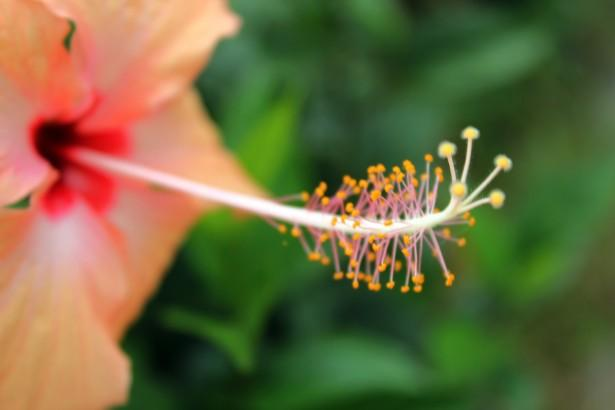
Thus, Anther is the part of the stamen where pollen is produced.
Note:
The androecium is the collective name for a flower's stamens. In Canna species, the androecium can have as few as half a stamen (i.e. a single locule) or as many as 3,482 stamens, as seen in the saguaro (Carnegiea gigantea). The androecium in various plant species forms a wide range of patterns, some of which are quite complex.
Complete answer:
Flowers may allow selfing (fusion of sperm and eggs from the same flower) when self-pollination occurs, or facilitate outcrossing (fusion of sperm and eggs from different individuals in a population) when cross-pollination occurs.
The sepals, petals, stamens, and pistils all make up a complete flower. An incomplete flower, on the other hand, lacks one or more of these structures.
A complete flower consists of two different parts:
Vegetative Part- petals, sepals.
Reproductive Part- Stamen, Pistil, Stigma, Style, Ovary.
The stamen is the male reproductive part of a flower. It is made up of a long tube, the filament, and a pollen-producing structure near the end. The anther is the name for this oval-shaped structure. The anther contains microsporangia, which are sac-like structures that produce pollen for pollination to take place. As a result, Microsporangia is where the spores are produced.
A stamen is made up of two parts: a filament and an anther that contains microsporangia. Anthers are usually two-lobed and are attached to the filament at the base or in the middle of the anther. The connective tissue is a sterile tissue that runs between the lobes and is an extension of the filament that contains conducting strands. On the dorsal side of the anther, it appears as an extension. The male gametophyte is contained in a pollen grain that develops from a microspore in the microsporangium.
Thus, Anther is the part of the stamen where pollen is produced.
Note:
The androecium is the collective name for a flower's stamens. In Canna species, the androecium can have as few as half a stamen (i.e. a single locule) or as many as 3,482 stamens, as seen in the saguaro (Carnegiea gigantea). The androecium in various plant species forms a wide range of patterns, some of which are quite complex.
Recently Updated Pages
Master Class 11 English: Engaging Questions & Answers for Success

Master Class 11 Social Science: Engaging Questions & Answers for Success
Master Class 11 Maths: Engaging Questions & Answers for Success
Master Class 11 Biology: Engaging Questions & Answers for Success
Master Class 11 Physics: Engaging Questions & Answers for Success
Master Class 11 Chemistry: Engaging Questions & Answers for Success
Trending doubts
Explain the Treaty of Vienna of 1815 class 10 social science CBSE
What is the full form of POSCO class 10 social science CBSE
Define Potential, Developed, Stock and Reserved resources
The diagonals of a rhombus are 10cm and 24cm Find the class 10 maths CBSE
One number is chosen from numbers 1 to 200 Find the class 10 maths CBSE
Why is Venus called Earths sister planet class 10 physics CBSE