



What is an isosceles triangle?
Answer
 Verified
544.5k+ views
Hint: To answer this question, we need to learn about the basic concepts of triangle, types of triangle which are classified based on their sides and their angles. Then, after we go to answer the given question i.e., what is an isosceles triangle.
Complete step-by-step solution:
Triangle is defined as the closed 2D figure having three sides, three angles and three vertices. A triangle can be formed by joining any three dots such that line segments connect each other end by end.
The point of intersection of two lines is called a vertex and the space between them is called an angle.
Types of triangles:
Triangles can be classified on the basis of their size as well as angles.
Classification of triangles on the basis of their sides is as follows
1. Equilateral Triangle: An equilateral triangle is one whose all the three sides are equal.
2. Isosceles triangle: An isosceles is one whose two sides are equal.
3. Scalene Triangle: A scalene triangle is one whose all three sides are unequal.
Classification of triangles on the basis of their angles is as follows
Acute Angled Triangle: A triangle whose all interior angles are less than \[{{90}^{\circ }}\].
Right Angled Triangle: A triangle whose one interior angle is \[{{90}^{\circ }}\].
Obtuse Angled Triangle: A triangle whose one interior angle is more than \[{{90}^{\circ }}\].
What is an isosceles triangle?
A triangle having two sides of equal length is called the isosceles triangle. In an isosceles triangle, the angles that are opposite to the equal sides are equal. In the triangle given below, two sides are of same length and one side is different length. Thus, it is an isosceles triangle.
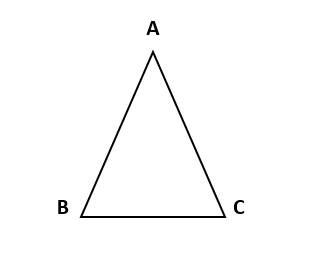
Here side AB and side AC are of equal lengths and BC of different length.
Note: It is important to know that the sum of all interior angles of a triangle is always 180 degrees. Two sides of an isosceles triangle are congruent to each other. In the above figure, side AB and Ac are of equal length. Area of isosceles triangle = \[\dfrac{1}{2}\times \text{base}\times \text{height}\].
Complete step-by-step solution:
Triangle is defined as the closed 2D figure having three sides, three angles and three vertices. A triangle can be formed by joining any three dots such that line segments connect each other end by end.
The point of intersection of two lines is called a vertex and the space between them is called an angle.
Types of triangles:
Triangles can be classified on the basis of their size as well as angles.
Classification of triangles on the basis of their sides is as follows
1. Equilateral Triangle: An equilateral triangle is one whose all the three sides are equal.
2. Isosceles triangle: An isosceles is one whose two sides are equal.
3. Scalene Triangle: A scalene triangle is one whose all three sides are unequal.
Classification of triangles on the basis of their angles is as follows
Acute Angled Triangle: A triangle whose all interior angles are less than \[{{90}^{\circ }}\].
Right Angled Triangle: A triangle whose one interior angle is \[{{90}^{\circ }}\].
Obtuse Angled Triangle: A triangle whose one interior angle is more than \[{{90}^{\circ }}\].
What is an isosceles triangle?
A triangle having two sides of equal length is called the isosceles triangle. In an isosceles triangle, the angles that are opposite to the equal sides are equal. In the triangle given below, two sides are of same length and one side is different length. Thus, it is an isosceles triangle.
Here side AB and side AC are of equal lengths and BC of different length.
Note: It is important to know that the sum of all interior angles of a triangle is always 180 degrees. Two sides of an isosceles triangle are congruent to each other. In the above figure, side AB and Ac are of equal length. Area of isosceles triangle = \[\dfrac{1}{2}\times \text{base}\times \text{height}\].

Recently Updated Pages
Master Class 7 Social Science: Engaging Questions & Answers for Success

Master Class 7 Science: Engaging Questions & Answers for Success
Master Class 7 Maths: Engaging Questions & Answers for Success
Class 7 Question and Answer - Your Ultimate Solutions Guide
Master Class 9 Social Science: Engaging Questions & Answers for Success
Master Class 9 Science: Engaging Questions & Answers for Success
Trending doubts
Full Form of IASDMIPSIFSIRSPOLICE class 7 social science CBSE
She sings a song Change into passive voice class 7 english CBSE
List of coprime numbers from 1 to 100 class 7 maths CBSE
Write a summary of the poem the quality of mercy by class 7 english CBSE
Write a short note on the great bath of MohenjoDar class 7 social science CBSE
The southernmost point of the Indian mainland is known class 7 social studies CBSE