




What is a Wavefront diagram?
Answer
 Verified
579k+ views
Hint: The wavefront of a time-varying field is defined as the set (locus) of all places where the wave has the same sinusoid phase. The phrase is only applicable to fields that change sinusoidally in time with a single temporal frequency at each location (otherwise the phase is not well defined).
Complete answer:
Wavefronts generally move with the passage of time. The wavefronts of waves propagating in a unidimensional media are generally single points; in a two-dimensional medium, they are curves, and in a three-dimensional one, they are surfaces. The wavefronts of a sinusoidal plane wave are planes perpendicular to the propagation direction that move in the same direction as the wave. The wavefronts of a sinusoidal spherical wave are spherical surfaces that grow with it. Refraction can affect the form and/or direction of wavefronts if the propagation speed varies at different places along the wavefront. Lenses, in particular, may transform optical wavefronts from planar to spherical or vice versa.
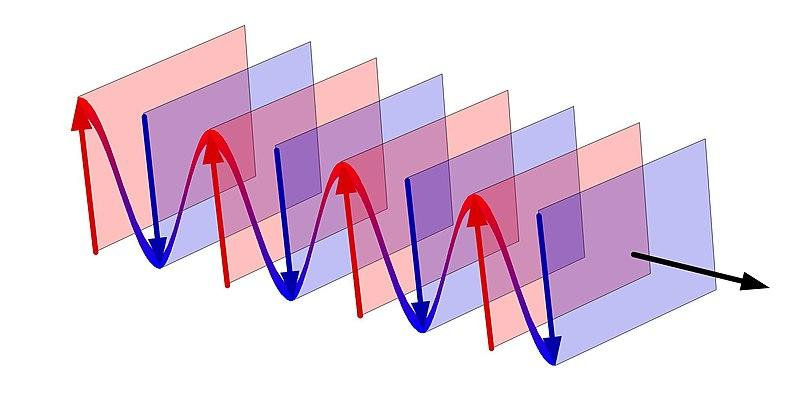
Maxwell's equations may be used to explain optical systems, and linear propagating waves like sound or electron beams have comparable wave equations. Huygens' principle, however, gives a fast technique to estimate the propagation of a wavefront over, for example, empty space, given the following simplifications. The following is the structure: Consider each point on the wavefront to be a new point source. The resultant field at additional locations may be estimated by computing the overall effect from each point source. This is a common method used in computational algorithms. For simple wavefronts, specific situations can be calculated directly.
Note: The plane wave, in which the rays are parallel to one another, is the most basic type of wavefront. Collimated light is the name given to the light produced by this sort of wave. The plane wavefront is an excellent model for a surface-section of a very large spherical wavefront; for example, sunlight reaches the planet with a 150 million-kilometer-radius spherical wavefront (1 AU). Over distances of the diameter of the Earth, such a wavefront can be considered planar for many purposes.
Complete answer:
Wavefronts generally move with the passage of time. The wavefronts of waves propagating in a unidimensional media are generally single points; in a two-dimensional medium, they are curves, and in a three-dimensional one, they are surfaces. The wavefronts of a sinusoidal plane wave are planes perpendicular to the propagation direction that move in the same direction as the wave. The wavefronts of a sinusoidal spherical wave are spherical surfaces that grow with it. Refraction can affect the form and/or direction of wavefronts if the propagation speed varies at different places along the wavefront. Lenses, in particular, may transform optical wavefronts from planar to spherical or vice versa.
Maxwell's equations may be used to explain optical systems, and linear propagating waves like sound or electron beams have comparable wave equations. Huygens' principle, however, gives a fast technique to estimate the propagation of a wavefront over, for example, empty space, given the following simplifications. The following is the structure: Consider each point on the wavefront to be a new point source. The resultant field at additional locations may be estimated by computing the overall effect from each point source. This is a common method used in computational algorithms. For simple wavefronts, specific situations can be calculated directly.
Note: The plane wave, in which the rays are parallel to one another, is the most basic type of wavefront. Collimated light is the name given to the light produced by this sort of wave. The plane wavefront is an excellent model for a surface-section of a very large spherical wavefront; for example, sunlight reaches the planet with a 150 million-kilometer-radius spherical wavefront (1 AU). Over distances of the diameter of the Earth, such a wavefront can be considered planar for many purposes.
Recently Updated Pages
Write structures of the following compounds i 2 Chloro3methylpentane class 11 chemistry CBSE

What is BLO What is the full form of BLO class 8 social science CBSE
Explain the Treaty of Vienna of 1815 class 10 social science CBSE
A Paragraph on Pollution in about 100-150 Words
XIX+XXX A 49 B 51 C 55 D 44 class 5 maths CBSE
If x a + bt + ct2 where x is in meters and t is in class 11 physics CBSE
Trending doubts
One Metric ton is equal to kg A 10000 B 1000 C 100 class 11 physics CBSE
Find the value of the expression given below sin 30circ class 11 maths CBSE
Draw a diagram of nephron and explain its structur class 11 biology CBSE
10 examples of friction in our daily life
Draw a diagram of a plant cell and label at least eight class 11 biology CBSE
Proton was discovered by A Thomson B Rutherford C Chadwick class 11 chemistry CBSE