




What is a polar plot?
Answer
 Verified
529.8k+ views
Hint: We know that a polar plot consists of two axis, and any point in polar form is represented with the help of two variables, indicating the distance of the point from the origin, and the angle that this line makes with the positive side of X axis.
Complete step by step answer:
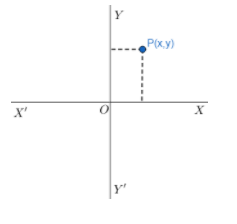
We know that a Cartesian plot consists of two perpendicular axes XX’ and YY’, and it is expressed in the terms of x and y. A Cartesian system with point P is shown below,
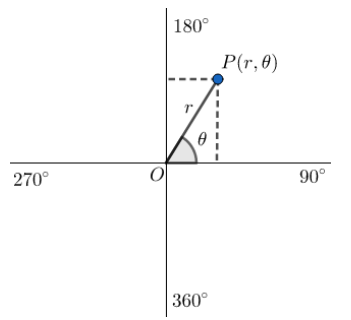
Similarly, a Polar plot consists of two perpendicular axes, but it is expressed in terms of r and $\theta $. Here, we know that r is the distance of the point from the origin O, and $\theta $ is the angle that the line joining the point with origin, makes with the positive side of the X axis. We have shown a polar plot with point P in the figure below.
We know that r is the distance between origin and point P. So, by Pythagoras theorem, we can write
${{r}^{2}}={{x}^{2}}+{{y}^{2}}$
and, $\tan \theta =\dfrac{y}{x}$.
So, by using these equations, we can write
$x=r\cos \theta $ and $y=r\sin \theta $.
Due to its similarity to the circular shape, we mostly use polar coordinates in the cases of circular symmetry.
Polar plot is also very efficient for problems involving complex numbers.
Note: We must remember that in polar form, the angle $\theta $ is taken with reference to the positive side of the X axis. We must also be careful in dealing with the sign of the angle. The angle will be positive for anti clockwise direction, and negative for clockwise direction.
Complete step by step answer:
We know that a Cartesian plot consists of two perpendicular axes XX’ and YY’, and it is expressed in the terms of x and y. A Cartesian system with point P is shown below,
Similarly, a Polar plot consists of two perpendicular axes, but it is expressed in terms of r and $\theta $. Here, we know that r is the distance of the point from the origin O, and $\theta $ is the angle that the line joining the point with origin, makes with the positive side of the X axis. We have shown a polar plot with point P in the figure below.
We know that r is the distance between origin and point P. So, by Pythagoras theorem, we can write
${{r}^{2}}={{x}^{2}}+{{y}^{2}}$
and, $\tan \theta =\dfrac{y}{x}$.
So, by using these equations, we can write
$x=r\cos \theta $ and $y=r\sin \theta $.
Due to its similarity to the circular shape, we mostly use polar coordinates in the cases of circular symmetry.
Polar plot is also very efficient for problems involving complex numbers.
Note: We must remember that in polar form, the angle $\theta $ is taken with reference to the positive side of the X axis. We must also be careful in dealing with the sign of the angle. The angle will be positive for anti clockwise direction, and negative for clockwise direction.
Recently Updated Pages
Master Class 11 Computer Science: Engaging Questions & Answers for Success

Master Class 11 Business Studies: Engaging Questions & Answers for Success
Master Class 11 Economics: Engaging Questions & Answers for Success
Master Class 11 English: Engaging Questions & Answers for Success
Master Class 11 Maths: Engaging Questions & Answers for Success
Master Class 11 Biology: Engaging Questions & Answers for Success
Trending doubts
One Metric ton is equal to kg A 10000 B 1000 C 100 class 11 physics CBSE
There are 720 permutations of the digits 1 2 3 4 5 class 11 maths CBSE
Discuss the various forms of bacteria class 11 biology CBSE
Draw a diagram of a plant cell and label at least eight class 11 biology CBSE
State the laws of reflection of light
Explain zero factorial class 11 maths CBSE