




What is a parallel circuit?
Answer
 Verified
537.3k+ views
Hint: A parallel circuit has branches that divide the current so that just a portion of it passes through each branch. In a parallel circuit, the voltage, or potential difference, between each branch is the same, but the currents may differ.
Complete answer:
An electrical circuit is a collection of devices used for energy storage, transmission, and conversion. One or more sources supply energy to a circuit, and one or more sinks remove it. Energy is converted from thermal, chemical, electromagnetic, or mechanical form to electrical form in the sources; the process is reversed in the sinks. Energy is carried in an electrical circuit through the use of electrical charge and the medium of magnetic and electric fields. Parallel and series circuits are two different types of circuits.
We are going to discuss parallel circuits: a parallel circuit is one in which many resistances are connected across one another in such a way that one terminal of each resistance is connected to form a junction point, and the remaining end is also connected to make another point.
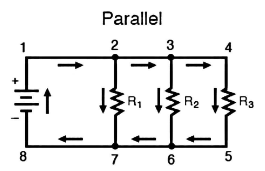
Parallel Circuits Have the Following Characteristics:
1. A similar potential difference is shared by all resistances at the same time.
2. The total current is divided into the number of parallel routes equal to the number of resistances. The sum of all the individual currents is always the aggregate current.
\[{\mathbf{I}}{\text{ }} = {\text{ }}{{\mathbf{I}}_{{\mathbf{1}}\;}} + {\text{ }}{{\mathbf{I}}_{{\mathbf{2}}\;}} + \;{{\mathbf{I}}_{{\mathbf{3}}\;}} + \; \ldots \ldots + \;{{\mathbf{I}}_{\mathbf{n}}}\]
3. The reciprocal of a parallel circuit's equivalent resistance is equal to the total of the reciprocals of the individual resistances.
4. The smallest of all resistances is the comparable resistance.
\[{\mathbf{R}}\; < \;{{\mathbf{R}}_{\mathbf{1}}},{\text{ }}{\mathbf{R}}\; < \;{{\mathbf{R}}_{\mathbf{2}}},{\text{ }} \ldots ..,{\text{ }}{\mathbf{R}}\; < \;{{\mathbf{R}}_{\mathbf{n}}}\]
5. The equivalent conductance is the result of adding the single conductance mathematically.
Note: The parallel circuit is the most common type of electrical circuit used in houses and equipment. It generates a considerably more stable and efficient power system than would otherwise be conceivable since it allows more than one channel for a current to travel through to a device. The parallel circuit has numerous applications.
Complete answer:
An electrical circuit is a collection of devices used for energy storage, transmission, and conversion. One or more sources supply energy to a circuit, and one or more sinks remove it. Energy is converted from thermal, chemical, electromagnetic, or mechanical form to electrical form in the sources; the process is reversed in the sinks. Energy is carried in an electrical circuit through the use of electrical charge and the medium of magnetic and electric fields. Parallel and series circuits are two different types of circuits.
We are going to discuss parallel circuits: a parallel circuit is one in which many resistances are connected across one another in such a way that one terminal of each resistance is connected to form a junction point, and the remaining end is also connected to make another point.
Parallel Circuits Have the Following Characteristics:
1. A similar potential difference is shared by all resistances at the same time.
2. The total current is divided into the number of parallel routes equal to the number of resistances. The sum of all the individual currents is always the aggregate current.
\[{\mathbf{I}}{\text{ }} = {\text{ }}{{\mathbf{I}}_{{\mathbf{1}}\;}} + {\text{ }}{{\mathbf{I}}_{{\mathbf{2}}\;}} + \;{{\mathbf{I}}_{{\mathbf{3}}\;}} + \; \ldots \ldots + \;{{\mathbf{I}}_{\mathbf{n}}}\]
3. The reciprocal of a parallel circuit's equivalent resistance is equal to the total of the reciprocals of the individual resistances.
4. The smallest of all resistances is the comparable resistance.
\[{\mathbf{R}}\; < \;{{\mathbf{R}}_{\mathbf{1}}},{\text{ }}{\mathbf{R}}\; < \;{{\mathbf{R}}_{\mathbf{2}}},{\text{ }} \ldots ..,{\text{ }}{\mathbf{R}}\; < \;{{\mathbf{R}}_{\mathbf{n}}}\]
5. The equivalent conductance is the result of adding the single conductance mathematically.
Note: The parallel circuit is the most common type of electrical circuit used in houses and equipment. It generates a considerably more stable and efficient power system than would otherwise be conceivable since it allows more than one channel for a current to travel through to a device. The parallel circuit has numerous applications.
Recently Updated Pages
Master Class 12 Economics: Engaging Questions & Answers for Success

Master Class 12 English: Engaging Questions & Answers for Success
Master Class 12 Social Science: Engaging Questions & Answers for Success
Master Class 12 Maths: Engaging Questions & Answers for Success
Master Class 12 Physics: Engaging Questions & Answers for Success
Master Class 10 English: Engaging Questions & Answers for Success
Trending doubts
Explain the Treaty of Vienna of 1815 class 10 social science CBSE
Why is it 530 pm in india when it is 1200 afternoon class 10 social science CBSE
What is the full form of POSCO class 10 social science CBSE
Define Potential, Developed, Stock and Reserved resources
Which Country Has the Largest Border with India?
Complete the sentence with the most appropriate word class 10 english CBSE