



What is a hypotenuse?
Answer
 Verified
532.5k+ views
Hint: To understand the term hypotenuse we will consider a right angle triangle and see its different elements like which side is to be considered as the base, perpendicular and the hypotenuse. Also, we will see an important theorem related to the right angle triangle known as the Pythagoras theorem and what is its use.
Complete step by step solution:
Here we have been asked about the term hypotenuse. To understand this term we need to consider a right angle triangle, so let us draw a right angle triangle.
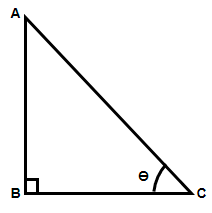
In the above figure we have considered a right angle triangle ABC right angle at B. Also, we have considered angle C equal to $\theta$. Now, let us see different elements of a right angle triangle such as its base, perpendicular and the hypotenuse.
Base and perpendicular of a right angle triangle is only defined when we define the angle $\theta$. According to the convention of naming we consider the side opposite to $\theta$ as the perpendicular and the side other than in front of the 90 degrees as the base, so in the above triangle we have AB as the perpendicular and BC as the base. If we will assume angle A as $\theta$ then we will have AB as the base and BC as the perpendicular.
Now, the side opposite to the angle 90 degrees is considered as the hypotenuse. In the above triangle it is the side AC. Hypotenuse is the longest side of a right angle triangle because the angle opposite to it is the greatest in a right triangle. To determine the length of hypotenuse we use the Pythagoras theorem given as: - $h=\sqrt{{{p}^{2}}+{{b}^{2}}}$, where (p) denotes the perpendicular, (b) denotes the base and (h) denotes the hypotenuse. If any of the two sides is known then we can determine the thirds side of the right angle triangle.
Note: Note that in a triangle the side opposite to the greatest angle is the longest while opposite to the smallest angle is the shortest. This is an important property you must remember. Even if we know the length of one side of a right triangle and one of the angles other than the 90 degrees then we can determine the measure of all the sides using trigonometry.
Complete step by step solution:
Here we have been asked about the term hypotenuse. To understand this term we need to consider a right angle triangle, so let us draw a right angle triangle.
In the above figure we have considered a right angle triangle ABC right angle at B. Also, we have considered angle C equal to $\theta$. Now, let us see different elements of a right angle triangle such as its base, perpendicular and the hypotenuse.
Base and perpendicular of a right angle triangle is only defined when we define the angle $\theta$. According to the convention of naming we consider the side opposite to $\theta$ as the perpendicular and the side other than in front of the 90 degrees as the base, so in the above triangle we have AB as the perpendicular and BC as the base. If we will assume angle A as $\theta$ then we will have AB as the base and BC as the perpendicular.
Now, the side opposite to the angle 90 degrees is considered as the hypotenuse. In the above triangle it is the side AC. Hypotenuse is the longest side of a right angle triangle because the angle opposite to it is the greatest in a right triangle. To determine the length of hypotenuse we use the Pythagoras theorem given as: - $h=\sqrt{{{p}^{2}}+{{b}^{2}}}$, where (p) denotes the perpendicular, (b) denotes the base and (h) denotes the hypotenuse. If any of the two sides is known then we can determine the thirds side of the right angle triangle.
Note: Note that in a triangle the side opposite to the greatest angle is the longest while opposite to the smallest angle is the shortest. This is an important property you must remember. Even if we know the length of one side of a right triangle and one of the angles other than the 90 degrees then we can determine the measure of all the sides using trigonometry.
Recently Updated Pages
Master Class 8 Social Science: Engaging Questions & Answers for Success

Master Class 8 English: Engaging Questions & Answers for Success
Class 8 Question and Answer - Your Ultimate Solutions Guide
Master Class 8 Maths: Engaging Questions & Answers for Success
Master Class 8 Science: Engaging Questions & Answers for Success
Master Class 7 English: Engaging Questions & Answers for Success
Trending doubts
Difference Between Plant Cell and Animal Cell
Fill the blanks with the suitable prepositions 1 The class 9 english CBSE
Who is eligible for RTE class 9 social science CBSE
Which places in India experience sunrise first and class 9 social science CBSE
What is pollution? How many types of pollution? Define it
Name 10 Living and Non living things class 9 biology CBSE