




What is a generator?
Answer
 Verified
625.2k+ views
Hint: Generator is the device which is used to convert magnetic energy into electric energy. Using a generator, current is produced in two forms namely alternating current and direct current. If the current varies with time then it is termed as alternating current. If the current remains constant with time then it is known as direct current.
Complete solution:
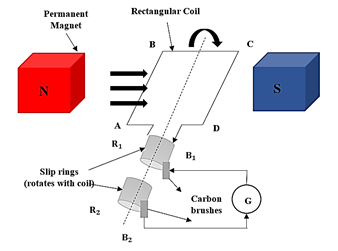
Generator is an electrical machine which transforms mechanical energy or magnetic energy into electric energy. This mechanical energy can be provided by a stream, water, gas turbine, water turbine, etc. The current produced by the generator can be either alternating current (AC) or direct current (DC). Based on the output of the generator, it can be classified as AC generator and DC generator. The working of a generator depends on the faraday law of electromagnetic induction.
Generators follow Fleming’s right hand rule. The purpose of right-hand rule is to find the direction of the induced current when the conductor is moved in a magnetic field. According to Fleming’s right hand rule, if we hold our right-hand thumb, forefinger of index finger and the middle finger all perpendicular to each other then, the thumb represents the direction of the motion of the conductor or the direction of the applied force, the forefinger represents the direction of the magnetic field in which the conductor is placed and the middle finger represents the direction of induced current in the conductor. In power stations, generators are used to generate electricity.
Note:
Students generally get confused between generators and motors. So, they should know the differences between generators and motors. Generator converts mechanical energy to electrical energy while the motor converts electrical energy to mechanical energy. Generators follow Fleming’s right hand rule while the motors follow Fleming’s left hand rule. Generators generate electricity while motors use electricity.
Complete solution:
Generator is an electrical machine which transforms mechanical energy or magnetic energy into electric energy. This mechanical energy can be provided by a stream, water, gas turbine, water turbine, etc. The current produced by the generator can be either alternating current (AC) or direct current (DC). Based on the output of the generator, it can be classified as AC generator and DC generator. The working of a generator depends on the faraday law of electromagnetic induction.
Generators follow Fleming’s right hand rule. The purpose of right-hand rule is to find the direction of the induced current when the conductor is moved in a magnetic field. According to Fleming’s right hand rule, if we hold our right-hand thumb, forefinger of index finger and the middle finger all perpendicular to each other then, the thumb represents the direction of the motion of the conductor or the direction of the applied force, the forefinger represents the direction of the magnetic field in which the conductor is placed and the middle finger represents the direction of induced current in the conductor. In power stations, generators are used to generate electricity.
Note:
Students generally get confused between generators and motors. So, they should know the differences between generators and motors. Generator converts mechanical energy to electrical energy while the motor converts electrical energy to mechanical energy. Generators follow Fleming’s right hand rule while the motors follow Fleming’s left hand rule. Generators generate electricity while motors use electricity.
Recently Updated Pages
Master Class 12 Economics: Engaging Questions & Answers for Success

Master Class 12 Social Science: Engaging Questions & Answers for Success
Master Class 12 English: Engaging Questions & Answers for Success
Master Class 12 Maths: Engaging Questions & Answers for Success
Master Class 12 Physics: Engaging Questions & Answers for Success
Master Class 12 Biology: Engaging Questions & Answers for Success
Trending doubts
Draw a labelled sketch of the human eye class 12 physics CBSE
Which are the Top 10 Largest Countries of the World?
Draw ray diagrams each showing i myopic eye and ii class 12 physics CBSE
Which is the correct genotypic ratio of mendel dihybrid class 12 biology CBSE
Differentiate between homogeneous and heterogeneous class 12 chemistry CBSE
Which animal never drinks water in its entire life class 12 biology CBSE