




What is a Fringe Width?
Answer
 Verified
597.3k+ views
Hint: The double-slit experiment is a demonstration that light and matter can display characteristics of both classically defined waves and particles; moreover, it displays the fundamentally probabilistic nature of quantum mechanical phenomena. The experiment belongs to a general class of "double path" experiments, during which a wave is split into two separate waves that later combine into one wave. Changes within the path-lengths of both waves lead to a phase shift, creating an interference pattern
Complete step-by-step solution:
Interference pattern obtained within the double-slit experiment consists of alternate bright and dark fringes which are parallel to the slits. the space between two consecutive bright or dark fringes is termed the fringe width.
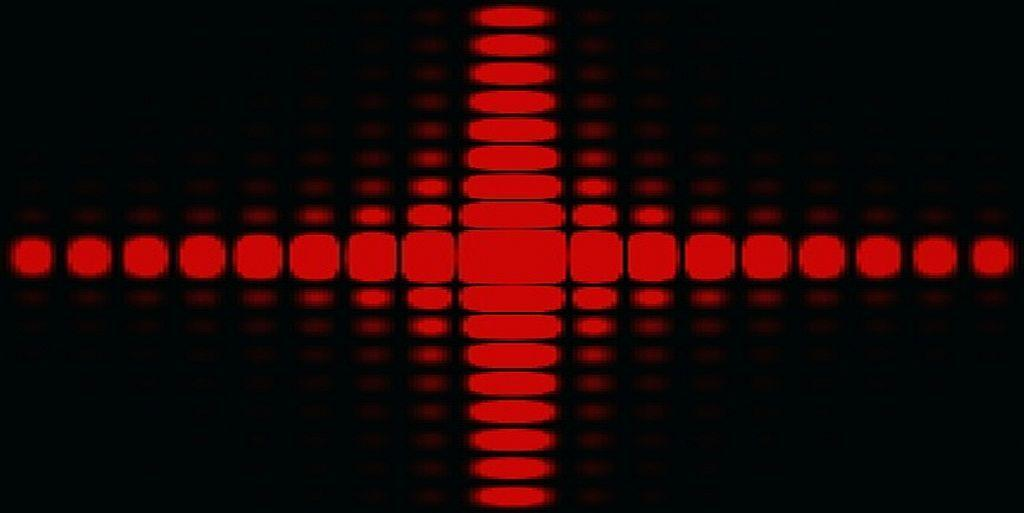
Fringe width is that the distance between two successive bright fringes or two successive dark fringes. within the interference pattern, the fringe width is constant for all the fringes. Fringe width is independent of order of fringe. Fringe width is directly proportional to wavelength of the sunshine used. it's given by
$\beta =\dfrac{\lambda D}{d}$
Where “D” is the distance of slit to screen and “d” is the distance between the slits.
$\lambda $ is the wavelength of light used.
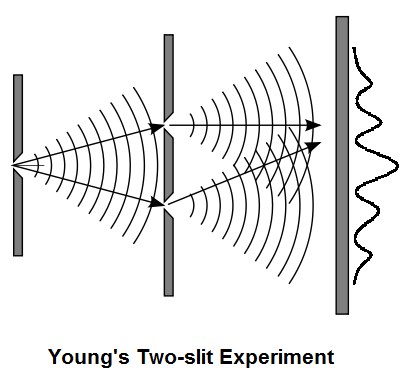
Note: This type of experiment was first performed, using light, by Thomas Young in 1801, as an illustration of the wave behavior of light. At that point it had been thought that light consisted of either waves or particles. With the start of modern physics, a few hundred years later, it had been realized that light could actually show behavior characteristic of both waves and particles. In 1927, Davisson and Germer demonstrated that electrons show a similar behavior, which was later extended to atoms and molecules.
Complete step-by-step solution:
Interference pattern obtained within the double-slit experiment consists of alternate bright and dark fringes which are parallel to the slits. the space between two consecutive bright or dark fringes is termed the fringe width.
Fringe width is that the distance between two successive bright fringes or two successive dark fringes. within the interference pattern, the fringe width is constant for all the fringes. Fringe width is independent of order of fringe. Fringe width is directly proportional to wavelength of the sunshine used. it's given by
$\beta =\dfrac{\lambda D}{d}$
Where “D” is the distance of slit to screen and “d” is the distance between the slits.
$\lambda $ is the wavelength of light used.
Note: This type of experiment was first performed, using light, by Thomas Young in 1801, as an illustration of the wave behavior of light. At that point it had been thought that light consisted of either waves or particles. With the start of modern physics, a few hundred years later, it had been realized that light could actually show behavior characteristic of both waves and particles. In 1927, Davisson and Germer demonstrated that electrons show a similar behavior, which was later extended to atoms and molecules.
Recently Updated Pages
Master Class 12 Economics: Engaging Questions & Answers for Success

Master Class 12 Social Science: Engaging Questions & Answers for Success
Master Class 12 English: Engaging Questions & Answers for Success
Master Class 12 Maths: Engaging Questions & Answers for Success
Master Class 12 Physics: Engaging Questions & Answers for Success
Master Class 12 Biology: Engaging Questions & Answers for Success
Trending doubts
Draw a labelled sketch of the human eye class 12 physics CBSE
Which are the Top 10 Largest Countries of the World?
Draw ray diagrams each showing i myopic eye and ii class 12 physics CBSE
Which is the correct genotypic ratio of mendel dihybrid class 12 biology CBSE
Differentiate between homogeneous and heterogeneous class 12 chemistry CBSE
Which animal never drinks water in its entire life class 12 biology CBSE