




What does $e$ mean in math?
Answer
 Verified
618k+ views
Hint: This type of problem is based on the concept of logarithmic and exponential function. The real number e in mathematics refers to the natural number or Euler’s number. The value of e found by experiment is 2.7182818 approximately. Functions can be defined from the number e which is called exponential function.
Complete step by step solution:
According to the question, we are asked to find what he means in mathematics.
‘e’ is a real number which is called a natural number or Euler’s number.
According to the definition of real numbers, all the rational numbers and irrational numbers are considered to be real numbers.
The value of e found by calculation is 2.7182818……
Here, we find that there are infinite numbers after the decimal. Such numbers are called irrational numbers.
Therefore, e is an irrational number which is a real number.
The approximate value of e is 2.718 which are used for calculation.
According to the definition of exponential function, \[{{e}^{x}}\] is an infinite series, which is
\[{{e}^{x}}=1+\dfrac{x}{1!}+\dfrac{{{x}^{2}}}{2!}+\dfrac{{{x}^{3}}}{3!}+\dfrac{{{x}^{4}}}{4!}+.........\infty \]
Here, the symbol ‘!’ refers to the factorial, that is \[x!=x\left( x-1 \right)\left( x-2 \right).....3.2.1\].
Now, we are asked to find the value of e.
\[\Rightarrow e=1+\dfrac{1}{1!}+\dfrac{{{1}^{2}}}{2!}+\dfrac{{{1}^{3}}}{3!}+\dfrac{{{1}^{4}}}{4!}+.........\infty \]
\[\Rightarrow e=1+\dfrac{1}{1!}+\dfrac{1}{2!}+\dfrac{1}{3!}+\dfrac{1}{4!}+.........\infty \]
On further simplification, we get
e=2. 7182818……
We can plot the graph of y=e.
Therefore, we get
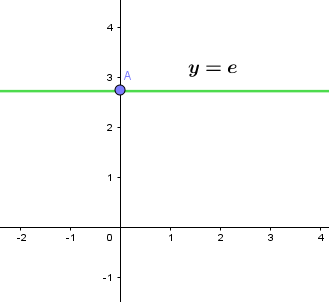
The real number e in logarithmic function plays a different role. If the base of the logarithmic function is e, then the logarithmic function turns to natural logarithm.
That is \[{{\log }_{e}}x=\ln x\].
Note: We can also represent e as \[{{e}^{1}}\].
We know the relation between logarithmic function and exponential function over x.
That is \[\ln \left( {{e}^{x}} \right)=x\].
Here, x=1.
Therefore, we get $ln(e)=1$
Complete step by step solution:
According to the question, we are asked to find what he means in mathematics.
‘e’ is a real number which is called a natural number or Euler’s number.
According to the definition of real numbers, all the rational numbers and irrational numbers are considered to be real numbers.
The value of e found by calculation is 2.7182818……
Here, we find that there are infinite numbers after the decimal. Such numbers are called irrational numbers.
Therefore, e is an irrational number which is a real number.
The approximate value of e is 2.718 which are used for calculation.
According to the definition of exponential function, \[{{e}^{x}}\] is an infinite series, which is
\[{{e}^{x}}=1+\dfrac{x}{1!}+\dfrac{{{x}^{2}}}{2!}+\dfrac{{{x}^{3}}}{3!}+\dfrac{{{x}^{4}}}{4!}+.........\infty \]
Here, the symbol ‘!’ refers to the factorial, that is \[x!=x\left( x-1 \right)\left( x-2 \right).....3.2.1\].
Now, we are asked to find the value of e.
\[\Rightarrow e=1+\dfrac{1}{1!}+\dfrac{{{1}^{2}}}{2!}+\dfrac{{{1}^{3}}}{3!}+\dfrac{{{1}^{4}}}{4!}+.........\infty \]
\[\Rightarrow e=1+\dfrac{1}{1!}+\dfrac{1}{2!}+\dfrac{1}{3!}+\dfrac{1}{4!}+.........\infty \]
On further simplification, we get
e=2. 7182818……
We can plot the graph of y=e.
Therefore, we get
The real number e in logarithmic function plays a different role. If the base of the logarithmic function is e, then the logarithmic function turns to natural logarithm.
That is \[{{\log }_{e}}x=\ln x\].
Note: We can also represent e as \[{{e}^{1}}\].
We know the relation between logarithmic function and exponential function over x.
That is \[\ln \left( {{e}^{x}} \right)=x\].
Here, x=1.
Therefore, we get $ln(e)=1$
Recently Updated Pages
Write any three differences between metals and nonmetals class 10 social science CBSE

Amit standing on a horizontal plane finds a bird flying class 10 maths CBSE
Two circles of radii 5 cm and 3 cm intersect at two class 10 maths CBSE
Solve the following i John and Jivanti together have class 10 maths CBSE
What is the relation between orthocenter circumcentre class 10 maths CBSE
Two plane mirrors are inclined at 70circ A ray incident class 10 physics CBSE
Trending doubts
Explain the Treaty of Vienna of 1815 class 10 social science CBSE
1 GB equals how many MB?
10 examples of evaporation in daily life with explanations
What is the full form of POSCO class 10 social science CBSE
Which is the hottest planet in the Solar system A Earth class 10 social science CBSE
Name any four life processes in living things class 10 biology CBSE