




What does casparian strip mean?
Answer
 Verified
518.4k+ views
Hint: Casparian strips is a thick layer of water impermeable substance that is present in the roots of plants. They are band-like thickening present in inner roots over the endodermis layer. They are present in both dicot and monocot roots.
Complete answer:
Casparian strips is a thick band of waxy material- suberin deposited on the radial and transverse walls of the endodermis, which is chemically unique from the rest of the cell wall. It is used to block the passive flow of materials, such as water and solutes like minerals and salts through them into the stele of a plant which constitutes all the tissues on the inner side of the endodermis like pericycle, vascular bundles, and pith.
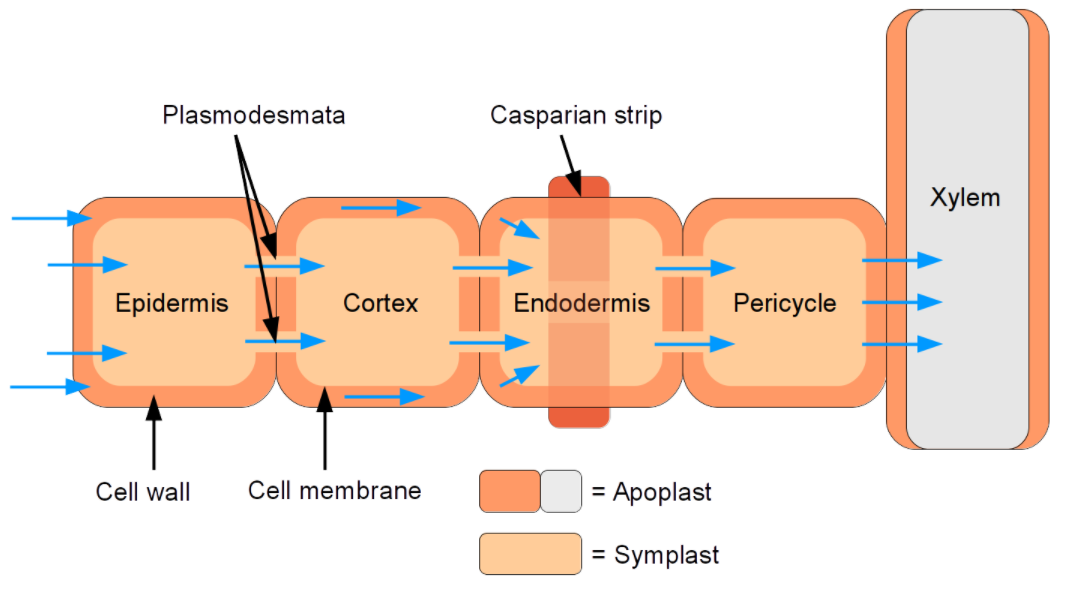
The band was first discovered as a wall structure by Robert Caspary; these bands are named as casparian strips after him. The strip forms during the early development of the cell and is a unit of the primary wall.
As these cells are water and solute impermeable in nature, they don’t allow these substances to pass through them therefore the movement of water through the root layers is ultimately simplastic in the endodermis.
Note:
The cytoplasm of the endodermal cell is tightly attached to the Casparian strip so that it does not readily separate from the strip when the cells are subjected to the effects of plasmolytic or other agents normally causing a contraction of protoplasts. The apoplastic system of adjacent cell walls is continuous throughout the plant except at the casparian strips of the endodermis in the root.
Complete answer:
Casparian strips is a thick band of waxy material- suberin deposited on the radial and transverse walls of the endodermis, which is chemically unique from the rest of the cell wall. It is used to block the passive flow of materials, such as water and solutes like minerals and salts through them into the stele of a plant which constitutes all the tissues on the inner side of the endodermis like pericycle, vascular bundles, and pith.
The band was first discovered as a wall structure by Robert Caspary; these bands are named as casparian strips after him. The strip forms during the early development of the cell and is a unit of the primary wall.
As these cells are water and solute impermeable in nature, they don’t allow these substances to pass through them therefore the movement of water through the root layers is ultimately simplastic in the endodermis.
Note:
The cytoplasm of the endodermal cell is tightly attached to the Casparian strip so that it does not readily separate from the strip when the cells are subjected to the effects of plasmolytic or other agents normally causing a contraction of protoplasts. The apoplastic system of adjacent cell walls is continuous throughout the plant except at the casparian strips of the endodermis in the root.
Recently Updated Pages
Master Class 11 English: Engaging Questions & Answers for Success

Master Class 11 Social Science: Engaging Questions & Answers for Success
Master Class 11 Maths: Engaging Questions & Answers for Success
Master Class 11 Biology: Engaging Questions & Answers for Success
Master Class 11 Physics: Engaging Questions & Answers for Success
Master Class 11 Chemistry: Engaging Questions & Answers for Success
Trending doubts
One Metric ton is equal to kg A 10000 B 1000 C 100 class 11 physics CBSE
Difference Between Prokaryotic Cells and Eukaryotic Cells
Difference between physical and chemical change class 11 chemistry CBSE
Find the value of the expression given below sin 30circ class 11 maths CBSE
Two of the body parts which do not appear in MRI are class 11 biology CBSE
Draw a diagram of a plant cell and label at least eight class 11 biology CBSE