




What are the isomers of ${{C}_{3}}{{H}_{6}}O$?
Answer
 Verified
542.7k+ views
Hint: Two or more compounds which consist of the same molecular formula but different structural arrangement of atoms are known as isomers and the phenomenon of forming isomers is known as isomerism. The isomers differ in physical as well as chemical properties.
Complete answer: To find the number of isomers, we first need to calculate the degree of unsaturation for the given compound. Now, let us discuss about degree of unsaturation.
The degree of unsaturation which is also known as double bond equivalents is a value which is used to determine the total number of rings and number of pi bonds that are present in a compound. It is calculate using the formula given below:
DBE$=C-\dfrac{H}{2}-\dfrac{X}{2}+\dfrac{N}{2}+1$
Where, C is the number of carbon atoms, H is the number of hydrogen atoms, X is the number of halogen atoms and N is the number of nitrogen atoms.
Now, for the given molecule the value of degree of unsaturation will be as follows:
DBE$=3-\dfrac{6}{2}+1$
$\Rightarrow \text{DBE}=1$
It indicates that there is a pi bond present in the molecule which confirms the presence of a double bond in the molecules as well as cyclic structures are also possible.
Hence, total eleven isomers (including stereoisomers) are possible for the given organic compound i.e., ${{C}_{3}}{{H}_{6}}O$ which are as follows:
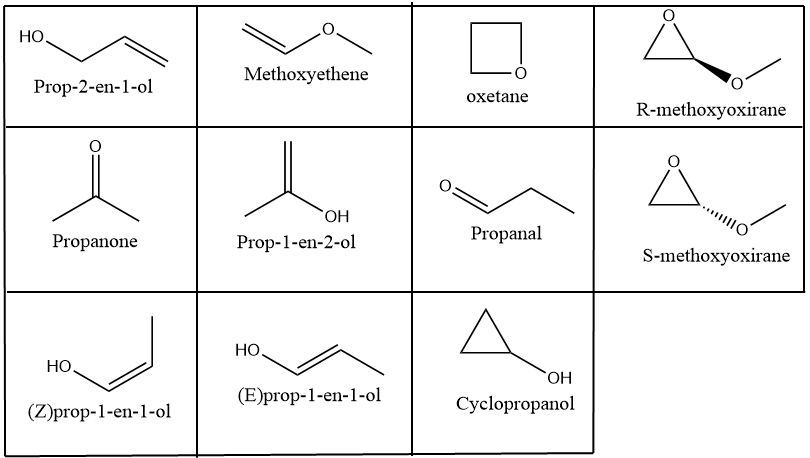
Note:
It is important to note that there is no fixed formula to find the number of isomers for a given molecule, you need to try every possible arrangement of the atoms in order to find the number of structures possible. However, the number of geometrical isomers can be calculated using the formula, number of $G.I={{2}^{n}}$ where n is the number of double bonds or degree of unsaturation.
Complete answer: To find the number of isomers, we first need to calculate the degree of unsaturation for the given compound. Now, let us discuss about degree of unsaturation.
The degree of unsaturation which is also known as double bond equivalents is a value which is used to determine the total number of rings and number of pi bonds that are present in a compound. It is calculate using the formula given below:
DBE$=C-\dfrac{H}{2}-\dfrac{X}{2}+\dfrac{N}{2}+1$
Where, C is the number of carbon atoms, H is the number of hydrogen atoms, X is the number of halogen atoms and N is the number of nitrogen atoms.
Now, for the given molecule the value of degree of unsaturation will be as follows:
DBE$=3-\dfrac{6}{2}+1$
$\Rightarrow \text{DBE}=1$
It indicates that there is a pi bond present in the molecule which confirms the presence of a double bond in the molecules as well as cyclic structures are also possible.
Hence, total eleven isomers (including stereoisomers) are possible for the given organic compound i.e., ${{C}_{3}}{{H}_{6}}O$ which are as follows:
Note:
It is important to note that there is no fixed formula to find the number of isomers for a given molecule, you need to try every possible arrangement of the atoms in order to find the number of structures possible. However, the number of geometrical isomers can be calculated using the formula, number of $G.I={{2}^{n}}$ where n is the number of double bonds or degree of unsaturation.
Recently Updated Pages
Master Class 11 English: Engaging Questions & Answers for Success

Master Class 11 Social Science: Engaging Questions & Answers for Success
Master Class 11 Maths: Engaging Questions & Answers for Success
Master Class 11 Biology: Engaging Questions & Answers for Success
Master Class 11 Physics: Engaging Questions & Answers for Success
Master Class 11 Chemistry: Engaging Questions & Answers for Success
Trending doubts
One Metric ton is equal to kg A 10000 B 1000 C 100 class 11 physics CBSE
Difference Between Prokaryotic Cells and Eukaryotic Cells
Find the value of the expression given below sin 30circ class 11 maths CBSE
1 ton equals to A 100 kg B 1000 kg C 10 kg D 10000 class 11 physics CBSE
Two of the body parts which do not appear in MRI are class 11 biology CBSE
What are hard magnetic materials class 11 physics CBSE