




What are symbiotic bacteria?
Answer
 Verified
569.1k+ views
Hint: Those bacteria that have the ability to fix nitrogen and are found in the mutually symbiotic relationship with the legumes are called the symbiotic bacteria. They are the species that help in the study of biological diversity fundamentals.
Complete answer:
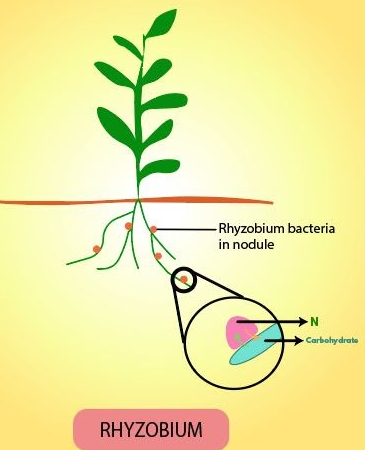
The symbiotic bacteria are those bacteria that are found in a symbiotic relationship with other organisms. In this association, both the pathogen and the host mutually benefited from each other. The plant will provide shelter to the bacteria while the bacteria will help the plant in the process of nitrogen fixation.
-The Rhizobium bacteria are habitants of the leguminous roots or nodules that are present in the soil. This association helps in the transfer of nutrition from the plants. Thus, this process of conversion of atmospheric nitrogen formation from the soil is known as the nitrogen fixation or biological nitrogen fixation, or even the nitrogen cycle.
-Rhizobium is the bacteria whose growth is measured in the laboratory medium and based on that it is classified as slow-growing or fast-growing.
Additional information
The symbiotic bacteria that are mutualistic in nature, the example is Azospirillum which is found in the cereal grasses.
Mycorrhizae or Mycorrhizal fungi are a class of fungus that can form a beneficial mutual relationship with $90\%$ of all land plant roots. The extended root in this fungi is named the mycelium. In this association, the plants and the fungi are mutually associated resulting in the process called mutualism, where the the plant provides sugars to the fungi that were produced by the process of photosynthesis while the Mycorrhizal fungi will help in providing the nutrients to the plant in the form of soil aggregates, mineral deposits, and organic matter.
Note:
The bacteria responsible for performing the process of nitrogen fixation in various plants is the Rhizobium, during the process of nitrogen fixation to express their genes they require a host. The Rhizobium bacteria is found to be rod-shaped and is gram-negative in nature having a motile structure. The Rhizobium bacteria was first identified in 1889 and was named the Rhizobium leguminosarum.
Complete answer:
The symbiotic bacteria are those bacteria that are found in a symbiotic relationship with other organisms. In this association, both the pathogen and the host mutually benefited from each other. The plant will provide shelter to the bacteria while the bacteria will help the plant in the process of nitrogen fixation.
-The Rhizobium bacteria are habitants of the leguminous roots or nodules that are present in the soil. This association helps in the transfer of nutrition from the plants. Thus, this process of conversion of atmospheric nitrogen formation from the soil is known as the nitrogen fixation or biological nitrogen fixation, or even the nitrogen cycle.
-Rhizobium is the bacteria whose growth is measured in the laboratory medium and based on that it is classified as slow-growing or fast-growing.
Additional information
The symbiotic bacteria that are mutualistic in nature, the example is Azospirillum which is found in the cereal grasses.
Mycorrhizae or Mycorrhizal fungi are a class of fungus that can form a beneficial mutual relationship with $90\%$ of all land plant roots. The extended root in this fungi is named the mycelium. In this association, the plants and the fungi are mutually associated resulting in the process called mutualism, where the the plant provides sugars to the fungi that were produced by the process of photosynthesis while the Mycorrhizal fungi will help in providing the nutrients to the plant in the form of soil aggregates, mineral deposits, and organic matter.
Note:
The bacteria responsible for performing the process of nitrogen fixation in various plants is the Rhizobium, during the process of nitrogen fixation to express their genes they require a host. The Rhizobium bacteria is found to be rod-shaped and is gram-negative in nature having a motile structure. The Rhizobium bacteria was first identified in 1889 and was named the Rhizobium leguminosarum.
Recently Updated Pages
Master Class 11 English: Engaging Questions & Answers for Success

Master Class 11 Social Science: Engaging Questions & Answers for Success
Master Class 11 Maths: Engaging Questions & Answers for Success
Master Class 11 Biology: Engaging Questions & Answers for Success
Master Class 11 Physics: Engaging Questions & Answers for Success
Master Class 11 Chemistry: Engaging Questions & Answers for Success
Trending doubts
One Metric ton is equal to kg A 10000 B 1000 C 100 class 11 physics CBSE
Difference Between Prokaryotic Cells and Eukaryotic Cells
Find the value of the expression given below sin 30circ class 11 maths CBSE
Difference between physical and chemical change class 11 chemistry CBSE
Two of the body parts which do not appear in MRI are class 11 biology CBSE
Draw a diagram of a plant cell and label at least eight class 11 biology CBSE