




What are interferons?
Answer
 Verified
618k+ views
Hint: These are one of the important modulators of the immune system. These complexes are produced by the body’s cells as a defensive response to viruses. These complexes increase antigen presentation.
Complete answer:
Virus-infected and tumour cells of our body secrete glycoproteins which protect the non-infected cells of our body from pathogen’s attack, they are known as interferons. These interferons activate macrophages which are natural killer cells, preventing viral replication. These compounds work by increasing antigen presentation to lymphocytes. Interferons were named so due to their ability to interfere with viral proliferation. The various forms of interferon are the body’s most rapidly produced and important defence against viruses. They can also combat bacterial and parasitic infections, inhibit cell division, and promote or impede the differentiation of cells. They are possibly produced by all vertebrate animals and by some invertebrates as well. Interferons are known to exhibit immunoregulatory functions such as inhibition ofB-cell activation, enhancing T-cell activity, and increasing the activity of natural killer cells.
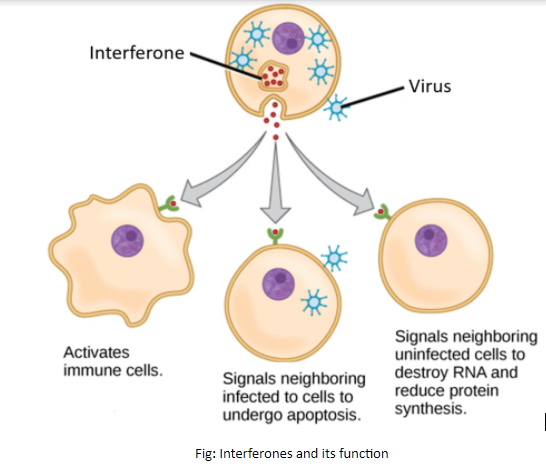
Note: Three forms of interferon have been recognized —alpha (α), beta (β), and gamma (γ) classified into two types: type I - α and β forms and type II - γ form based on the type of cell that produces the interferon and the functional characteristics of the protein. On stimulation by virus, Type I interferons are produced by almost any cell; thus inducing viral resistance in cells. On the other hand, Type II interferons are produced by NK cells and T lymphocytes whose main purpose is to signal the immune system to respond to infectious agents or cancerous growth.
Complete answer:
Virus-infected and tumour cells of our body secrete glycoproteins which protect the non-infected cells of our body from pathogen’s attack, they are known as interferons. These interferons activate macrophages which are natural killer cells, preventing viral replication. These compounds work by increasing antigen presentation to lymphocytes. Interferons were named so due to their ability to interfere with viral proliferation. The various forms of interferon are the body’s most rapidly produced and important defence against viruses. They can also combat bacterial and parasitic infections, inhibit cell division, and promote or impede the differentiation of cells. They are possibly produced by all vertebrate animals and by some invertebrates as well. Interferons are known to exhibit immunoregulatory functions such as inhibition ofB-cell activation, enhancing T-cell activity, and increasing the activity of natural killer cells.
Note: Three forms of interferon have been recognized —alpha (α), beta (β), and gamma (γ) classified into two types: type I - α and β forms and type II - γ form based on the type of cell that produces the interferon and the functional characteristics of the protein. On stimulation by virus, Type I interferons are produced by almost any cell; thus inducing viral resistance in cells. On the other hand, Type II interferons are produced by NK cells and T lymphocytes whose main purpose is to signal the immune system to respond to infectious agents or cancerous growth.
Recently Updated Pages
Master Class 12 Business Studies: Engaging Questions & Answers for Success

Master Class 12 Chemistry: Engaging Questions & Answers for Success
Master Class 12 Biology: Engaging Questions & Answers for Success
Class 12 Question and Answer - Your Ultimate Solutions Guide
Master Class 9 General Knowledge: Engaging Questions & Answers for Success
Master Class 9 Maths: Engaging Questions & Answers for Success
Trending doubts
Which are the Top 10 Largest Countries of the World?
Draw a labelled sketch of the human eye class 12 physics CBSE
Name the crygenes that control cotton bollworm and class 12 biology CBSE
Differentiate between homogeneous and heterogeneous class 12 chemistry CBSE
In a transcription unit the promoter is said to be class 12 biology CBSE
Sulphuric acid is known as the king of acids State class 12 chemistry CBSE