




What are circular functions?
Answer
 Verified
528.3k+ views
Hint: Here we will understand the term circular functions which are also known as trigonometric functions. We will use the diagram of a right angle triangle with a known angle $\theta$ using which we will define the perpendicular and the base. Further we find the relations between the six trigonometric functions and sides, angles of the triangle. Consider hypotenuse as h, base as b and perpendicular as p.
Complete step by step solution:
Here we have been asked to describe the term ‘circular functions’. Let us see these functions using some diagrammatic representations.
In mathematics, circular functions are also known as trigonometric functions. Trigonometry is the branch of mathematics that deals in the relations between the sides and angles of a triangle. There are six trigonometric functions namely: sine, cosine, tangent, secant, cosecant and cotangent functions. Let us see them one by one.
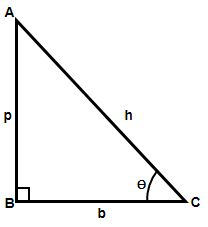
In the above figure we have drawn a right angle triangle ABC having right angle at B. We have assumed angle C as $\theta$. Now, according to the convention we must assume the side opposite to $\theta$ as perpendicular (p) and the other side as the base (b). The side opposite to the angle 90 degrees is always the hypotenuse (h).
(i) Sine: - The sine function is defined as the ratio of the perpendicular and the hypotenuse of the triangle. Mathematically it is given by the relation $\sin \theta =\dfrac{p}{h}$.
(ii) Cosine: - The cosine function is defined as the ratio of the base and the hypotenuse of the triangle. Mathematically it is given by the relation $\cos \theta =\dfrac{b}{h}$.
(iii) Tangent: - The tangent function is defined as the ratio of the sine and the cosine function. Mathematically it is given by the relation $\tan \theta =\dfrac{\sin \theta }{\cos \theta }=\dfrac{p}{b}$.
(iv) Secant: - The secant function is defined as the inverse of the cosine function. Mathematically it is given by the relation $\sec \theta =\dfrac{1}{\cos \theta }=\dfrac{h}{b}$.
(v) Cosecant: - The cosecant function is defined as the inverse of the sine function. Mathematically it is given by the relation $\csc \theta =\dfrac{1}{\sin \theta }=\dfrac{h}{p}$.
(v) Cotangent: - The cotangent function is defined as the inverse of the tangent function. Mathematically it is given by the relation $\cot \theta =\dfrac{1}{\tan \theta }=\dfrac{b}{p}$.
Note: Note that trigonometry is a vast topic and there are many relations and identities like the three basic identities given as ${{\sin }^{2}}\theta +{{\cos }^{2}}\theta =1$, ${{\sec }^{2}}\theta -{{\tan }^{2}}\theta =1$ and ${{\csc }^{2}}\theta -{{\cot }^{2}}\theta =1$. These identities must be remembered. Also, we have predetermined values of the sic trigonometric functions for some common angles like ${{0}^{\circ }},{{30}^{\circ }},{{45}^{\circ }},{{60}^{\circ }}$ and ${{90}^{\circ }}$ which are used in the chapter ‘height and distance’.
Complete step by step solution:
Here we have been asked to describe the term ‘circular functions’. Let us see these functions using some diagrammatic representations.
In mathematics, circular functions are also known as trigonometric functions. Trigonometry is the branch of mathematics that deals in the relations between the sides and angles of a triangle. There are six trigonometric functions namely: sine, cosine, tangent, secant, cosecant and cotangent functions. Let us see them one by one.
In the above figure we have drawn a right angle triangle ABC having right angle at B. We have assumed angle C as $\theta$. Now, according to the convention we must assume the side opposite to $\theta$ as perpendicular (p) and the other side as the base (b). The side opposite to the angle 90 degrees is always the hypotenuse (h).
(i) Sine: - The sine function is defined as the ratio of the perpendicular and the hypotenuse of the triangle. Mathematically it is given by the relation $\sin \theta =\dfrac{p}{h}$.
(ii) Cosine: - The cosine function is defined as the ratio of the base and the hypotenuse of the triangle. Mathematically it is given by the relation $\cos \theta =\dfrac{b}{h}$.
(iii) Tangent: - The tangent function is defined as the ratio of the sine and the cosine function. Mathematically it is given by the relation $\tan \theta =\dfrac{\sin \theta }{\cos \theta }=\dfrac{p}{b}$.
(iv) Secant: - The secant function is defined as the inverse of the cosine function. Mathematically it is given by the relation $\sec \theta =\dfrac{1}{\cos \theta }=\dfrac{h}{b}$.
(v) Cosecant: - The cosecant function is defined as the inverse of the sine function. Mathematically it is given by the relation $\csc \theta =\dfrac{1}{\sin \theta }=\dfrac{h}{p}$.
(v) Cotangent: - The cotangent function is defined as the inverse of the tangent function. Mathematically it is given by the relation $\cot \theta =\dfrac{1}{\tan \theta }=\dfrac{b}{p}$.
Note: Note that trigonometry is a vast topic and there are many relations and identities like the three basic identities given as ${{\sin }^{2}}\theta +{{\cos }^{2}}\theta =1$, ${{\sec }^{2}}\theta -{{\tan }^{2}}\theta =1$ and ${{\csc }^{2}}\theta -{{\cot }^{2}}\theta =1$. These identities must be remembered. Also, we have predetermined values of the sic trigonometric functions for some common angles like ${{0}^{\circ }},{{30}^{\circ }},{{45}^{\circ }},{{60}^{\circ }}$ and ${{90}^{\circ }}$ which are used in the chapter ‘height and distance’.
Recently Updated Pages
Master Class 11 Computer Science: Engaging Questions & Answers for Success

Master Class 11 Business Studies: Engaging Questions & Answers for Success
Master Class 11 Economics: Engaging Questions & Answers for Success
Master Class 11 English: Engaging Questions & Answers for Success
Master Class 11 Maths: Engaging Questions & Answers for Success
Master Class 11 Biology: Engaging Questions & Answers for Success
Trending doubts
One Metric ton is equal to kg A 10000 B 1000 C 100 class 11 physics CBSE
There are 720 permutations of the digits 1 2 3 4 5 class 11 maths CBSE
Discuss the various forms of bacteria class 11 biology CBSE
Draw a diagram of a plant cell and label at least eight class 11 biology CBSE
State the laws of reflection of light
Explain zero factorial class 11 maths CBSE