



What are bridge elements?
Answer
 Verified
579.3k+ views
Hint :Bridge elements are those elements which show the diagonal relationship with the element of the neighboring period. Period 2 elements are referred to as bridge elements. For example, $ Be $ is a bridge element as it shows diagonal relationship with $ Al $ .
Complete Step By Step Answer:
Bridge elements are those elements which show the diagonal relationship with the element of neighboring period. Diagonal relationship describes the similarity in certain properties between two elements which placed diagonally when we move from left to right in two neighbouring periods. These properties include comparable atomic size, the polarization of atoms, electronegativity and so on. The elements which show diagonal relationship are illustrated in the following diagram.
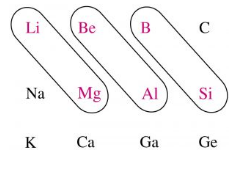
Period 2 elements are referred to as bridge elements. These are so called because these elements bridge the gap between metals on one side (group 1 and 2) and nonmetals/metalloids on the other side (group 13-18). Therefore, from the above diagram we conclude that Lithium $ \left( Li \right) $ , beryllium $ \left( Be \right) $ and boron $ \left( B \right) $ are bridge elements.
Additional Information:
Diagonal relationship arises because moving along the period and down the period has opposite effects. For instance, as we move down the group, atomic size increases. In contrast, when we move along the period, atomic size decreases.
Note :
It is important to note that bridge elements are those elements which show the diagonal relationship with the element of the neighboring period. Diagonal relationship describes the similarity in certain properties between two elements which are placed diagonally when we move from left to right in two neighbouring periods. Lithium $ \left( Li \right) $ , beryllium $ \left( Be \right) $ and boron $ \left( B \right) $ are examples of bridge elements.
Complete Step By Step Answer:
Bridge elements are those elements which show the diagonal relationship with the element of neighboring period. Diagonal relationship describes the similarity in certain properties between two elements which placed diagonally when we move from left to right in two neighbouring periods. These properties include comparable atomic size, the polarization of atoms, electronegativity and so on. The elements which show diagonal relationship are illustrated in the following diagram.
Period 2 elements are referred to as bridge elements. These are so called because these elements bridge the gap between metals on one side (group 1 and 2) and nonmetals/metalloids on the other side (group 13-18). Therefore, from the above diagram we conclude that Lithium $ \left( Li \right) $ , beryllium $ \left( Be \right) $ and boron $ \left( B \right) $ are bridge elements.
Additional Information:
Diagonal relationship arises because moving along the period and down the period has opposite effects. For instance, as we move down the group, atomic size increases. In contrast, when we move along the period, atomic size decreases.
Note :
It is important to note that bridge elements are those elements which show the diagonal relationship with the element of the neighboring period. Diagonal relationship describes the similarity in certain properties between two elements which are placed diagonally when we move from left to right in two neighbouring periods. Lithium $ \left( Li \right) $ , beryllium $ \left( Be \right) $ and boron $ \left( B \right) $ are examples of bridge elements.
Recently Updated Pages
10 examples of friction in our daily life

Draw a diagram of nephron and explain its structur class 11 biology CBSE
Write structures of the following compounds i 2 Chloro3methylpentane class 11 chemistry CBSE
What is BLO What is the full form of BLO class 8 social science CBSE
Explain the Treaty of Vienna of 1815 class 10 social science CBSE
A Paragraph on Pollution in about 100-150 Words
Trending doubts
Find the value of the expression given below sin 30circ class 11 maths CBSE
What do you mean by retardation What is its SI uni class 11 physics CBSE
Difference between physical and chemical change class 11 chemistry CBSE
What are derived physical quantities Give any two examples class 11 physics CBSE
Which of the following is a derived physical quantity class 11 physics CBSE
Describe various types of epithelial tissues with the class 11 biology CBSE