




Wharton’s duct is associated with
A. Brunner’s gland
B. Sublingual salivary gland
C. Submaxillary salivary gland
D. Parotid salivary gland
Answer
 Verified
599.4k+ views
Hint:Wharton’s duct secretes mixed secretions which are mostly serous. It is one of the three major salivary glands of human beings. These ducts are present along the side of the lower jawbone and these are medium-sized ducts.
Complete answer:
The Wharton’s duct which is also known as the submandibular duct is associated with the submaxillary salivary gland. It is one of the three major salivary ducts in the mouth. It is about 5 cm long and is medium-sized as compared to the larger parotid gland. Its walls are much thinner than the parotid duct. It pours saliva at the base of the tongue by draining it from each bilateral submandibular gland and sublingual gland.
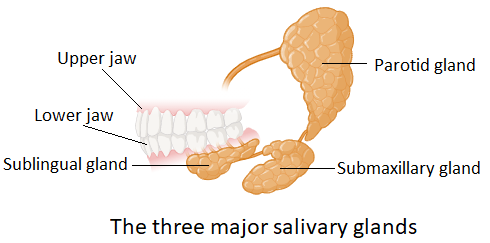
The Wharton’s duct originates from the deep part of the submandibular gland. Numerous branches begin from the superficial surface of the gland and extend forward to pass between the sublingual gland and genioglossus muscles (extrinsic muscles of the tongue). It opens from a narrow opening present on the summit of a small papilla which lies on the side of the frenulum of the tongue. This means that they open up near the central incisors in the lower jaw.
These ducts function to drain saliva at the base of the tongue to mix with the food particles and make them wet. Partial digestion of food occurs in the mouth by the action of saliva. Also, saliva makes it easy for the food to travel down the esophagus by peristalsis.
Therefore, from the above discussion, we can conclude that option C) is the right answer.
Note: The parotid salivary glands and the sublingual glands are the two other major mouth glands. The parotid glands are the largest and their ducts are called Stenson’s ducts. The sublingual glands are the smallest and are situated beneath the tongue. They open through ducts of Rivinus at the floor of the buccal cavity.
Complete answer:
The Wharton’s duct which is also known as the submandibular duct is associated with the submaxillary salivary gland. It is one of the three major salivary ducts in the mouth. It is about 5 cm long and is medium-sized as compared to the larger parotid gland. Its walls are much thinner than the parotid duct. It pours saliva at the base of the tongue by draining it from each bilateral submandibular gland and sublingual gland.
The Wharton’s duct originates from the deep part of the submandibular gland. Numerous branches begin from the superficial surface of the gland and extend forward to pass between the sublingual gland and genioglossus muscles (extrinsic muscles of the tongue). It opens from a narrow opening present on the summit of a small papilla which lies on the side of the frenulum of the tongue. This means that they open up near the central incisors in the lower jaw.
These ducts function to drain saliva at the base of the tongue to mix with the food particles and make them wet. Partial digestion of food occurs in the mouth by the action of saliva. Also, saliva makes it easy for the food to travel down the esophagus by peristalsis.
Therefore, from the above discussion, we can conclude that option C) is the right answer.
Note: The parotid salivary glands and the sublingual glands are the two other major mouth glands. The parotid glands are the largest and their ducts are called Stenson’s ducts. The sublingual glands are the smallest and are situated beneath the tongue. They open through ducts of Rivinus at the floor of the buccal cavity.
Recently Updated Pages
Master Class 11 English: Engaging Questions & Answers for Success

Master Class 11 Social Science: Engaging Questions & Answers for Success
Master Class 11 Maths: Engaging Questions & Answers for Success
Master Class 11 Biology: Engaging Questions & Answers for Success
Master Class 11 Physics: Engaging Questions & Answers for Success
Master Class 11 Chemistry: Engaging Questions & Answers for Success
Trending doubts
One Metric ton is equal to kg A 10000 B 1000 C 100 class 11 physics CBSE
Difference Between Prokaryotic Cells and Eukaryotic Cells
Two of the body parts which do not appear in MRI are class 11 biology CBSE
Find the value of the expression given below sin 30circ class 11 maths CBSE
Draw a diagram of a plant cell and label at least eight class 11 biology CBSE
10 examples of friction in our daily life