




Weight of a body in air is $40g$. If its volume is $10cc$, then its weight in water is
(A) $30g$
(B) $40g$
(C) $50g$
(D) None of these
Answer
 Verified
581.4k+ views
Hint We know that weight of a body is net force applied on the body. When we put an object in water, its weight decreased by the weight of the volume of the object inside the water. Weight of the body is decreased due to buoyant force applied by water.
Complete step by step solution
Given, the weight of a body in air is $40g$ and its volume is $10cc$, where cc is $c{m^3}$.
Then the density of the body is $\dfrac{{40g}}{{10cc}} = 4g/cc$.
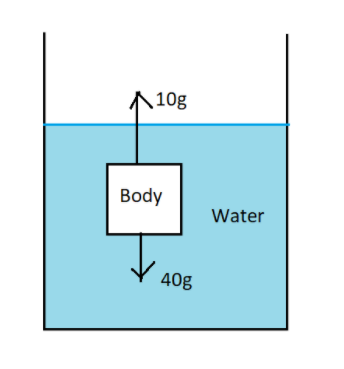
When we put the body in water, the body will replace the water of volume $10cc$ due to which water applies some buoyant force on the body in an upward direction. We know the density of water is $1g/cc$.
Here we can see that the density of the body is greater than water then the body completely sinks into water.
Then buoyant force on the body or decrease in weight is $1 \times 10 = 10g$.
Now, there are two forces applied on the body: one is $40g$ due to its weight in downward direction and another is $10g$ due to buoyant force applied by water. Then the net weight of the body is $40 - 10 = 30g$.
Hence the correct answer is option A.
Note In above question the body is completely submerged into water because its density is more than that of water but if its density is less than water then its some is inside the water remaining is outside the water. Or we can say that the body floats on the surface of water in that case.
Complete step by step solution
Given, the weight of a body in air is $40g$ and its volume is $10cc$, where cc is $c{m^3}$.
Then the density of the body is $\dfrac{{40g}}{{10cc}} = 4g/cc$.
When we put the body in water, the body will replace the water of volume $10cc$ due to which water applies some buoyant force on the body in an upward direction. We know the density of water is $1g/cc$.
Here we can see that the density of the body is greater than water then the body completely sinks into water.
Then buoyant force on the body or decrease in weight is $1 \times 10 = 10g$.
Now, there are two forces applied on the body: one is $40g$ due to its weight in downward direction and another is $10g$ due to buoyant force applied by water. Then the net weight of the body is $40 - 10 = 30g$.
Hence the correct answer is option A.
Note In above question the body is completely submerged into water because its density is more than that of water but if its density is less than water then its some is inside the water remaining is outside the water. Or we can say that the body floats on the surface of water in that case.
Recently Updated Pages
Master Class 11 Computer Science: Engaging Questions & Answers for Success

Master Class 11 Business Studies: Engaging Questions & Answers for Success
Master Class 11 Economics: Engaging Questions & Answers for Success
Master Class 11 English: Engaging Questions & Answers for Success
Master Class 11 Maths: Engaging Questions & Answers for Success
Master Class 11 Biology: Engaging Questions & Answers for Success
Trending doubts
One Metric ton is equal to kg A 10000 B 1000 C 100 class 11 physics CBSE
There are 720 permutations of the digits 1 2 3 4 5 class 11 maths CBSE
Discuss the various forms of bacteria class 11 biology CBSE
Draw a diagram of a plant cell and label at least eight class 11 biology CBSE
State the laws of reflection of light
Explain zero factorial class 11 maths CBSE