




We Using the $x$-intercept and $y$-intercept, how do you graph $2x-3y=5$?
Answer
 Verified
596.4k+ views
Hint: In this question we will first convert the given linear expression in the general form of the equation of a line which is $y=mx+b$, where $b$ is the $y$ intercept and $m$ is the slope of the line, and then solve for the values for the $x$ intercept and the $y$ intercept to plot the line on the graph.
Complete step-by-step answer:
We have the expression as $2x-3y=5$
We will first convert this expression to the slope intercept form of a line which is $y=mx+b$.
$\Rightarrow 2x-3y=5$
On transferring the term $2x$ from the left-hand side to the right-hand side, we get:
$\Rightarrow -3y=5-2x$
Now on multiplying both the sides of the expression by $-1$, we get:
$\Rightarrow 3y=-5+2x$
The right-hand side can be rearranged and written as:
$\Rightarrow 3y=2x-5$
On transferring the term $3$ from the left-hand side to the right-hand side, we get:
$\Rightarrow y=\dfrac{2x-5}{3}$
On splitting the denominator, we get:
$\Rightarrow y=\dfrac{2}{3}x-\dfrac{5}{3}$
Therefore, the above equation is in the form of $y=mx+b$
From the general format, we know that $b$ is the $y$ intercept of the line therefore $y=-\dfrac{5}{3}$
Now to calculate the $x$ intercept from the equation we will substitute $y=0$ and solve for $x$.
On substituting $y=0$, we get:
$\Rightarrow 0=\dfrac{2}{3}x-\dfrac{5}{3}$
On transferring $\dfrac{5}{3}$ from the right-hand side to the left-hand side and rearranging the terms, we get:
$\Rightarrow \dfrac{2}{3}x=\dfrac{5}{3}$
On simplifying, we get:
$\Rightarrow 2x=5$
On transferring $2$ from the left-hand side to the right-hand side, we get:
$\Rightarrow x=\dfrac{5}{2}$
Which can be simplified as:
$\Rightarrow x=2.5$, which is the $x$ intercept.
On plotting the graph by taking the two points as $(0,-1.66)$ and $(2.5,0)$, we get:
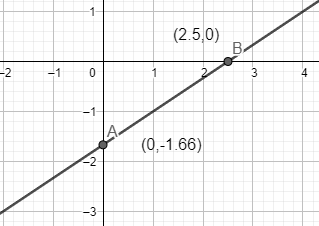
Which is the required solution.
Note: Slope of a line is calculated as the ratio between the vertical change and the horizontal change. It can be also defined as how much the change in one intercept will affect the change in another intercept.
It can be calculated using the formula $m=\dfrac{{{y}_{2}}-{{y}_{1}}}{{{x}_{2}}-{{x}_{1}}}$ where $({{x}_{1}},{{y}_{1}})$ coordinates of first line and $({{x}_{2}},{{y}_{2}})$ are the coordinates of the second line.
Complete step-by-step answer:
We have the expression as $2x-3y=5$
We will first convert this expression to the slope intercept form of a line which is $y=mx+b$.
$\Rightarrow 2x-3y=5$
On transferring the term $2x$ from the left-hand side to the right-hand side, we get:
$\Rightarrow -3y=5-2x$
Now on multiplying both the sides of the expression by $-1$, we get:
$\Rightarrow 3y=-5+2x$
The right-hand side can be rearranged and written as:
$\Rightarrow 3y=2x-5$
On transferring the term $3$ from the left-hand side to the right-hand side, we get:
$\Rightarrow y=\dfrac{2x-5}{3}$
On splitting the denominator, we get:
$\Rightarrow y=\dfrac{2}{3}x-\dfrac{5}{3}$
Therefore, the above equation is in the form of $y=mx+b$
From the general format, we know that $b$ is the $y$ intercept of the line therefore $y=-\dfrac{5}{3}$
Now to calculate the $x$ intercept from the equation we will substitute $y=0$ and solve for $x$.
On substituting $y=0$, we get:
$\Rightarrow 0=\dfrac{2}{3}x-\dfrac{5}{3}$
On transferring $\dfrac{5}{3}$ from the right-hand side to the left-hand side and rearranging the terms, we get:
$\Rightarrow \dfrac{2}{3}x=\dfrac{5}{3}$
On simplifying, we get:
$\Rightarrow 2x=5$
On transferring $2$ from the left-hand side to the right-hand side, we get:
$\Rightarrow x=\dfrac{5}{2}$
Which can be simplified as:
$\Rightarrow x=2.5$, which is the $x$ intercept.
On plotting the graph by taking the two points as $(0,-1.66)$ and $(2.5,0)$, we get:
Which is the required solution.
Note: Slope of a line is calculated as the ratio between the vertical change and the horizontal change. It can be also defined as how much the change in one intercept will affect the change in another intercept.
It can be calculated using the formula $m=\dfrac{{{y}_{2}}-{{y}_{1}}}{{{x}_{2}}-{{x}_{1}}}$ where $({{x}_{1}},{{y}_{1}})$ coordinates of first line and $({{x}_{2}},{{y}_{2}})$ are the coordinates of the second line.
Recently Updated Pages
Master Class 11 English: Engaging Questions & Answers for Success

Master Class 11 Social Science: Engaging Questions & Answers for Success
Master Class 11 Maths: Engaging Questions & Answers for Success
Master Class 11 Biology: Engaging Questions & Answers for Success
Master Class 11 Physics: Engaging Questions & Answers for Success
Master Class 11 Chemistry: Engaging Questions & Answers for Success
Trending doubts
One Metric ton is equal to kg A 10000 B 1000 C 100 class 11 physics CBSE
Difference Between Prokaryotic Cells and Eukaryotic Cells
Find the value of the expression given below sin 30circ class 11 maths CBSE
Difference between physical and chemical change class 11 chemistry CBSE
Two of the body parts which do not appear in MRI are class 11 biology CBSE
Draw a diagram of a plant cell and label at least eight class 11 biology CBSE