




We know that $\cos 2\theta =\dfrac{1-{{\tan }^{2}}\theta }{1+{{\tan }^{2}}\theta }$ , so verify this identity for $\theta =30{}^\circ $ .
Answer
 Verified
636.3k+ views
Hint: Start by putting $\theta =30{}^\circ $ in the left-hand side of the identity given in the question. Put the value and use the value $\cos 60{}^\circ =\dfrac{1}{2}$ , which is known from the trigonometric table to get a simplified value of the LHS of the equation. Now put $\theta =30{}^\circ $ in the RHS and use the value $\tan 30{}^\circ =\dfrac{1}{\sqrt{3}}$ to get the simplified value of RHS. If the RHS and LHS are equal, the identity is verified.
Complete step by step solution:
Before moving to the solution, let us discuss the nature of sine and cosine function, which we would be using in the solution. We can better understand this using the graph of sine and cosine.
First, let us start with the graph of sinx.
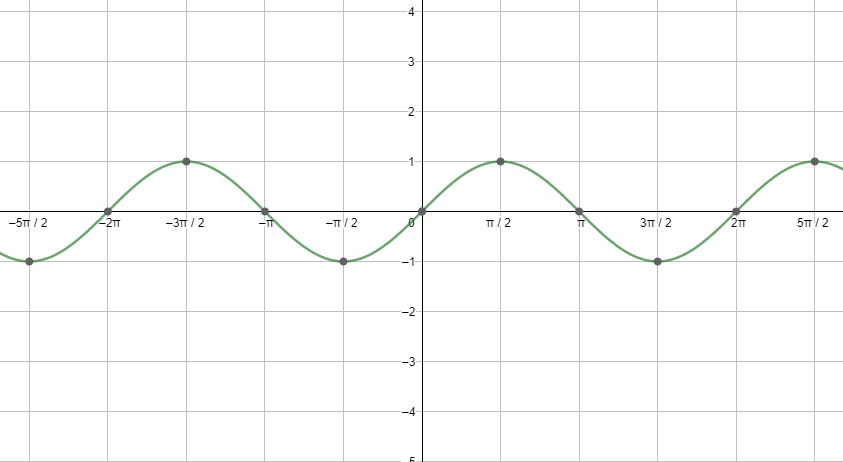
Next, let us see the graph of cosx.

Looking at both the graphs, and using the relations between the different trigonometric ratios, we get
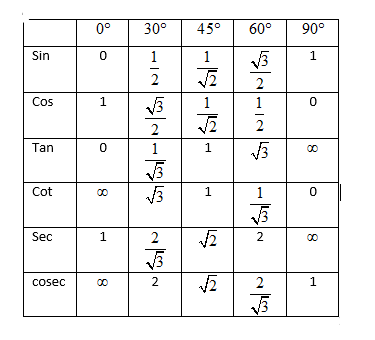
Let us start the solution to the above question by simplifying the left-hand side of the equation $\cos 2\theta =\dfrac{1-{{\tan }^{2}}\theta }{1+{{\tan }^{2}}\theta }$ by putting the value $\theta =30{}^\circ $ .
$\cos 2\theta $
$=\cos \left( 2\times 30{}^\circ \right)$
$=\cos 60{}^\circ $
And we know that the value of $\cos 60{}^\circ $ is equal to $\dfrac{1}{2}$ . So, we get
$=\cos 60{}^\circ =\dfrac{1}{2}$
So, the left-hand side of the equation $\cos 2\theta =\dfrac{1-{{\tan }^{2}}\theta }{1+{{\tan }^{2}}\theta }$ is equal to $\dfrac{1}{2}$ .
Now let us simplify the right-hand side of the equation by putting the values $\theta =30{}^\circ $ .
$\dfrac{1-{{\tan }^{2}}\theta }{1+{{\tan }^{2}}\theta }$
$=\dfrac{1-{{\tan }^{2}}30{}^\circ }{1+{{\tan }^{2}}30{}^\circ }$
Now we know that $\tan 30{}^\circ =\dfrac{1}{\sqrt{3}}$ .
$=\dfrac{1-{{\tan }^{2}}30{}^\circ }{1+{{\tan }^{2}}30{}^\circ }$
$=\dfrac{1-{{\left( \dfrac{1}{\sqrt{3}} \right)}^{2}}}{1+{{\left( \dfrac{1}{\sqrt{3}} \right)}^{2}}}$
$=\dfrac{1-\dfrac{1}{3}}{1+\dfrac{1}{3}}=\dfrac{\dfrac{2}{3}}{\dfrac{4}{3}}=\dfrac{1}{2}$
Therefore, we can say that the left-hand side of the equation $\cos 2\theta =\dfrac{1-{{\tan }^{2}}\theta }{1+{{\tan }^{2}}\theta }$ is equal to the right-hand side. So, we have verified the above equation.
Note: Always remember whenever you are asked to verify a formula for a particular value, you are not allowed to use that and all other formulas derived from it while solving. So, it is good practice to solve the verifying problems using fundamental formulas and values, as we might not know about the origins of different complex formulas and whether they are related to the formula that we are verifying or not.
Complete step by step solution:
Before moving to the solution, let us discuss the nature of sine and cosine function, which we would be using in the solution. We can better understand this using the graph of sine and cosine.
First, let us start with the graph of sinx.
Next, let us see the graph of cosx.
Looking at both the graphs, and using the relations between the different trigonometric ratios, we get
Let us start the solution to the above question by simplifying the left-hand side of the equation $\cos 2\theta =\dfrac{1-{{\tan }^{2}}\theta }{1+{{\tan }^{2}}\theta }$ by putting the value $\theta =30{}^\circ $ .
$\cos 2\theta $
$=\cos \left( 2\times 30{}^\circ \right)$
$=\cos 60{}^\circ $
And we know that the value of $\cos 60{}^\circ $ is equal to $\dfrac{1}{2}$ . So, we get
$=\cos 60{}^\circ =\dfrac{1}{2}$
So, the left-hand side of the equation $\cos 2\theta =\dfrac{1-{{\tan }^{2}}\theta }{1+{{\tan }^{2}}\theta }$ is equal to $\dfrac{1}{2}$ .
Now let us simplify the right-hand side of the equation by putting the values $\theta =30{}^\circ $ .
$\dfrac{1-{{\tan }^{2}}\theta }{1+{{\tan }^{2}}\theta }$
$=\dfrac{1-{{\tan }^{2}}30{}^\circ }{1+{{\tan }^{2}}30{}^\circ }$
Now we know that $\tan 30{}^\circ =\dfrac{1}{\sqrt{3}}$ .
$=\dfrac{1-{{\tan }^{2}}30{}^\circ }{1+{{\tan }^{2}}30{}^\circ }$
$=\dfrac{1-{{\left( \dfrac{1}{\sqrt{3}} \right)}^{2}}}{1+{{\left( \dfrac{1}{\sqrt{3}} \right)}^{2}}}$
$=\dfrac{1-\dfrac{1}{3}}{1+\dfrac{1}{3}}=\dfrac{\dfrac{2}{3}}{\dfrac{4}{3}}=\dfrac{1}{2}$
Therefore, we can say that the left-hand side of the equation $\cos 2\theta =\dfrac{1-{{\tan }^{2}}\theta }{1+{{\tan }^{2}}\theta }$ is equal to the right-hand side. So, we have verified the above equation.
Note: Always remember whenever you are asked to verify a formula for a particular value, you are not allowed to use that and all other formulas derived from it while solving. So, it is good practice to solve the verifying problems using fundamental formulas and values, as we might not know about the origins of different complex formulas and whether they are related to the formula that we are verifying or not.
Recently Updated Pages
Master Class 11 English: Engaging Questions & Answers for Success

Master Class 11 Social Science: Engaging Questions & Answers for Success
Master Class 11 Maths: Engaging Questions & Answers for Success
Master Class 11 Biology: Engaging Questions & Answers for Success
Master Class 11 Physics: Engaging Questions & Answers for Success
Master Class 11 Chemistry: Engaging Questions & Answers for Success
Trending doubts
Explain the Treaty of Vienna of 1815 class 10 social science CBSE
What is the Total Duration of Football Match?
First Cotton Mill of India
In which year voting age was reduced from 21 to 18?
10 examples of evaporation in daily life with explanations
What planets have no moons Which one has only one moon class 10 physics CBSE