




Water level of a cylindrical vessel of height 15cm is initially 10cm. Stone of a particular volume is dropped so that initially the level rises by 2cm and finally settles to an increase of 1cm. If the probability that any stone dropped goes inside the vessel is ‘P’, then the probability that water spills out of the vessel at the ${{n}^{th}}$ throw is
[a] $^{n-1}{{C}_{4}}{{p}^{5}}{{\left( 1-p \right)}^{5}}$
[b] $^{n}{{C}_{3}}{{p}^{5}}{{\left( 1-p \right)}^{n-5}}$
[c] $^{n}{{C}_{6}}{{p}^{6}}{{\left( 1-p \right)}^{n-6}}$
[d] $^{n}{{C}_{6}}{{p}^{6}}{{\left( 1-p \right)}^{5}}$
Answer
 Verified
646.5k+ views
Hint: Determine the height of the water level in the vessel so that the next incoming stone falling in the vessel will cause the water to spill. Determine the number of stones (say k) that should fall in the vessel to attain that height. Observe that for the water to spill on the ${{n}^{th}}$ throw , exactly k stones should fall in the first n-1 throws and ${{n}^{th}}$ throw should fall in the vessel. Use the fact that the throws are independent of each other and the probability of the stone falling in the vessel is constant and hence the throws are Bernoulli trials with success probability p. Use the fact that the probability of k successes in first n trials in Bernoulli trials is given by $P\left( X=k \right){{=}^{n}}{{C}_{k}}{{p}^{k}}{{\left( 1-p \right)}^{n-k}}$. Hence determine the probability of k successes in the first n-1 trials and success on the ${{n}^{th}}$ trial. Hence determine which of the options is correct.
Complete step by step answer:
Let the height of the water level in the vessel be “h” so that the next incoming stone falling in the vessel will cause the water to spill. Since each stone falling in the vessel causes a maximum of 2 cm increase in the height of the water in the vessel. Hence, if h+2 is greater than 15, water will spill out of the vessel.
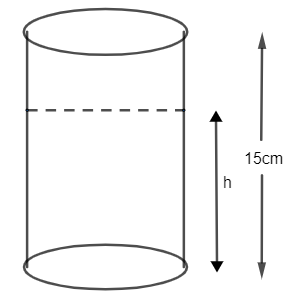
Hence, we have
$\begin{align}
& h+2>15 \\
& \Rightarrow h>13 \\
& \Rightarrow h\ge 14 \\
\end{align}$
Also, at height h-1, water should not spill if the stone falls in the vessel.
Hence, we have
$h-1+2\le 15\Rightarrow h\le 14$
Hence, we have h = 14cm.
When a stone falls in the vessel net increase in the height of the water is 1cm. Hence for increasing the height by 14-10 = 4cm, we need to drop $\dfrac{4}{1}=4$ stones in the vessel.
Hence for the water to spill at before ${{n}^{th}}$ throw exactly 4 stones should fall in the vessel and the ${{n}^{th}}$ throw should also fall in the vessel.
Since each of the throws is independent and the probability of landing the stone in the vessel is constant, we can treat each throw as Bernoulli Trial with success probability p.
We know that the probability of k successes in first n trials in Bernoulli trials is given by $P\left( X=k \right){{=}^{n}}{{C}_{k}}{{p}^{k}}{{\left( 1-p \right)}^{n-k}}$
Hence, we have
Probability that 4 stones fall in the vessel during first n-1 throws is $^{n-1}{{C}_{4}}{{p}^{4}}{{\left( 1-p \right)}^{n-5}}$
Probability that the ${{n}^{th}}$ stone will fall in the vessel is $p$
Hence the probability that the water will spill on ${{n}^{th}}$ throw is
$^{n-1}{{C}_{4}}{{p}^{4}}{{\left( 1-p \right)}^{n-5}}p{{=}^{n-1}}{{C}_{4}}{{p}^{5}}{{\left( 1-p \right)}^{n-5}}$
So, the correct answer is “Option A”.
Note: [1] The sequence describing the probabilities of ${{n}^{th}}$ throw causing the water spill as n varies is studied in higher classes as a stochastic process. These processes are very important in real world examples and have helped engineers understand the real-world phenomenon in an elegant way.
[2] Many students make a mistake by finding the probability that 5 stones fall in vessel in n throws and claim that the probability that water spills on ${{n}^{th}}$ throw will be same which is incorrect since it is possible that the ${{5}^{th}}$ success occurs at n-1 throws and the stone does not fall inside the vessel on ${{n}^{th}}$ throw. Hence no water was spilled on ${{n}^{th}}$ throw although 5 throws have fallen inside the vessel.
Complete step by step answer:
Let the height of the water level in the vessel be “h” so that the next incoming stone falling in the vessel will cause the water to spill. Since each stone falling in the vessel causes a maximum of 2 cm increase in the height of the water in the vessel. Hence, if h+2 is greater than 15, water will spill out of the vessel.
Hence, we have
$\begin{align}
& h+2>15 \\
& \Rightarrow h>13 \\
& \Rightarrow h\ge 14 \\
\end{align}$
Also, at height h-1, water should not spill if the stone falls in the vessel.
Hence, we have
$h-1+2\le 15\Rightarrow h\le 14$
Hence, we have h = 14cm.
When a stone falls in the vessel net increase in the height of the water is 1cm. Hence for increasing the height by 14-10 = 4cm, we need to drop $\dfrac{4}{1}=4$ stones in the vessel.
Hence for the water to spill at before ${{n}^{th}}$ throw exactly 4 stones should fall in the vessel and the ${{n}^{th}}$ throw should also fall in the vessel.
Since each of the throws is independent and the probability of landing the stone in the vessel is constant, we can treat each throw as Bernoulli Trial with success probability p.
We know that the probability of k successes in first n trials in Bernoulli trials is given by $P\left( X=k \right){{=}^{n}}{{C}_{k}}{{p}^{k}}{{\left( 1-p \right)}^{n-k}}$
Hence, we have
Probability that 4 stones fall in the vessel during first n-1 throws is $^{n-1}{{C}_{4}}{{p}^{4}}{{\left( 1-p \right)}^{n-5}}$
Probability that the ${{n}^{th}}$ stone will fall in the vessel is $p$
Hence the probability that the water will spill on ${{n}^{th}}$ throw is
$^{n-1}{{C}_{4}}{{p}^{4}}{{\left( 1-p \right)}^{n-5}}p{{=}^{n-1}}{{C}_{4}}{{p}^{5}}{{\left( 1-p \right)}^{n-5}}$
So, the correct answer is “Option A”.
Note: [1] The sequence describing the probabilities of ${{n}^{th}}$ throw causing the water spill as n varies is studied in higher classes as a stochastic process. These processes are very important in real world examples and have helped engineers understand the real-world phenomenon in an elegant way.
[2] Many students make a mistake by finding the probability that 5 stones fall in vessel in n throws and claim that the probability that water spills on ${{n}^{th}}$ throw will be same which is incorrect since it is possible that the ${{5}^{th}}$ success occurs at n-1 throws and the stone does not fall inside the vessel on ${{n}^{th}}$ throw. Hence no water was spilled on ${{n}^{th}}$ throw although 5 throws have fallen inside the vessel.
Recently Updated Pages
Explain the structure of megasporangium class 12 biology CBSE

Why is chloroform kept in dark coloured bottles class 12 chemistry CBSE
Derive the balancing condition of a Wheatstone bri class 12 physics CBSE
Draw VI characteristics of a pn junction diode Explain class 12 physics CBSE
Is it possible to carry pride in ones language too class 12 english CBSE
In a population at Hardy Weinberg equilibrium the allele class 12 biology CBSE
Trending doubts
Draw a labelled sketch of the human eye class 12 physics CBSE
Which are the Top 10 Largest Countries of the World?
Draw ray diagrams each showing i myopic eye and ii class 12 physics CBSE
Which is the correct genotypic ratio of mendel dihybrid class 12 biology CBSE
Differentiate between homogeneous and heterogeneous class 12 chemistry CBSE
Which animal never drinks water in its entire life class 12 biology CBSE