




Water is flowing in a stream with velocity 5 km/hr in an easterly direction relative to the shore. Speed of a boat relative to still water is 20 km/hr. If the boat enters the stream heading North, with what velocity will the boat actually travel?
Answer
 Verified
574.5k+ views
Hint: This will be solved by considering various velocity vectors and adding them. Here perpendicular axes are the x axis i.e east direction and the y axis i.e north direction. We get the angle made by the resultant vector with x axis i.e east direction and we can find the magnitude of resultant by vector addition.
Formula used:
$\mathop {{V_{bg}}}\limits^ \to = \mathop {{V_{bw}}}\limits^ \to + \mathop {{V_{wg}}}\limits^ \to $
Complete step by step answer:
This can be solved by using the relative velocity concept. We cannot absolutely tell whether the body is in motion or in rest. It depends on the observer's point of view. If the observer is moving then the body which is at rest with respect to ground will be under motion with respect to the moving observer. So everything is relative. Nothing is absolute.
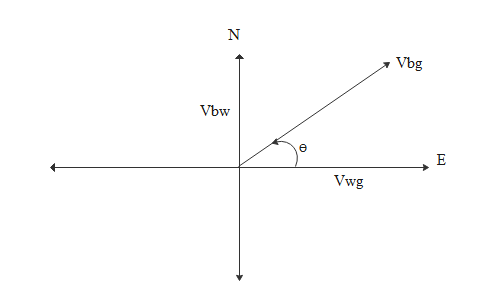
Here water is moving in east direction with respect to ground and its velocity is given by $\mathop {{V_{wg}}}\limits^ \to $ and velocity of boat with respect to still water in the sense velocity of boat with respect to water and is given by $\mathop {{V_{bw}}}\limits^ \to $ and we are asked to find out the velocity of boat with respect to ground $\mathop {{V_{bg}}}\limits^ \to $. By referring to the below diagram we get the clear idea.
So
$\mathop {{V_{bg}}}\limits^ \to = \mathop {{V_{bw}}}\limits^ \to + \mathop {{V_{wg}}}\limits^ \to $
$\mathop {{V_{bw}}}\limits^ \to = 20\mathop j\limits^ \wedge $ and $\mathop {{V_{wg}}}\limits^ \to = 5\mathop i\limits^ \wedge $
$\eqalign{
& \Rightarrow \tan \theta = \dfrac{{20\mathop j\limits^ \wedge }}{{5\mathop i\limits^ \wedge }} \cr
& \Rightarrow \theta = {\tan ^{ - 1}}\left( 4 \right) \cr} $
The direction of actual velocity of the boat with respect to ground is $\theta = {\tan ^{ - 1}}\left( 4 \right)$ north of east.
The magnitude of velocity of boat with respect to ground is
$\eqalign{
& \mathop {{V_{bg}}}\limits^ \to = \mathop {{V_{bw}}}\limits^ \to + \mathop {{V_{wg}}}\limits^ \to \cr
& \Rightarrow {V_{bg}} = \sqrt {{V_{bw}}^2 + {V_{wg}}^2} \cr
& \Rightarrow {V_{bg}} = \sqrt {{{20}^2} + {5^2}} \cr
& \therefore {V_{bg}} = 20.61km/hr \cr} $
Note:
Since the boat is trying to go exactly to the north, i.e to the shore, he is trying to cross the river in the shortest time. There are two conditions, one is the shortest time and the shortest path. In the shortest path the horizontal drift will be zero. In the shortest time the drift will not be zero but the time will be minimum.
Formula used:
$\mathop {{V_{bg}}}\limits^ \to = \mathop {{V_{bw}}}\limits^ \to + \mathop {{V_{wg}}}\limits^ \to $
Complete step by step answer:
This can be solved by using the relative velocity concept. We cannot absolutely tell whether the body is in motion or in rest. It depends on the observer's point of view. If the observer is moving then the body which is at rest with respect to ground will be under motion with respect to the moving observer. So everything is relative. Nothing is absolute.
Here water is moving in east direction with respect to ground and its velocity is given by $\mathop {{V_{wg}}}\limits^ \to $ and velocity of boat with respect to still water in the sense velocity of boat with respect to water and is given by $\mathop {{V_{bw}}}\limits^ \to $ and we are asked to find out the velocity of boat with respect to ground $\mathop {{V_{bg}}}\limits^ \to $. By referring to the below diagram we get the clear idea.
So
$\mathop {{V_{bg}}}\limits^ \to = \mathop {{V_{bw}}}\limits^ \to + \mathop {{V_{wg}}}\limits^ \to $
$\mathop {{V_{bw}}}\limits^ \to = 20\mathop j\limits^ \wedge $ and $\mathop {{V_{wg}}}\limits^ \to = 5\mathop i\limits^ \wedge $
$\eqalign{
& \Rightarrow \tan \theta = \dfrac{{20\mathop j\limits^ \wedge }}{{5\mathop i\limits^ \wedge }} \cr
& \Rightarrow \theta = {\tan ^{ - 1}}\left( 4 \right) \cr} $
The direction of actual velocity of the boat with respect to ground is $\theta = {\tan ^{ - 1}}\left( 4 \right)$ north of east.
The magnitude of velocity of boat with respect to ground is
$\eqalign{
& \mathop {{V_{bg}}}\limits^ \to = \mathop {{V_{bw}}}\limits^ \to + \mathop {{V_{wg}}}\limits^ \to \cr
& \Rightarrow {V_{bg}} = \sqrt {{V_{bw}}^2 + {V_{wg}}^2} \cr
& \Rightarrow {V_{bg}} = \sqrt {{{20}^2} + {5^2}} \cr
& \therefore {V_{bg}} = 20.61km/hr \cr} $
Note:
Since the boat is trying to go exactly to the north, i.e to the shore, he is trying to cross the river in the shortest time. There are two conditions, one is the shortest time and the shortest path. In the shortest path the horizontal drift will be zero. In the shortest time the drift will not be zero but the time will be minimum.
Recently Updated Pages
Master Class 11 Computer Science: Engaging Questions & Answers for Success

Master Class 11 Business Studies: Engaging Questions & Answers for Success
Master Class 11 Economics: Engaging Questions & Answers for Success
Master Class 11 English: Engaging Questions & Answers for Success
Master Class 11 Maths: Engaging Questions & Answers for Success
Master Class 11 Biology: Engaging Questions & Answers for Success
Trending doubts
One Metric ton is equal to kg A 10000 B 1000 C 100 class 11 physics CBSE
There are 720 permutations of the digits 1 2 3 4 5 class 11 maths CBSE
Discuss the various forms of bacteria class 11 biology CBSE
Draw a diagram of a plant cell and label at least eight class 11 biology CBSE
State the laws of reflection of light
Explain zero factorial class 11 maths CBSE