




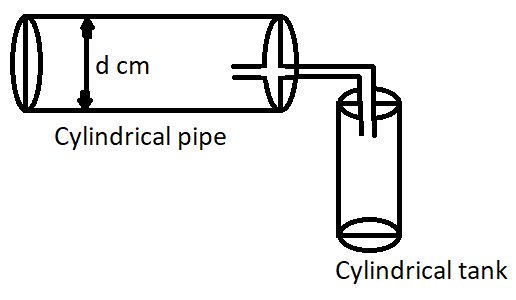
Water is flowing at the rate of 2.52Km/hr. through a cylindrical pipe into a cylindrical tank, the radius of base is 40cm. if the increase in the level of the water in the tank in half an hour is 3.25m, find the internal diameter of the pipe.
Solution –
Answer
 Verified
574k+ views
Hint: In this particular question use the concept that the volume of water fall in the cylindrical tank in half an hour is equal to the length of water in the cylindrical pipe in half an hour, where volume in the cylinder is given as $\pi {r^2}h$ so use these concepts to reach the solution of the question.
Complete step-by-step answer:
Given data,
Water is flowing at the rate of 2.52Km/hr. through a cylindrical pipe into a cylindrical tank.
So the length of the water column in a cylindrical pipe in half an hour = $2.52\left( {\dfrac{1}{2}} \right) = 1.26$Km.
As we know that 1 Km = 1000 m = 1000 (100) = 100000 cm.
So the length (h) of the water column in the cylindrical pipe in half an hour = 126000 cm.
Let the internal diameter of the cylindrical pipe be (d) cm.
As we know that the radius is half of the diameter.
So the radius of the cylindrical pipe, r = (d/2) cm.
Now as we know that the formula of volume of cylinder is = $\pi {r^2}h$, where r = radius of the cylinder and h = length or height of the cylinder.
So the volume of water that will flow through the cylindrical pipe
\[ \Rightarrow V = \pi \times {\left( {\dfrac{d}{2}} \right)^2} \times 126000{\text{ c}}{{\text{m}}^3}\]...................... (1)
Now it is given that this water falls into the cylindrical tank.
So increase in the water level in the cylindrical tank, h’ = 3.25 m = 325 cm.
Now it is given that the radius (r’) of base is 40 cm.
So the volume (V’) of the water that falls into the cylindrical tank = $\pi {\left( {r'} \right)^2}h'$ cubic Cm.
So the volume (V’) of the water that falls into the cylindrical tank = $\pi {\left( {40} \right)^2}325$ cubic Cm.......... (2)
Now the volume of the water that falls into the cylindrical tank = volume of length of water available in the cylindrical pipe in half an hour.
Therefore, V = V’
$ \Rightarrow \pi \times {\left( {\dfrac{d}{2}} \right)^2} \times 126000 = \pi {\left( {40} \right)^2}325$
Now simplify this we have,
$ \Rightarrow \dfrac{{{d^2}}}{4} = \dfrac{{{{\left( {40} \right)}^2}325}}{{126000}}$
$ \Rightarrow {d^2} = \dfrac{{4{{\left( {40} \right)}^2}325}}{{126000}} = 16.507$
Now take square root on both sides we have,
$ \Rightarrow d = \sqrt {16.507} = 4.063$ Cm
So this is the required internal diameter of the pipe.
Note – Whenever we face such types of questions the key concept we have to remember is that always recall the formula of the volume of the cylinder which is stated above then first find out the volume of water fall in the cylindrical tank in half an hour as above then calculate the length of water column in cylindrical pipe as above and then equate them and simplify we will get the required answer.
Complete step-by-step answer:
Given data,
Water is flowing at the rate of 2.52Km/hr. through a cylindrical pipe into a cylindrical tank.
So the length of the water column in a cylindrical pipe in half an hour = $2.52\left( {\dfrac{1}{2}} \right) = 1.26$Km.
As we know that 1 Km = 1000 m = 1000 (100) = 100000 cm.
So the length (h) of the water column in the cylindrical pipe in half an hour = 126000 cm.
Let the internal diameter of the cylindrical pipe be (d) cm.
As we know that the radius is half of the diameter.
So the radius of the cylindrical pipe, r = (d/2) cm.
Now as we know that the formula of volume of cylinder is = $\pi {r^2}h$, where r = radius of the cylinder and h = length or height of the cylinder.
So the volume of water that will flow through the cylindrical pipe
\[ \Rightarrow V = \pi \times {\left( {\dfrac{d}{2}} \right)^2} \times 126000{\text{ c}}{{\text{m}}^3}\]...................... (1)
Now it is given that this water falls into the cylindrical tank.
So increase in the water level in the cylindrical tank, h’ = 3.25 m = 325 cm.
Now it is given that the radius (r’) of base is 40 cm.
So the volume (V’) of the water that falls into the cylindrical tank = $\pi {\left( {r'} \right)^2}h'$ cubic Cm.
So the volume (V’) of the water that falls into the cylindrical tank = $\pi {\left( {40} \right)^2}325$ cubic Cm.......... (2)
Now the volume of the water that falls into the cylindrical tank = volume of length of water available in the cylindrical pipe in half an hour.
Therefore, V = V’
$ \Rightarrow \pi \times {\left( {\dfrac{d}{2}} \right)^2} \times 126000 = \pi {\left( {40} \right)^2}325$
Now simplify this we have,
$ \Rightarrow \dfrac{{{d^2}}}{4} = \dfrac{{{{\left( {40} \right)}^2}325}}{{126000}}$
$ \Rightarrow {d^2} = \dfrac{{4{{\left( {40} \right)}^2}325}}{{126000}} = 16.507$
Now take square root on both sides we have,
$ \Rightarrow d = \sqrt {16.507} = 4.063$ Cm
So this is the required internal diameter of the pipe.
Note – Whenever we face such types of questions the key concept we have to remember is that always recall the formula of the volume of the cylinder which is stated above then first find out the volume of water fall in the cylindrical tank in half an hour as above then calculate the length of water column in cylindrical pipe as above and then equate them and simplify we will get the required answer.
Recently Updated Pages
Master Class 12 Economics: Engaging Questions & Answers for Success

Master Class 12 Biology: Engaging Questions & Answers for Success
Master Class 11 English: Engaging Questions & Answers for Success
Master Class 11 Physics: Engaging Questions & Answers for Success
Master Class 11 Computer Science: Engaging Questions & Answers for Success
Master Class 11 Chemistry: Engaging Questions & Answers for Success
Trending doubts
What is the Total Duration of Football Match?
Explain the Treaty of Vienna of 1815 class 10 social science CBSE
In football, which nation is called "La Roja"?
Why is there a time difference of about 5 hours between class 10 social science CBSE
10 examples of evaporation in daily life with explanations
What is the full form of POSCO class 10 social science CBSE