




Why is water important to amphibians?
Answer
 Verified
519.3k+ views
Hint: Amphibians are vertebrates, having backbones. They are four-legged organisms, which are uniquely attached to water. They have to live in both land and water when developing into adults. Unlike fish, they breathe atmospheric oxygen through the lungs. They differ from reptiles in having soft, moist, and scale-less skin. They begin their lives in water and even adults, who stay in the land, have to return to the water for reproduction.
Complete answer:
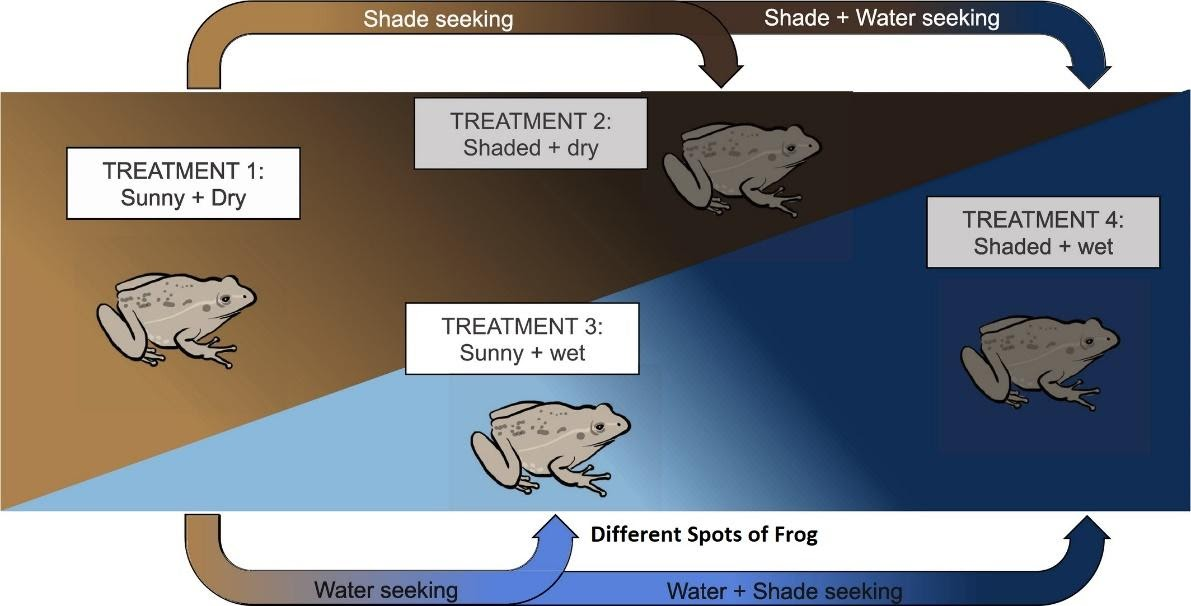
Fig.: Depending on the need, Change of Places for Frog
Water is a necessity for most amphibians. Amphibians are land animals, which have retained some aquatic adaptations, and thus, require water for several significant parts of their lifecycle and way of life. Amphibians require water for reproduction, feeding, respiration, etc. Their eggs are not watertight; hence they must be in or near water. Frogs, toads, salamanders, and newts all belong to amphibians.
Amphibians are tied to wet or moist environments for breathing; they depend on the health of that ecosystem for survival. Many of them are sensitive to levels of water and quality also. They lay eggs in water, hence young amphibians begin their life cycle as aquatic animals. Also for mating, they should be in the water.
They possess bony skeletons. Their eggs do not possess soft skin and a hard shell. So, females lay eggs in water, and babies called tadpoles or larvae live in water. They use gills for breathing and find food as fishes do.
The skin aids them to breathe, as oxygen easily passes through it. Amphibians lose a lot of water through the skin. They breathe and absorb water via their thin skin. So they are present in moist or wet environments, where they reload their water reserves.
Note:
Frogs absorb water through the skin rather than drinking. Though many frogs live in grassy areas or woodlands, eventually they return to ponds for breeding each year. They have specialized skin, which allows them to absorb oxygen from water or air, rather than breathing via gills or lungs. But it functions only when the skin is moist. If the skin becomes dry, they are unable to absorb oxygen.
Complete answer:
Fig.: Depending on the need, Change of Places for Frog
Water is a necessity for most amphibians. Amphibians are land animals, which have retained some aquatic adaptations, and thus, require water for several significant parts of their lifecycle and way of life. Amphibians require water for reproduction, feeding, respiration, etc. Their eggs are not watertight; hence they must be in or near water. Frogs, toads, salamanders, and newts all belong to amphibians.
Amphibians are tied to wet or moist environments for breathing; they depend on the health of that ecosystem for survival. Many of them are sensitive to levels of water and quality also. They lay eggs in water, hence young amphibians begin their life cycle as aquatic animals. Also for mating, they should be in the water.
They possess bony skeletons. Their eggs do not possess soft skin and a hard shell. So, females lay eggs in water, and babies called tadpoles or larvae live in water. They use gills for breathing and find food as fishes do.
The skin aids them to breathe, as oxygen easily passes through it. Amphibians lose a lot of water through the skin. They breathe and absorb water via their thin skin. So they are present in moist or wet environments, where they reload their water reserves.
Note:
Frogs absorb water through the skin rather than drinking. Though many frogs live in grassy areas or woodlands, eventually they return to ponds for breeding each year. They have specialized skin, which allows them to absorb oxygen from water or air, rather than breathing via gills or lungs. But it functions only when the skin is moist. If the skin becomes dry, they are unable to absorb oxygen.
Recently Updated Pages
Master Class 11 English: Engaging Questions & Answers for Success

Master Class 11 Social Science: Engaging Questions & Answers for Success
Master Class 11 Maths: Engaging Questions & Answers for Success
Master Class 11 Biology: Engaging Questions & Answers for Success
Master Class 11 Physics: Engaging Questions & Answers for Success
Master Class 11 Chemistry: Engaging Questions & Answers for Success
Trending doubts
One Metric ton is equal to kg A 10000 B 1000 C 100 class 11 physics CBSE
Difference Between Prokaryotic Cells and Eukaryotic Cells
Two of the body parts which do not appear in MRI are class 11 biology CBSE
Find the value of the expression given below sin 30circ class 11 maths CBSE
Draw a diagram of a plant cell and label at least eight class 11 biology CBSE
10 examples of friction in our daily life