




Water flows through the tube as shown in the figure. The areas of cross-section of the wide and the narrow portions of the tube are $5\,c{m^2}$ and $2\,c{m^2}$ respectively. The rate of flow of water through the tube is $500\,\dfrac{{c{m^3}}}{s}$. Find the difference of mercury levels in the U-tube.
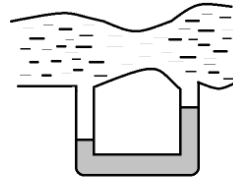
Answer
 Verified
571.8k+ views
Hint: In this question, we need to determine the difference of mercury levels in the U-tube. We will determine the area and velocity by using the continuous equation. Then by using Bernoulli’s equation we will determine the equation for $h$. Then, substitute the values and evaluate to determine the difference of mercury levels.
Complete step by step answer:
It is given that, the rate of flow of water through the tube=$500\,\dfrac{{c{m^3}}}{s}$
We know that, the rate of flow of water=$area(A) \times velocity(V)$
Now, by using continuity equation,
${A_1}{V_1} = {A_2}{V_2}$
It is given that the areas of cross-section of the wide and the narrow portions of the tube are $5\,c{m^2}$ and $2\,c{m^2}$ respectively.
Therefore, $5{V_1} = 2{V_2} = 500\,\dfrac{{c{m^3}}}{s}$
Then,${V_1} = \dfrac{{500}}{5}$
Therefore, ${V_1} = 100\,\dfrac{{cm}}{s}$ $ = 0.1\,\dfrac{m}{s}$
Also, ${V_2} = \dfrac{{500}}{2}$
${V_2} = 250\,\dfrac{{cm}}{s}$ $ = 2.5\,\dfrac{m}{s}$
Let the pressure at the wide section=${p_A}$
And, the pressure at narrow section=${p_B}$
Now, by using Bernoulli’s equation, we have,
${p_A} + \dfrac{1}{2}{\rho _W}{V_A}^2 = {p_B} + \dfrac{1}{2}{\rho _W}{V_B}^2$
$\Rightarrow{p_A} - {p_B} = \dfrac{1}{2}{\rho _W}\left( {{V_B}^2 - {V_A}^2} \right)$
Since, the difference in pressure at two points i.e.,${p_A} - {p_B} = {\rho _{{H_g}}}gh$
Let the difference in height levels of mercury=$h$
And,${\rho _{{H_g}}}$ is the density of mercury
${\rho _{{H_g}}}gh = \dfrac{1}{2}{\rho _W}\left( {{V_2}^2 - {V_1}^2} \right)$
Therefore, $h = \dfrac{{{\rho _W}\left( {{V_2}^2 - {V_1}^2} \right)}}{{2{\rho _{{H_g}}}g}}$
Now, by substituting the values, we have,
$h= \dfrac{{{{10}^3}\left( {6.25 - 1} \right)}}{{2 \times 13.6 \times {{10}^3} \times 9.8}}$
$\Rightarrow h = 0.0196\,m$
$\therefore h = 1.96\,cm$
Hence, the difference of mercury levels in the U-tube is $1.96\,cm$.
Note: It is important here to note that, whenever these types of problems are given first, determine the area and velocity then, apply Bernoulli’s equation and solve it. The continuous equation is nothing but it describes the transport of some quantity i.e., the product of cross-sectional area and the velocity which is a constant.
Complete step by step answer:
It is given that, the rate of flow of water through the tube=$500\,\dfrac{{c{m^3}}}{s}$
We know that, the rate of flow of water=$area(A) \times velocity(V)$
Now, by using continuity equation,
${A_1}{V_1} = {A_2}{V_2}$
It is given that the areas of cross-section of the wide and the narrow portions of the tube are $5\,c{m^2}$ and $2\,c{m^2}$ respectively.
Therefore, $5{V_1} = 2{V_2} = 500\,\dfrac{{c{m^3}}}{s}$
Then,${V_1} = \dfrac{{500}}{5}$
Therefore, ${V_1} = 100\,\dfrac{{cm}}{s}$ $ = 0.1\,\dfrac{m}{s}$
Also, ${V_2} = \dfrac{{500}}{2}$
${V_2} = 250\,\dfrac{{cm}}{s}$ $ = 2.5\,\dfrac{m}{s}$
Let the pressure at the wide section=${p_A}$
And, the pressure at narrow section=${p_B}$
Now, by using Bernoulli’s equation, we have,
${p_A} + \dfrac{1}{2}{\rho _W}{V_A}^2 = {p_B} + \dfrac{1}{2}{\rho _W}{V_B}^2$
$\Rightarrow{p_A} - {p_B} = \dfrac{1}{2}{\rho _W}\left( {{V_B}^2 - {V_A}^2} \right)$
Since, the difference in pressure at two points i.e.,${p_A} - {p_B} = {\rho _{{H_g}}}gh$
Let the difference in height levels of mercury=$h$
And,${\rho _{{H_g}}}$ is the density of mercury
${\rho _{{H_g}}}gh = \dfrac{1}{2}{\rho _W}\left( {{V_2}^2 - {V_1}^2} \right)$
Therefore, $h = \dfrac{{{\rho _W}\left( {{V_2}^2 - {V_1}^2} \right)}}{{2{\rho _{{H_g}}}g}}$
Now, by substituting the values, we have,
$h= \dfrac{{{{10}^3}\left( {6.25 - 1} \right)}}{{2 \times 13.6 \times {{10}^3} \times 9.8}}$
$\Rightarrow h = 0.0196\,m$
$\therefore h = 1.96\,cm$
Hence, the difference of mercury levels in the U-tube is $1.96\,cm$.
Note: It is important here to note that, whenever these types of problems are given first, determine the area and velocity then, apply Bernoulli’s equation and solve it. The continuous equation is nothing but it describes the transport of some quantity i.e., the product of cross-sectional area and the velocity which is a constant.
Recently Updated Pages
Basicity of sulphurous acid and sulphuric acid are

Master Class 11 Business Studies: Engaging Questions & Answers for Success
Master Class 11 Computer Science: Engaging Questions & Answers for Success
Master Class 11 Economics: Engaging Questions & Answers for Success
Master Class 11 Social Science: Engaging Questions & Answers for Success
Master Class 11 English: Engaging Questions & Answers for Success
Trending doubts
One Metric ton is equal to kg A 10000 B 1000 C 100 class 11 physics CBSE
The largest wind power cluster is located in the state class 11 social science CBSE
Explain zero factorial class 11 maths CBSE
State and prove Bernoullis theorem class 11 physics CBSE
Which among the following are examples of coming together class 11 social science CBSE
Can anyone list 10 advantages and disadvantages of friction