




Water flows at the rate of $10\text{ m/minute}$ through a cylindrical pipe $5mm$ in diameter. How long would it take to fill a conical vessel whose diameter at the base is $40cm$ and depth $24cm$?
Answer
 Verified
570.6k+ views
Hint: For answering this question we will use the given information and find the volume of the conical vessel which is given as $\pi {{r}^{2}}\dfrac{h}{3}$ and by assuming the time as $t$ and derive the volume of the water flowing which is given as $\pi {{r}^{2}}l$ and equate both of them.
Complete step-by-step solution
Now consider the question it is given that the rate of water flow is $10\text{ m/minute}$.
Given that the diameter of the cylindrical pipe is $5mm$ this implies that the radius will be $\dfrac{5}{2}mm$.
It would be convenient if all the units are the same so we will say that the radius of the cylindrical pipe is $\dfrac{5}{2}\times {{10}^{-3}}m$.
Now the length of the pipe containing water for $t$ seconds is given as $10t$ because the rate is $\text{10 m/minute}$.
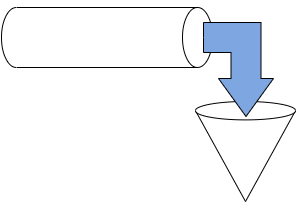
So the volume of water flowing into the conical vessel is equal to the volume of the cylindrical pipe which is mathematically given as $\pi {{r}^{2}}l$ which is equal to $\pi {{\left( \dfrac{5}{2}\times {{10}^{-3}} \right)}^{2}}\left( 10t \right)$.
And here we need the time taken to fill the conical vessel whose diameter is $40cm$ and depth is $24cm$.
When the conical vessel is completely filled the volume of the conical vessel will be equal to the volume of water flowing.
Volume of conical vessel is given as $\pi {{r}^{2}}\dfrac{h}{3}$ which is equal to $\pi {{\left( 20\times {{10}^{-2}} \right)}^{2}}\left( \dfrac{24\times {{10}^{-2}}}{3} \right)$ .
By equating them we will have $\pi {{\left( \dfrac{5}{2}\times {{10}^{-3}} \right)}^{2}}\left( 10t \right)=\pi {{\left( 20\times {{10}^{-2}} \right)}^{2}}\left( \dfrac{24\times {{10}^{-2}}}{3} \right)$ .
By simplifying this we will have
$\begin{align}
& \Rightarrow {{\left( \dfrac{5}{2} \right)}^{2}}\times {{10}^{-6}}\left( 10t \right)={{\left( 20 \right)}^{2}}\left( \dfrac{24}{3} \right)\times {{10}^{-6}} \\
& \Rightarrow {{\left( \dfrac{5}{2} \right)}^{2}}\left( 10t \right)={{\left( 20 \right)}^{2}}\times 8 \\
\end{align}$.
By further simplifying this we will have
$\begin{align}
& \left( t \right)=\dfrac{{{\left( 20 \right)}^{2}}\times 8}{10}\times {{\left( \dfrac{2}{5} \right)}^{2}} \\
& \Rightarrow t=\dfrac{400\times 8\times 4}{10\times 25} \\
& \Rightarrow t=\dfrac{256}{5}=51\dfrac{1}{5}\min \\
\end{align}$ .
Since $1\min =60\sec $ we can write $\dfrac{1}{5}\min =12\sec $ .
So $t=51\min 12\sec $ .
Therefore we conclude that when water flows at the rate of $10\text{ m/minute}$ through a cylindrical pipe $5mm$ in diameter into a conical vessel whose diameter at the base is $40cm$ and depth $24cm$, it will take $51\min 12\sec $ to fill it completely.
Note: The important fact is that when the conical vessel is completely filled the volume of the conical vessel will be equal to the volume of water flowing. In questions of this type, care should be taken during unit conversions. The formulas to be remembered for solving this question are the volume of water flowing into the conical vessel given by $\pi {{r}^{2}}l$ and the volume of the conical vessel is given by $\pi {{r}^{2}}\dfrac{h}{3}$. Here rate signifies the length of water flowing through the pipe per minute of time.
Complete step-by-step solution
Now consider the question it is given that the rate of water flow is $10\text{ m/minute}$.
Given that the diameter of the cylindrical pipe is $5mm$ this implies that the radius will be $\dfrac{5}{2}mm$.
It would be convenient if all the units are the same so we will say that the radius of the cylindrical pipe is $\dfrac{5}{2}\times {{10}^{-3}}m$.
Now the length of the pipe containing water for $t$ seconds is given as $10t$ because the rate is $\text{10 m/minute}$.
So the volume of water flowing into the conical vessel is equal to the volume of the cylindrical pipe which is mathematically given as $\pi {{r}^{2}}l$ which is equal to $\pi {{\left( \dfrac{5}{2}\times {{10}^{-3}} \right)}^{2}}\left( 10t \right)$.
And here we need the time taken to fill the conical vessel whose diameter is $40cm$ and depth is $24cm$.
When the conical vessel is completely filled the volume of the conical vessel will be equal to the volume of water flowing.
Volume of conical vessel is given as $\pi {{r}^{2}}\dfrac{h}{3}$ which is equal to $\pi {{\left( 20\times {{10}^{-2}} \right)}^{2}}\left( \dfrac{24\times {{10}^{-2}}}{3} \right)$ .
By equating them we will have $\pi {{\left( \dfrac{5}{2}\times {{10}^{-3}} \right)}^{2}}\left( 10t \right)=\pi {{\left( 20\times {{10}^{-2}} \right)}^{2}}\left( \dfrac{24\times {{10}^{-2}}}{3} \right)$ .
By simplifying this we will have
$\begin{align}
& \Rightarrow {{\left( \dfrac{5}{2} \right)}^{2}}\times {{10}^{-6}}\left( 10t \right)={{\left( 20 \right)}^{2}}\left( \dfrac{24}{3} \right)\times {{10}^{-6}} \\
& \Rightarrow {{\left( \dfrac{5}{2} \right)}^{2}}\left( 10t \right)={{\left( 20 \right)}^{2}}\times 8 \\
\end{align}$.
By further simplifying this we will have
$\begin{align}
& \left( t \right)=\dfrac{{{\left( 20 \right)}^{2}}\times 8}{10}\times {{\left( \dfrac{2}{5} \right)}^{2}} \\
& \Rightarrow t=\dfrac{400\times 8\times 4}{10\times 25} \\
& \Rightarrow t=\dfrac{256}{5}=51\dfrac{1}{5}\min \\
\end{align}$ .
Since $1\min =60\sec $ we can write $\dfrac{1}{5}\min =12\sec $ .
So $t=51\min 12\sec $ .
Therefore we conclude that when water flows at the rate of $10\text{ m/minute}$ through a cylindrical pipe $5mm$ in diameter into a conical vessel whose diameter at the base is $40cm$ and depth $24cm$, it will take $51\min 12\sec $ to fill it completely.
Note: The important fact is that when the conical vessel is completely filled the volume of the conical vessel will be equal to the volume of water flowing. In questions of this type, care should be taken during unit conversions. The formulas to be remembered for solving this question are the volume of water flowing into the conical vessel given by $\pi {{r}^{2}}l$ and the volume of the conical vessel is given by $\pi {{r}^{2}}\dfrac{h}{3}$. Here rate signifies the length of water flowing through the pipe per minute of time.
Recently Updated Pages
Master Class 10 Computer Science: Engaging Questions & Answers for Success

Master Class 10 General Knowledge: Engaging Questions & Answers for Success
Master Class 10 English: Engaging Questions & Answers for Success
Master Class 10 Social Science: Engaging Questions & Answers for Success
Master Class 10 Maths: Engaging Questions & Answers for Success
Master Class 10 Science: Engaging Questions & Answers for Success
Trending doubts
What is the median of the first 10 natural numbers class 10 maths CBSE
Which women's tennis player has 24 Grand Slam singles titles?
Who is the Brand Ambassador of Incredible India?
Why is there a time difference of about 5 hours between class 10 social science CBSE
Write a letter to the principal requesting him to grant class 10 english CBSE
A moving boat is observed from the top of a 150 m high class 10 maths CBSE