




Why is Voltmeter connected in parallel?
Answer
 Verified
563.1k+ views
Hint: In order to answer the above question, we will learn about the voltmeter which is an electric device used to measure voltage across two points in a circuit. We will try to understand the working of this device and reach our answer.
Complete step by step solution:
As we know that the voltmeter is an instrument that calculates the voltage or potential difference in volts. It operates on the principle that the torque is produced by the current that is induced by the measurands voltage, and that this torque deflects the instrument's pointer. The pointer's deflection is proportional to the potential difference between the two lines. The voltmeter is always attached to the circuit in parallel.
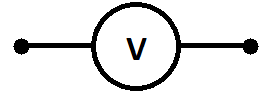
The voltmeter is represented by the alphabet \[V\] inside the circle
We can say that the voltmeter is designed in such a way that its internal resistance is always high. When it is connected in series with the circuit, it reduces the amount of current that flows as a result of the measurands voltage. As a result, the voltmeter's reading will be thrown off.
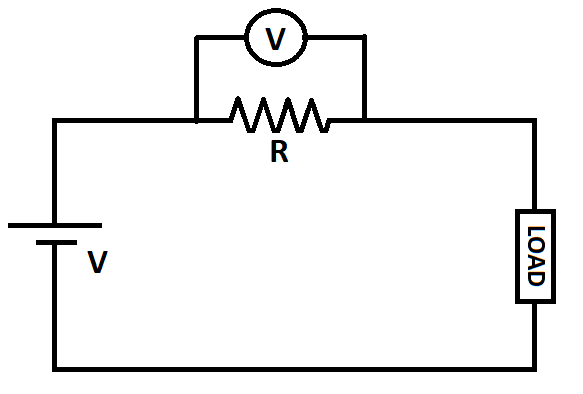
The voltmeter is often connected in parallel with the circuit, resulting in the same voltage drop. The voltmeter's high resistance combines with the impedance of the element it is attached to. And the system's total impedance is the same as the element's impedance. As a result, the voltmeter does not create any obstruction in the circuit, and the metre gives the right reading.
Note:
Since it tests the potential difference between the two points of the circuit, the voltmeter has a very high internal resistance. The current of the measuring unit is unaffected by the voltmeter. The current will pass through the voltmeter if it has a low resistance, and the voltmeter gives an incorrect reading. The voltmeter's high resistance prevents current from passing through it, resulting in the right reading.
Complete step by step solution:
As we know that the voltmeter is an instrument that calculates the voltage or potential difference in volts. It operates on the principle that the torque is produced by the current that is induced by the measurands voltage, and that this torque deflects the instrument's pointer. The pointer's deflection is proportional to the potential difference between the two lines. The voltmeter is always attached to the circuit in parallel.
The voltmeter is represented by the alphabet \[V\] inside the circle
We can say that the voltmeter is designed in such a way that its internal resistance is always high. When it is connected in series with the circuit, it reduces the amount of current that flows as a result of the measurands voltage. As a result, the voltmeter's reading will be thrown off.
The voltmeter is often connected in parallel with the circuit, resulting in the same voltage drop. The voltmeter's high resistance combines with the impedance of the element it is attached to. And the system's total impedance is the same as the element's impedance. As a result, the voltmeter does not create any obstruction in the circuit, and the metre gives the right reading.
Note:
Since it tests the potential difference between the two points of the circuit, the voltmeter has a very high internal resistance. The current of the measuring unit is unaffected by the voltmeter. The current will pass through the voltmeter if it has a low resistance, and the voltmeter gives an incorrect reading. The voltmeter's high resistance prevents current from passing through it, resulting in the right reading.
Recently Updated Pages
Master Class 12 Business Studies: Engaging Questions & Answers for Success

Master Class 12 Chemistry: Engaging Questions & Answers for Success
Master Class 12 Biology: Engaging Questions & Answers for Success
Class 12 Question and Answer - Your Ultimate Solutions Guide
Master Class 11 English: Engaging Questions & Answers for Success
Master Class 11 Social Science: Engaging Questions & Answers for Success
Trending doubts
Which are the Top 10 Largest Countries of the World?
Draw a labelled sketch of the human eye class 12 physics CBSE
The end of compass needle which points towards north class 12 physics CBSE
Differentiate between homogeneous and heterogeneous class 12 chemistry CBSE
In order to find out the different types of gametes class 12 biology NEET_UG
Why is the cell called the structural and functional class 12 biology CBSE