




Virion is a/an
(A)Virus without a protein coat
(B)Enucleated virus
(C) Prion
(D)Virus
Answer
 Verified
578.4k+ views
Hint: Virion is an entire particle of an infecting agent that is covered with the protein coat, which is able to replicate only in the living body, and can't replicate outside the host body.
Complete answer:
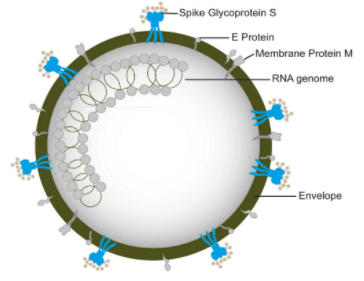
Virion is a complete viral particle consisting of RNA or DNA surrounded by a shell made up of protein, constituting the infective form of a virus. A virus is a type of submicroscopic infective agent which only replicates inside the living cells of an organism. All life forms that include plants and animals are all infected by viruses, even bacteria and archaea also get infected.
Additional Information: A particle of virus having an outer shell made of a protein called capsid while an inner core is made up of genetic material like DNA or RNA macromolecule (either ribonucleic or deoxyribonucleic acid). The core confers infectivity, and therefore the capsid provides specificity to the virus. The capsid in the case of some virions is also covered by a fatty membrane which may make the virus inactivated when it is exposed to the ether and chloroform that are fat solvents. The virions are of specialized shapes that include spheroidal in shape, but in general, they are actually icosahedral (the capsid having 20 triangular faces)—with regularly arranged units called capsomeres, that are two to 5, or more in number along all sides. The macromolecule is densely coiled within. Other virions have a capsid consisting of an irregular number of surface spikes, with the macromolecule loosely coiled within. Virions of most of the plant viruses are rod-shaped; the capsid may be a naked cylinder (lacking a fatty membrane) within which lies a straight or helical rod of the macromolecule.
So, the correct answer is ‘Virus’.
Note: A prion is a sort of protein that will trigger normal proteins within the brain to fold abnormally. Prion diseases can affect anyone i.e both humans and animals and are sometimes spread to humans by infected meat products. The foremost common sort of prion disease that affects humans is Creutzfeldt-Jakob disease (CJD).
Complete answer:
Virion is a complete viral particle consisting of RNA or DNA surrounded by a shell made up of protein, constituting the infective form of a virus. A virus is a type of submicroscopic infective agent which only replicates inside the living cells of an organism. All life forms that include plants and animals are all infected by viruses, even bacteria and archaea also get infected.
Additional Information: A particle of virus having an outer shell made of a protein called capsid while an inner core is made up of genetic material like DNA or RNA macromolecule (either ribonucleic or deoxyribonucleic acid). The core confers infectivity, and therefore the capsid provides specificity to the virus. The capsid in the case of some virions is also covered by a fatty membrane which may make the virus inactivated when it is exposed to the ether and chloroform that are fat solvents. The virions are of specialized shapes that include spheroidal in shape, but in general, they are actually icosahedral (the capsid having 20 triangular faces)—with regularly arranged units called capsomeres, that are two to 5, or more in number along all sides. The macromolecule is densely coiled within. Other virions have a capsid consisting of an irregular number of surface spikes, with the macromolecule loosely coiled within. Virions of most of the plant viruses are rod-shaped; the capsid may be a naked cylinder (lacking a fatty membrane) within which lies a straight or helical rod of the macromolecule.
So, the correct answer is ‘Virus’.
Note: A prion is a sort of protein that will trigger normal proteins within the brain to fold abnormally. Prion diseases can affect anyone i.e both humans and animals and are sometimes spread to humans by infected meat products. The foremost common sort of prion disease that affects humans is Creutzfeldt-Jakob disease (CJD).
Recently Updated Pages
Master Class 11 Computer Science: Engaging Questions & Answers for Success

Master Class 11 Business Studies: Engaging Questions & Answers for Success
Master Class 11 Economics: Engaging Questions & Answers for Success
Master Class 11 English: Engaging Questions & Answers for Success
Master Class 11 Maths: Engaging Questions & Answers for Success
Master Class 11 Biology: Engaging Questions & Answers for Success
Trending doubts
One Metric ton is equal to kg A 10000 B 1000 C 100 class 11 physics CBSE
There are 720 permutations of the digits 1 2 3 4 5 class 11 maths CBSE
Discuss the various forms of bacteria class 11 biology CBSE
Draw a diagram of a plant cell and label at least eight class 11 biology CBSE
State the laws of reflection of light
Explain zero factorial class 11 maths CBSE