




Vinegar is a dilute aqueous solution of which acid.
Answer
 Verified
539.7k+ views
Hint: Dilute acetic acid solution is called vinegar. The IUPAC name of acetic acid is ethanoic acid which contains carboxylic acid as a functional group. Acids are sour in taste and have a pungent smell.
Complete answer:
Vinegar is a dilute aqueous solution of acetic acid. As vinegar contains acid and thus it is sour in taste and has a pungent smell. Approximate 5 % of acetic acid is added into 95 % of water to make vinegar. The chemical formula of acetic acid is \[C{{H}_{3}}COOH\] and its structure is given as follows:
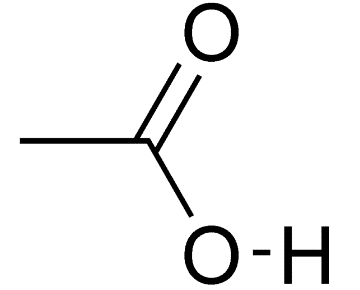
From the above structure, we conclude that carboxylic acid is present as a functional group in acetic acid. The IUPAC name of acetic acid is ethanoic acid.
Additional Information:
The word “Vinegar” is derived from latin in which “vin” refers to wine and “egar” refers to sour. Vinegar is commercially synthesized by the fermentation of sugar in the presence of yeast. Vinegar has antibacterial properties and that’s why it is used as a preservative in the kitchen in order to inhibit food spoilage. For instance, vinegar is used as a preservative in making pickles. Moreover, this antibacterial property of vinegar is also utilized in farms to inhibit bacterial and fungal growth.
Note:
It is important to note that vinegar is a dilute aqueous solution of acetic acid or ethanoic acid. Approximate 5 % of acetic acid is added into 95 % of water to make vinegar. Vinegar has a wide range of applications in everyday life especially in cooking, baking, in making pickles, in cleaning and so on.
Complete answer:
Vinegar is a dilute aqueous solution of acetic acid. As vinegar contains acid and thus it is sour in taste and has a pungent smell. Approximate 5 % of acetic acid is added into 95 % of water to make vinegar. The chemical formula of acetic acid is \[C{{H}_{3}}COOH\] and its structure is given as follows:
From the above structure, we conclude that carboxylic acid is present as a functional group in acetic acid. The IUPAC name of acetic acid is ethanoic acid.
Additional Information:
The word “Vinegar” is derived from latin in which “vin” refers to wine and “egar” refers to sour. Vinegar is commercially synthesized by the fermentation of sugar in the presence of yeast. Vinegar has antibacterial properties and that’s why it is used as a preservative in the kitchen in order to inhibit food spoilage. For instance, vinegar is used as a preservative in making pickles. Moreover, this antibacterial property of vinegar is also utilized in farms to inhibit bacterial and fungal growth.
Note:
It is important to note that vinegar is a dilute aqueous solution of acetic acid or ethanoic acid. Approximate 5 % of acetic acid is added into 95 % of water to make vinegar. Vinegar has a wide range of applications in everyday life especially in cooking, baking, in making pickles, in cleaning and so on.
Recently Updated Pages
Master Class 12 Economics: Engaging Questions & Answers for Success

Master Class 12 English: Engaging Questions & Answers for Success
Master Class 12 Social Science: Engaging Questions & Answers for Success
Master Class 12 Maths: Engaging Questions & Answers for Success
Master Class 12 Physics: Engaging Questions & Answers for Success
Master Class 9 General Knowledge: Engaging Questions & Answers for Success
Trending doubts
One Metric ton is equal to kg A 10000 B 1000 C 100 class 11 physics CBSE
Difference Between Prokaryotic Cells and Eukaryotic Cells
Two of the body parts which do not appear in MRI are class 11 biology CBSE
Find the value of the expression given below sin 30circ class 11 maths CBSE
1 ton equals to A 100 kg B 1000 kg C 10 kg D 10000 class 11 physics CBSE
Draw a diagram of nephron and explain its structur class 11 biology CBSE