




Verify the Euler’s formula for the given solid.
Answer
 Verified
588.5k+ views
Hint: Use the Euler’s Formula (i.e. F +V = E + 2), where F is the total number of Faces in the given solid, V is the total number of the vertices and E is the total number of edges. Count all the faces, vertices and the edges, and to verify the Left-Hand side of Euler’s formula equal to the Right-Hand side of the formula.
Complete step by step answer:
We know that the Euler’s formula is given as:
F +V = E + 2 where, F is the total number of Faces in the given solid.
V is the total number of the vertices.
E is the total number of edges.
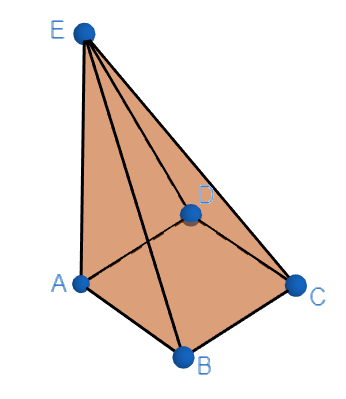
The above given solid is a pyramid whose base is rectangle.
The blue dots in the given figure donates vertices (i.e. corner) of the pyramid.
So, the vertices of the given solid are A, B, C, D, E.
Hence, total number of vertices = 5 = V
Edges of the given solid are AB, BC, CD, AD, DE, AE, BE, CE.
Hence, total number of edges = 8 = E
Now, the faces of the given solid are $\square ABCD,\vartriangle ABE,\vartriangle BCE,\vartriangle CDE,\vartriangle ADE$.
Hence, total number of faces = 5 = F
Now, from Euler’s formula, we know that:
F +V = E + 2
By putting the value of F, V, E in the above equation, we will get:
\[\Rightarrow 5+5=8+2\]
$\Rightarrow 10=10$
Since, we see that the Left-Hand side of the above equation is equal to the Right-Hand side.
So, Euler’s formula is true for the above given solid.
Hence, verified.
Note: Students usually make mistakes while counting the number of edges, and faces of 3-D figures, because edges and faces usually overlap over each other, when we plot a solid on a plane and they seem to us like they are a single edge or a single face.
Complete step by step answer:
We know that the Euler’s formula is given as:
F +V = E + 2 where, F is the total number of Faces in the given solid.
V is the total number of the vertices.
E is the total number of edges.
The above given solid is a pyramid whose base is rectangle.
The blue dots in the given figure donates vertices (i.e. corner) of the pyramid.
So, the vertices of the given solid are A, B, C, D, E.
Hence, total number of vertices = 5 = V
Edges of the given solid are AB, BC, CD, AD, DE, AE, BE, CE.
Hence, total number of edges = 8 = E
Now, the faces of the given solid are $\square ABCD,\vartriangle ABE,\vartriangle BCE,\vartriangle CDE,\vartriangle ADE$.
Hence, total number of faces = 5 = F
Now, from Euler’s formula, we know that:
F +V = E + 2
By putting the value of F, V, E in the above equation, we will get:
\[\Rightarrow 5+5=8+2\]
$\Rightarrow 10=10$
Since, we see that the Left-Hand side of the above equation is equal to the Right-Hand side.
So, Euler’s formula is true for the above given solid.
Hence, verified.
Note: Students usually make mistakes while counting the number of edges, and faces of 3-D figures, because edges and faces usually overlap over each other, when we plot a solid on a plane and they seem to us like they are a single edge or a single face.
Recently Updated Pages
Find the greatest six digit number that is exactly class 8 maths CBSE

What is the time difference between India and Cana class 8 social science CBSE
Compare LPG and wood as fuels class 8 chemistry CBSE
In Indian rupees 1 trillion is equal to how many c class 8 maths CBSE
30 opposite words in English from a to z class 8 english CBSE
How many cubic feet equals to 1 unit sand class 8 maths CBSE
Trending doubts
What is BLO What is the full form of BLO class 8 social science CBSE
Citizens of India can vote at the age of A 18 years class 8 social science CBSE
Full form of STD, ISD and PCO
One cusec is equal to how many liters class 8 maths CBSE
What are the methods of reducing friction. Explain
What is the difference between rai and mustard see class 8 biology CBSE