




How do you verify that resistance of a conductor of uniform cross-section area is
proportional to the length of the conductor at constant temperature.
Answer
 Verified
584.7k+ views
Hint: In this solution, we can verify the required statement by using a simple experiment with the
help of wire, key, ammeter and battery.
Complete step-by-step answer:
Resistance: In an electrical circuit, resistance is a function of opposition to current flow.
Resistance is expressed in ohms, symbolized by the omega (Greek) letter. Conductors: Materials
providing very little resistance where electrons can easily pass.
Conductor: A conductor is an entity or type of material in physics and electrical engineering that
allows the flow of charge (electrical current) in one or more directions. Metal materials are
common conductors of electrical appliances. Electrical conductors allow electrons to flow inside
the conduction band between the atoms of that material with drift speed. Metals, metal alloy,
electrolyte or other non-metals such as graphite and conductive polymer can be the electrical
conductors.
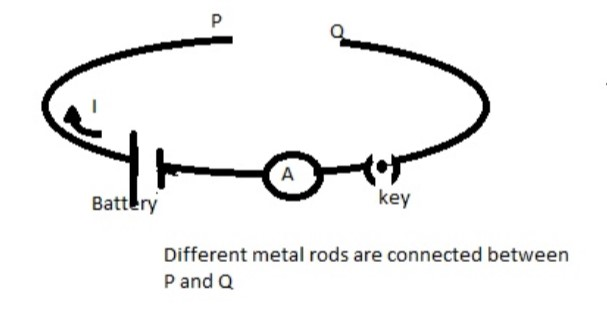
A conductor's resistance means the impediment produced in electrons flow or current flow.
Naturally, the longer the driver's range, the greater the resistance provided to keep the driver's
area stable and at the same temperature. To check this, take a wire of length $l$ of some area and
find its resistance ${\rm{R}}$ at some temperature and at the same temperature takes a $2l$ length
of the same wire again, the resistance will come as$2{\rm{R}}$.
Hence, $R \propto l$ at constant temperature.
Note: To verify this statement, observe the current flow or electron flow, note ammeter reading, and
perceive the battery percentage is required.
help of wire, key, ammeter and battery.
Complete step-by-step answer:
Resistance: In an electrical circuit, resistance is a function of opposition to current flow.
Resistance is expressed in ohms, symbolized by the omega (Greek) letter. Conductors: Materials
providing very little resistance where electrons can easily pass.
Conductor: A conductor is an entity or type of material in physics and electrical engineering that
allows the flow of charge (electrical current) in one or more directions. Metal materials are
common conductors of electrical appliances. Electrical conductors allow electrons to flow inside
the conduction band between the atoms of that material with drift speed. Metals, metal alloy,
electrolyte or other non-metals such as graphite and conductive polymer can be the electrical
conductors.
A conductor's resistance means the impediment produced in electrons flow or current flow.
Naturally, the longer the driver's range, the greater the resistance provided to keep the driver's
area stable and at the same temperature. To check this, take a wire of length $l$ of some area and
find its resistance ${\rm{R}}$ at some temperature and at the same temperature takes a $2l$ length
of the same wire again, the resistance will come as$2{\rm{R}}$.
Hence, $R \propto l$ at constant temperature.
Note: To verify this statement, observe the current flow or electron flow, note ammeter reading, and
perceive the battery percentage is required.
Recently Updated Pages
Master Class 10 Computer Science: Engaging Questions & Answers for Success

Master Class 10 General Knowledge: Engaging Questions & Answers for Success
Master Class 10 English: Engaging Questions & Answers for Success
Master Class 10 Social Science: Engaging Questions & Answers for Success
Master Class 10 Maths: Engaging Questions & Answers for Success
Master Class 10 Science: Engaging Questions & Answers for Success
Trending doubts
What is the median of the first 10 natural numbers class 10 maths CBSE
Which women's tennis player has 24 Grand Slam singles titles?
Who is the Brand Ambassador of Incredible India?
Why is there a time difference of about 5 hours between class 10 social science CBSE
Write a letter to the principal requesting him to grant class 10 english CBSE
A moving boat is observed from the top of a 150 m high class 10 maths CBSE