




Verify Rolle’s theorem for the following function on the indicated interval
$f\left( x \right)={{x}^{2}}+5x+6\text{ on }\left[ -3,-2 \right]$
Answer
 Verified
627.6k+ views
Hint: Recall the conditions of Rolle’s theorem. Verify whether those conditions are satisfied. If they are satisfied, recall the guarantee of Rolle's theorem. Check whether the guarantee is true for the above function. Hence verify Rolle’s theorem.
Complete step-by-step answer:
Rolle’s theorem: If f(x) is a function such that:
[1] f(x) is continuous in the interval [a,b]
[2] Derivable in the interval (a,b)
[3] f(a) = f(b)
then there exists c such that aHere $f\left( x \right)={{x}^{2}}+5x+6$
Since f(x) is a polynomial and polynomials are continuous for all real x, we have
f(x) is continuous in [-3,-2].
Also f’(x) = 2x+5 is a polynomial in x and hence is continuous in (-3,-2).
Hence f(x) is differentiable in (-3,-2) [Because if the derivative of a function is continuous in an interval, then the function is differentiable in that interval].
Also f(-3) $={{\left( -3 \right)}^{2}}+5\left( -3 \right)+6=9-15+6=0$ and f(-2) $={{\left( -2 \right)}^{2}}+5\left( -2 \right)+6=4-10+6=0$, we have f(-3) = f(-2) = 0.
Hence all conditions of Rolle’s theorem are satisfied. Hence there exists a real number c such that -3 < c < -2 such that
f’(c)=0.
Now f’(c)=2c+5=0
Hence 2c =-5
i.e. $c=-\dfrac{5}{2}$
i.e. c=-2.5.
Now since
-3 <-2.5< -2.
Hence there exists a c = -2.5 such that -3< c < -2 and f’(c) =0.
Note: [1] Rolle’s theorem guarantees the existence of one such “c”, however, does not say anything about the number of such “c”. Hence there may exist more than one such “c” which satisfy the above conditions as in the following graph.
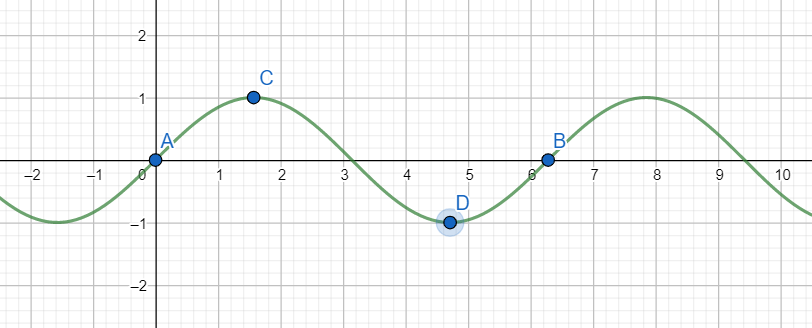
In the interval [A, B] there exist two points C and D at which the derivative of the above function vanishes.
Complete step-by-step answer:
Rolle’s theorem: If f(x) is a function such that:
[1] f(x) is continuous in the interval [a,b]
[2] Derivable in the interval (a,b)
[3] f(a) = f(b)
then there exists c such that a
Since f(x) is a polynomial and polynomials are continuous for all real x, we have
f(x) is continuous in [-3,-2].
Also f’(x) = 2x+5 is a polynomial in x and hence is continuous in (-3,-2).
Hence f(x) is differentiable in (-3,-2) [Because if the derivative of a function is continuous in an interval, then the function is differentiable in that interval].
Also f(-3) $={{\left( -3 \right)}^{2}}+5\left( -3 \right)+6=9-15+6=0$ and f(-2) $={{\left( -2 \right)}^{2}}+5\left( -2 \right)+6=4-10+6=0$, we have f(-3) = f(-2) = 0.
Hence all conditions of Rolle’s theorem are satisfied. Hence there exists a real number c such that -3 < c < -2 such that
f’(c)=0.
Now f’(c)=2c+5=0
Hence 2c =-5
i.e. $c=-\dfrac{5}{2}$
i.e. c=-2.5.
Now since
-3 <-2.5< -2.
Hence there exists a c = -2.5 such that -3< c < -2 and f’(c) =0.
Note: [1] Rolle’s theorem guarantees the existence of one such “c”, however, does not say anything about the number of such “c”. Hence there may exist more than one such “c” which satisfy the above conditions as in the following graph.
In the interval [A, B] there exist two points C and D at which the derivative of the above function vanishes.
Recently Updated Pages
Basicity of sulphurous acid and sulphuric acid are

Master Class 11 Business Studies: Engaging Questions & Answers for Success
Master Class 11 Computer Science: Engaging Questions & Answers for Success
Master Class 11 Economics: Engaging Questions & Answers for Success
Master Class 11 Social Science: Engaging Questions & Answers for Success
Master Class 11 English: Engaging Questions & Answers for Success
Trending doubts
One Metric ton is equal to kg A 10000 B 1000 C 100 class 11 physics CBSE
The largest wind power cluster is located in the state class 11 social science CBSE
Explain zero factorial class 11 maths CBSE
State and prove Bernoullis theorem class 11 physics CBSE
Which among the following are examples of coming together class 11 social science CBSE
Draw a diagram of a plant cell and label at least eight class 11 biology CBSE