




How do you verify ${\cos ^2}x - {\sin ^2}x = 1 - 2{\sin ^2}x$?
Answer
 Verified
630.9k+ views
Hint: Here we need to use the trigonometric properties where we must know that in the right angles triangle $\sin \theta = \dfrac{{{\text{perpendicular }}}}{{{\text{hypotenuse}}}}$ and $\cos \theta = \dfrac{{{\text{base}}}}{{{\text{hypotenuse}}}}$ where $\theta $ is the angle between the base and the hypotenuse. So we can derive from it the property that ${\cos ^2}x + {\sin ^2}x = 1$ and then get the desired result.
Complete step-by-step answer:
Here we are given that we need to verify ${\cos ^2}x - {\sin ^2}x = 1 - 2{\sin ^2}x$
So let us take the right angled triangle $ABC$ right angles at $B$
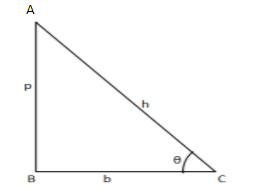
We know that $\sin \theta = \dfrac{{{\text{perpendicular }}}}{{{\text{hypotenuse}}}}$ and $\cos \theta = \dfrac{{{\text{base}}}}{{{\text{hypotenuse}}}}$
So we can say that according to the figure:
$\sin \theta = \dfrac{{{\text{perpendicular }}}}{{{\text{hypotenuse}}}} = \dfrac{p}{h}$$ - - - - (1)$
$\cos \theta = \dfrac{{{\text{base}}}}{{{\text{hypotenuse}}}} = \dfrac{b}{h} - - - - - (2)$
Squaring (1) and (2) and adding we get:
$\Rightarrow$ ${\sin ^2}\theta + {\cos ^2}\theta = \dfrac{{{p^2} + {b^2}}}{{{h^2}}}$
Now we know that according to the Pythagoras theorem we have:
$\Rightarrow$ ${p^2} + {b^2} = {h^2}$
So we can say that:
$
{\sin ^2}\theta + {\cos ^2}\theta = \dfrac{{{h^2}}}{{{h^2}}} = 1 \\
\Rightarrow {\sin ^2}\theta + {\cos ^2}\theta = 1 \\
$
So we get that ${\sin ^2}x + {\cos ^2}x = 1$
So we get that ${\cos ^2}x = 1 - {\sin ^2}x - - - - - (3)$
Now we need to find the value of ${\cos ^2}x - {\sin ^2}x$
Put the value in it from the equation (3):
So we will get:
$1 - {\sin ^2}x - {\sin ^2}x = 1 - 2{\sin ^2}x$
Hence we get the required verification by just using the trigonometric identities and using them to convert into the type as we need in the proof. So we need to utilise our mind in order to know and judge which formula we need to apply in order to get the result that is required.
For example: If we are given that we need to prove ${\cos ^2}x - {\sin ^2}x = 2{\cos ^2}x - 1$
So we just need to think that we need to get the terms in cosine in our proof so we will try to eliminate the terms that contain sin and we will get the desired proof.
Here we will substitute ${\sin ^2}x = 1 - {\cos ^2}x$ instead of ${\cos ^2}x = 1 - {\sin ^2}x$.
Note: In these types of problems where we need to prove or verify the left hand side and the right hand side of the problem, we need to just know the properties and formulae of the trigonometric identities and get the desired proof by using substitution in the correct way.
Complete step-by-step answer:
Here we are given that we need to verify ${\cos ^2}x - {\sin ^2}x = 1 - 2{\sin ^2}x$
So let us take the right angled triangle $ABC$ right angles at $B$
We know that $\sin \theta = \dfrac{{{\text{perpendicular }}}}{{{\text{hypotenuse}}}}$ and $\cos \theta = \dfrac{{{\text{base}}}}{{{\text{hypotenuse}}}}$
So we can say that according to the figure:
$\sin \theta = \dfrac{{{\text{perpendicular }}}}{{{\text{hypotenuse}}}} = \dfrac{p}{h}$$ - - - - (1)$
$\cos \theta = \dfrac{{{\text{base}}}}{{{\text{hypotenuse}}}} = \dfrac{b}{h} - - - - - (2)$
Squaring (1) and (2) and adding we get:
$\Rightarrow$ ${\sin ^2}\theta + {\cos ^2}\theta = \dfrac{{{p^2} + {b^2}}}{{{h^2}}}$
Now we know that according to the Pythagoras theorem we have:
$\Rightarrow$ ${p^2} + {b^2} = {h^2}$
So we can say that:
$
{\sin ^2}\theta + {\cos ^2}\theta = \dfrac{{{h^2}}}{{{h^2}}} = 1 \\
\Rightarrow {\sin ^2}\theta + {\cos ^2}\theta = 1 \\
$
So we get that ${\sin ^2}x + {\cos ^2}x = 1$
So we get that ${\cos ^2}x = 1 - {\sin ^2}x - - - - - (3)$
Now we need to find the value of ${\cos ^2}x - {\sin ^2}x$
Put the value in it from the equation (3):
So we will get:
$1 - {\sin ^2}x - {\sin ^2}x = 1 - 2{\sin ^2}x$
Hence we get the required verification by just using the trigonometric identities and using them to convert into the type as we need in the proof. So we need to utilise our mind in order to know and judge which formula we need to apply in order to get the result that is required.
For example: If we are given that we need to prove ${\cos ^2}x - {\sin ^2}x = 2{\cos ^2}x - 1$
So we just need to think that we need to get the terms in cosine in our proof so we will try to eliminate the terms that contain sin and we will get the desired proof.
Here we will substitute ${\sin ^2}x = 1 - {\cos ^2}x$ instead of ${\cos ^2}x = 1 - {\sin ^2}x$.
Note: In these types of problems where we need to prove or verify the left hand side and the right hand side of the problem, we need to just know the properties and formulae of the trigonometric identities and get the desired proof by using substitution in the correct way.
Recently Updated Pages
If x a + bt + ct2 where x is in meters and t is in class 11 physics CBSE

A car covers the first half distance between two places class 11 physics CBSE
The resultant of two vectors overrightarrow P and overrightarrow class 11 physics CBSE
Find the value of cos 135 class 11 maths CBSE
A mass M is held in place by an applied force F and class 11 physics CBSE
A solution of glucose in water is labelled as 10 dfracwv class 11 chemistry CBSE
Trending doubts
One Metric ton is equal to kg A 10000 B 1000 C 100 class 11 physics CBSE
Find the value of the expression given below sin 30circ class 11 maths CBSE
What do you mean by retardation What is its SI uni class 11 physics CBSE
Draw a diagram of nephron and explain its structur class 11 biology CBSE
10 examples of friction in our daily life
Difference between physical and chemical change class 11 chemistry CBSE