




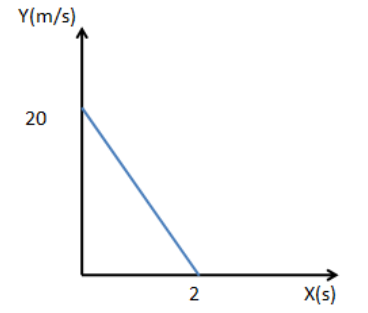
Velocity – time graph of a particle of mass \[2kg\] moving in a straight line is as shown in the figure. Work done by all the forces on the particle is :
a. \[400J\]
b. \[- 400J\]
c. \[- 200J\]
d. \[200J\]
Answer
 Verified
585.3k+ views
Hint: The velocity-time graph shows the value of velocity along the y-axis with respect to time along the x-axis. Find the acceleration from the given velocity and time.
The force is the product of the mass of the object and the acceleration.
The amount of the work-done is gained by the product of the force and the displacement.
Note that, we can find the displacement by calculating the area covered by the figure in the velocity-time graph.
Formula used:
Acceleration $a = \dfrac{{v{\text{(velocity)}}}}{{t{\text{(time)}}}}$
Now the applied force can be written as $F = m \times a$ , here $m$ is known as the mass of the object
The work-done $W = F \times s$
$s = $ the displacement = the area of the triangle that covers the velocity-time graph
$ = \dfrac{1}{2} \times {\text{base}} \times {\text{height}}$
$ = \dfrac{1}{2}vt$
Complete step by step answer:
The above graph is a velocity-time graph where the velocity is along the y-axis and the time is along the x-axis.
Given that, the velocity, $v = 20m/s$ at time $t = 2\sec $
So the Acceleration
$a = \dfrac{{v{\text{(velocity)}}}}{{t{\text{(time)}}}}$
$a = \dfrac{{20}}{2} = 10m/{s^2}$
The mass of the object $m = 2kg$
The applied force $F = m \times a = 2 \times 10 = 20N$
We know the work done is defined by the product of the applied force on an object and the displacement of that object due to this force.
Hence, The work-done $W = F \times s$
Now the displacement is calculated by measuring the area of the triangle shown in the graph.
$s = \dfrac{1}{2} \times {\text{base}} \times {\text{height}}$
$ \Rightarrow s = \dfrac{1}{2} \times 2 \times {\text{20}}$
$s = 20m$
So, The work-done $W = F \times s = 20 \times 20$
$ \Rightarrow W = 400J$
So the work-done by the forces acting on the object is $W = 400J$
Hence, the correct answer is option (A).
Note: The slope of the graph represents the acceleration of the particle, it can be written as $a = \dfrac{{dv}}{{dt}}$ which is the ratio of velocity change and time change getting from the graph.
The area of the triangle defines the displacement of the particle in a velocity-time graph.
The unit of displacement is meter. So if we find this from the area of the triangle it will be $s = \dfrac{1}{2} \times {\text{base}} \times {\text{height}}$ which is $ = \dfrac{1}{2}vt$. And from this we get
$\dfrac{1}{2} \times \dfrac{{{\text{meter}}}}{{\sec }} \times {\text{sec = }}\dfrac{{{\text{meter}}}}{2}$.
The force is the product of the mass of the object and the acceleration.
The amount of the work-done is gained by the product of the force and the displacement.
Note that, we can find the displacement by calculating the area covered by the figure in the velocity-time graph.
Formula used:
Acceleration $a = \dfrac{{v{\text{(velocity)}}}}{{t{\text{(time)}}}}$
Now the applied force can be written as $F = m \times a$ , here $m$ is known as the mass of the object
The work-done $W = F \times s$
$s = $ the displacement = the area of the triangle that covers the velocity-time graph
$ = \dfrac{1}{2} \times {\text{base}} \times {\text{height}}$
$ = \dfrac{1}{2}vt$
Complete step by step answer:
The above graph is a velocity-time graph where the velocity is along the y-axis and the time is along the x-axis.
Given that, the velocity, $v = 20m/s$ at time $t = 2\sec $
So the Acceleration
$a = \dfrac{{v{\text{(velocity)}}}}{{t{\text{(time)}}}}$
$a = \dfrac{{20}}{2} = 10m/{s^2}$
The mass of the object $m = 2kg$
The applied force $F = m \times a = 2 \times 10 = 20N$
We know the work done is defined by the product of the applied force on an object and the displacement of that object due to this force.
Hence, The work-done $W = F \times s$
Now the displacement is calculated by measuring the area of the triangle shown in the graph.
$s = \dfrac{1}{2} \times {\text{base}} \times {\text{height}}$
$ \Rightarrow s = \dfrac{1}{2} \times 2 \times {\text{20}}$
$s = 20m$
So, The work-done $W = F \times s = 20 \times 20$
$ \Rightarrow W = 400J$
So the work-done by the forces acting on the object is $W = 400J$
Hence, the correct answer is option (A).
Note: The slope of the graph represents the acceleration of the particle, it can be written as $a = \dfrac{{dv}}{{dt}}$ which is the ratio of velocity change and time change getting from the graph.
The area of the triangle defines the displacement of the particle in a velocity-time graph.
The unit of displacement is meter. So if we find this from the area of the triangle it will be $s = \dfrac{1}{2} \times {\text{base}} \times {\text{height}}$ which is $ = \dfrac{1}{2}vt$. And from this we get
$\dfrac{1}{2} \times \dfrac{{{\text{meter}}}}{{\sec }} \times {\text{sec = }}\dfrac{{{\text{meter}}}}{2}$.
Recently Updated Pages
Master Class 11 Social Science: Engaging Questions & Answers for Success

Master Class 11 Physics: Engaging Questions & Answers for Success
Master Class 11 Maths: Engaging Questions & Answers for Success
Master Class 11 Economics: Engaging Questions & Answers for Success
Master Class 11 Computer Science: Engaging Questions & Answers for Success
Master Class 11 Chemistry: Engaging Questions & Answers for Success
Trending doubts
One Metric ton is equal to kg A 10000 B 1000 C 100 class 11 physics CBSE
There are 720 permutations of the digits 1 2 3 4 5 class 11 maths CBSE
1 Quintal is equal to a 110 kg b 10 kg c 100kg d 1000 class 11 physics CBSE
State and prove Bernoullis theorem class 11 physics CBSE
Difference Between Prokaryotic Cells and Eukaryotic Cells
Which among the following are examples of coming together class 11 social science CBSE