




Velamen is found in
(a) Vanda
(b) Rose
(c) Viscian
(d) Santalum
Answer
 Verified
613.8k+ views
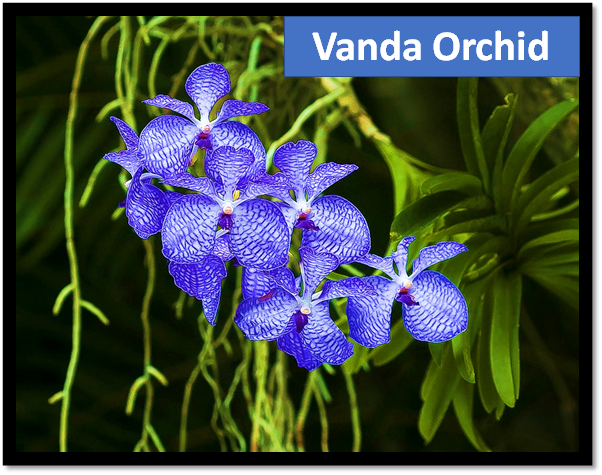
Hint: This is a genus in the orchid family, Orchidaceae. These flowers are usually flat and have a short spur on the lip, the flowers are long- lasting and often fragrant too. These are mainly used for the development of attractive hybrids by crossing this species with those of other orchid genera.
Correct step by step answer:
A velamen is spongy, with multiple epidermises that cover the roots of some epiphytic or semi- epiphytic plants, like orchid and Clivia species. Vanda is an epiphytic orchid that usually grows on branches of other trees. Vanda is an epiphytic orchid that usually grows on branches of other trees. The velamen of orchid is the white or grey covering of the aerial root. It is thick with many cell layers and is capable of absorbing atmospheric moisture and nutrients. The roots of orchids are often associated with symbiotic fungi or bacteria which fix the nutrients from the air. This functionality allows the orchid to exist in locations that should provide a reproductive or vegetative advantage such as improved exposure or reduced competition from other plant species.
The velamen also serves a mechanical function of protecting the vascular tissues in the root cortex, also shielding the root from transpirational water loss. Vanda does not take any food, water, or minerals from the host tree but grows on the branches to get the firm support and also to get maximum sunlight in a thick forest where sunlight does not reach on the ground due to the presence of numerous trees.
So, the correct answer is,’ Vanda’.
Note:
- Velamen tissue from the roots is nothing but the parenchymatous cells that are loosely arranged and they are capable of absorption of water vapor directly from the atmosphere.
- With the help of this water, the green leaves of Vanda can synthesize its own food and survive. - Velamen is absent in the plants of Rosa, Viscin, and Santalum.
Correct step by step answer:
A velamen is spongy, with multiple epidermises that cover the roots of some epiphytic or semi- epiphytic plants, like orchid and Clivia species. Vanda is an epiphytic orchid that usually grows on branches of other trees. Vanda is an epiphytic orchid that usually grows on branches of other trees. The velamen of orchid is the white or grey covering of the aerial root. It is thick with many cell layers and is capable of absorbing atmospheric moisture and nutrients. The roots of orchids are often associated with symbiotic fungi or bacteria which fix the nutrients from the air. This functionality allows the orchid to exist in locations that should provide a reproductive or vegetative advantage such as improved exposure or reduced competition from other plant species.
The velamen also serves a mechanical function of protecting the vascular tissues in the root cortex, also shielding the root from transpirational water loss. Vanda does not take any food, water, or minerals from the host tree but grows on the branches to get the firm support and also to get maximum sunlight in a thick forest where sunlight does not reach on the ground due to the presence of numerous trees.
So, the correct answer is,’ Vanda’.
Note:
- Velamen tissue from the roots is nothing but the parenchymatous cells that are loosely arranged and they are capable of absorption of water vapor directly from the atmosphere.
- With the help of this water, the green leaves of Vanda can synthesize its own food and survive. - Velamen is absent in the plants of Rosa, Viscin, and Santalum.
Recently Updated Pages
Master Class 11 Social Science: Engaging Questions & Answers for Success

Master Class 11 Chemistry: Engaging Questions & Answers for Success
Master Class 12 Business Studies: Engaging Questions & Answers for Success
Master Class 12 Chemistry: Engaging Questions & Answers for Success
Master Class 12 Biology: Engaging Questions & Answers for Success
Class 12 Question and Answer - Your Ultimate Solutions Guide
Trending doubts
How many of the following diseases can be studied with class 11 biology CBSE
Which of the following enzymes is used for carboxylation class 11 biology CBSE
Explain zero factorial class 11 maths CBSE
Receptor sites for neurotransmitters are present on class 11 biology CBSE
JGA JuxtaGlomerular Apparatus a sensitive region which class 11 biology CBSE
Root hairs develop from the region of A Meristematic class 11 biology CBSE