




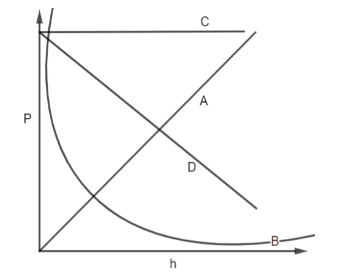
Variation with atmospheric pressure above the sea level is graphically shown with (temperature of the atmosphere is assumed to be constant here)
A. C
B. D
C. A
D. B
Answer
 Verified
531k+ views
Hint: To solve this question we need to find the variation of pressure with increasing altitude assuming that the temperature of the atmosphere remains constant. We need to recall the pressure variation in the atmosphere.
Complete step by step answer:
The atmospheric pressure varies with the increasing altitude as the density of air decreases as we rise above the sea level and the air becomes rarer. Pressure decreases with increasing altitude. The pressure at any level in the atmosphere may be interpreted as the total weight of the air above a unit area at any given elevation.
At higher elevations, the air is less dense above a given surface than a similar surface at lower elevations. Therefore atmospheric pressure decreases as we go up above the sea level but we still don’t know the exact variation.We will now look at the pressure variation formula to know the exact trend of its with increasing altitude
\[P = {P_o}{e^{\dfrac{{ - mgh}}{{KT}}}}\]
Where $P$ is the atmospheric pressure, ${P_o}$ is the average sea-level atmospheric pressure. $m$ is the molar mass of earth’s air, $g$ is gravitational acceleration, $h$ is the height, $T$ is standard temperature and $R$ is the universal gas constant.
From the above formula, we can see that the atmospheric pressure varies exponentially therefore curve B given in the question graph is correct.
Hence, the correct option is D.
Note: The atmospheric pressure is the pressure exerted by the weight of the atmosphere, which at sea level has a value of $101,325{\text{kPa}}$ ( value of ${P_o}$ ). It should be noted that the pressure variation formula is also known as the barometric formula. Barometers are used to measure pressure in millibars.
Complete step by step answer:
The atmospheric pressure varies with the increasing altitude as the density of air decreases as we rise above the sea level and the air becomes rarer. Pressure decreases with increasing altitude. The pressure at any level in the atmosphere may be interpreted as the total weight of the air above a unit area at any given elevation.
At higher elevations, the air is less dense above a given surface than a similar surface at lower elevations. Therefore atmospheric pressure decreases as we go up above the sea level but we still don’t know the exact variation.We will now look at the pressure variation formula to know the exact trend of its with increasing altitude
\[P = {P_o}{e^{\dfrac{{ - mgh}}{{KT}}}}\]
Where $P$ is the atmospheric pressure, ${P_o}$ is the average sea-level atmospheric pressure. $m$ is the molar mass of earth’s air, $g$ is gravitational acceleration, $h$ is the height, $T$ is standard temperature and $R$ is the universal gas constant.
From the above formula, we can see that the atmospheric pressure varies exponentially therefore curve B given in the question graph is correct.
Hence, the correct option is D.
Note: The atmospheric pressure is the pressure exerted by the weight of the atmosphere, which at sea level has a value of $101,325{\text{kPa}}$ ( value of ${P_o}$ ). It should be noted that the pressure variation formula is also known as the barometric formula. Barometers are used to measure pressure in millibars.
Recently Updated Pages
Master Class 11 Economics: Engaging Questions & Answers for Success

Master Class 11 English: Engaging Questions & Answers for Success
Master Class 11 Maths: Engaging Questions & Answers for Success
Class 11 Question and Answer - Your Ultimate Solutions Guide
Master Class 11 Social Science: Engaging Questions & Answers for Success
Master Class 11 Business Studies: Engaging Questions & Answers for Success
Trending doubts
There are 720 permutations of the digits 1 2 3 4 5 class 11 maths CBSE
In what year Guru Nanak Dev ji was born A15 April 1469 class 11 social science CBSE
Draw a diagram of a plant cell and label at least eight class 11 biology CBSE
Explain zero factorial class 11 maths CBSE
When guru nanak ji was born in 1469 AD according to class 11 social studies CBSE
Difference between unicellular and multicellular o class 11 biology CBSE