




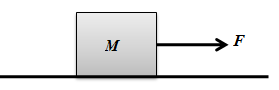
What is the value of friction force f for the following value of applied force F?
a. 1N
b. 2N
c. 3N
d. 4N
e. 20N
Assume the coefficient of friction to be \[{\mu _s} = 0.3\]: \[{\mu _k} = 0.25\]
Mass of the body is \[{\text{M}} = 1\,{\text{kg}}\]. (Assume\[g = 10\,m{s^{ - 2}}\])
Answer
 Verified
575.7k+ views
Hint: Calculate the static friction and kinetic friction using the given values. The static friction acts on the body when it is not moving. The kinetic friction acts on the moving body to oppose its motion. Use Newton’s second law to determine the value of static friction.
Formula used:
\[{f_s} = {\mu _s}N\]
Here, \[{\mu _s}\] is the coefficient of static friction, N is the normal force, M is the mass and g is the acceleration due to gravity.
\[{f_k} = {\mu _k}N\]
Here, \[{\mu _k}\] is the coefficient of kinetic friction.
Complete step by step solution:
We know that, the static friction force is given as,
\[{f_s} = {\mu _s}N\]
\[ \Rightarrow {f_s} = {\mu _s}Mg\] …… (1)
Here, \[{\mu _s}\] is the coefficient of static friction, N is the normal force, M is the mass and g is the acceleration due to gravity.
We also know that the kinetic friction is given as,
\[{f_k} = {\mu _k}N\]
\[ \Rightarrow {f_k} = {\mu _k}Mg\] …… (2)
Here, \[{\mu _k}\] is the coefficient of kinetic friction.
Substituting 0.3 for \[{\mu _s}\], 1 kg for M and \[10\,m{s^{ - 2}}\] for g in equation (1), we get,
\[{f_s} = \left( {0.3} \right)\left( 1 \right)\left( {10} \right)\]
\[ \Rightarrow {f_s} = 3\,N\]
Therefore, the static friction acting on the block is 3 N. This static friction will not let the block move if the applied force is less than 3 N.
Substituting 0.25 for \[{\mu _k}\], 1 kg for M and \[10\,m{s^{ - 2}}\] for g in equation (2), we get,
\[{f_k} = \left( {0.25} \right)\left( 1 \right)\left( {10} \right)\]
\[ \Rightarrow {f_k} = 2.5\,N\]
Therefore, the kinetic friction acting on the block is 2.5 N. This kinetic friction will stop the motion of the block if the applied force is less than 2.5 N.
For \[F = 1\,N\],
We have discussed that the block will not move if the applied force is less than 3 N. In this case, since the block is not moving, the net force on the body is zero. Therefore, we can write,
\[F - {f_s} = 0\]
\[ \Rightarrow {f_s} = F\]
\[ \Rightarrow {f_s} = 1\,N\]
Therefore, the value of friction force is 1 N.
For \[F = 2\,N\],
We have discussed that the block will not move if the applied force is less than 3 N. In this case, since the block is not moving, the net force on the body is zero. Therefore, we can write,
\[F - {f_s} = 0\]
\[ \Rightarrow {f_s} = F\]
\[ \Rightarrow {f_s} = 2\,N\]
Therefore, the value of friction force is 2 N.
For \[F = 3\,N\],
In this case, the applied force equals the static friction force. The body will tend to move but will not move. Therefore, the friction force is 3 N.
For \[F = 4\,N\],
Now, the applied force is greater than the static friction. Therefore, we can see the block will start moving and the friction force acting on the block is kinetic friction. Therefore, the net friction force acting on the block is the maximum kinetic friction. Therefore,
\[f = 2.5\,N\]
For \[F = 20\,N\],
In this case, the block is moving. Therefore, the friction acting on the block is the maximum kinetic friction. Therefore,
\[f = 2.5\,N\]
Note:
When the applied force is less than the static friction, the acceleration of the block is zero. Therefore, we have used Newton’s second law to determine the value of friction force because the friction force balances the applied force. When the block has started moving, we cannot apply Newton’s second law as the acceleration is unknown. In that case, the kinetic friction acting on the body will remain constant.
Formula used:
\[{f_s} = {\mu _s}N\]
Here, \[{\mu _s}\] is the coefficient of static friction, N is the normal force, M is the mass and g is the acceleration due to gravity.
\[{f_k} = {\mu _k}N\]
Here, \[{\mu _k}\] is the coefficient of kinetic friction.
Complete step by step solution:
We know that, the static friction force is given as,
\[{f_s} = {\mu _s}N\]
\[ \Rightarrow {f_s} = {\mu _s}Mg\] …… (1)
Here, \[{\mu _s}\] is the coefficient of static friction, N is the normal force, M is the mass and g is the acceleration due to gravity.
We also know that the kinetic friction is given as,
\[{f_k} = {\mu _k}N\]
\[ \Rightarrow {f_k} = {\mu _k}Mg\] …… (2)
Here, \[{\mu _k}\] is the coefficient of kinetic friction.
Substituting 0.3 for \[{\mu _s}\], 1 kg for M and \[10\,m{s^{ - 2}}\] for g in equation (1), we get,
\[{f_s} = \left( {0.3} \right)\left( 1 \right)\left( {10} \right)\]
\[ \Rightarrow {f_s} = 3\,N\]
Therefore, the static friction acting on the block is 3 N. This static friction will not let the block move if the applied force is less than 3 N.
Substituting 0.25 for \[{\mu _k}\], 1 kg for M and \[10\,m{s^{ - 2}}\] for g in equation (2), we get,
\[{f_k} = \left( {0.25} \right)\left( 1 \right)\left( {10} \right)\]
\[ \Rightarrow {f_k} = 2.5\,N\]
Therefore, the kinetic friction acting on the block is 2.5 N. This kinetic friction will stop the motion of the block if the applied force is less than 2.5 N.
For \[F = 1\,N\],
We have discussed that the block will not move if the applied force is less than 3 N. In this case, since the block is not moving, the net force on the body is zero. Therefore, we can write,
\[F - {f_s} = 0\]
\[ \Rightarrow {f_s} = F\]
\[ \Rightarrow {f_s} = 1\,N\]
Therefore, the value of friction force is 1 N.
For \[F = 2\,N\],
We have discussed that the block will not move if the applied force is less than 3 N. In this case, since the block is not moving, the net force on the body is zero. Therefore, we can write,
\[F - {f_s} = 0\]
\[ \Rightarrow {f_s} = F\]
\[ \Rightarrow {f_s} = 2\,N\]
Therefore, the value of friction force is 2 N.
For \[F = 3\,N\],
In this case, the applied force equals the static friction force. The body will tend to move but will not move. Therefore, the friction force is 3 N.
For \[F = 4\,N\],
Now, the applied force is greater than the static friction. Therefore, we can see the block will start moving and the friction force acting on the block is kinetic friction. Therefore, the net friction force acting on the block is the maximum kinetic friction. Therefore,
\[f = 2.5\,N\]
For \[F = 20\,N\],
In this case, the block is moving. Therefore, the friction acting on the block is the maximum kinetic friction. Therefore,
\[f = 2.5\,N\]
Note:
When the applied force is less than the static friction, the acceleration of the block is zero. Therefore, we have used Newton’s second law to determine the value of friction force because the friction force balances the applied force. When the block has started moving, we cannot apply Newton’s second law as the acceleration is unknown. In that case, the kinetic friction acting on the body will remain constant.
Recently Updated Pages
Master Class 11 Computer Science: Engaging Questions & Answers for Success

Master Class 11 Business Studies: Engaging Questions & Answers for Success
Master Class 11 Economics: Engaging Questions & Answers for Success
Master Class 11 English: Engaging Questions & Answers for Success
Master Class 11 Maths: Engaging Questions & Answers for Success
Master Class 11 Biology: Engaging Questions & Answers for Success
Trending doubts
One Metric ton is equal to kg A 10000 B 1000 C 100 class 11 physics CBSE
There are 720 permutations of the digits 1 2 3 4 5 class 11 maths CBSE
Discuss the various forms of bacteria class 11 biology CBSE
Draw a diagram of a plant cell and label at least eight class 11 biology CBSE
State the laws of reflection of light
10 examples of friction in our daily life