




Why is the value of acceleration due to gravity 0 at the centre of the earth ? Prove with mathematical calculations?
Answer
 Verified
525.9k+ views
Hint: Newton’s gravitational law states that, “all particles in the universe attract every other particle with a force that is directly proportional to the product of their masses and inversely proportional to the square of distance between them”. To solve this question we take earth and another object to be the two masses. And we equate the forces acting on them.
Formula used:
Newton’s gravitational law,
$F=\dfrac{G{{m}_{1}}{{m}_{2}}}{{{r}^{2}}}$
Density,
$\rho =MV$
Volume of Sphere,
$V=\dfrac{4}{3}\pi {{r}^{3}}$
Complete step-by-step answer:
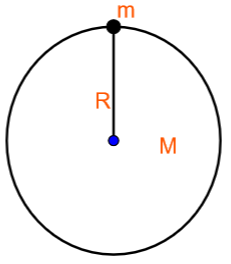
Consider earth as shown in the above figure.
Let ‘M’ be the mass of earth, and ‘R’ be the earth’s radius.
Now, let us assume that there is a small mass ‘m’ on the surface of earth.
According to Newton’s law of gravitation,
If there are two masses${{m}_{1}}$ and${{m}_{2}}$, separated by a distance ‘r’, then ${{m}_{1}}$ attracts${{m}_{2}}$ with a force,
$F=\dfrac{G{{m}_{1}}{{m}_{2}}}{{{r}^{2}}}$ Were, $'G'$ is gravitational constant.
Here we have Earth and another body on the surface of earth.
By Newton’s law of gravitation, we know that earth attracts the mass on its surface.
The force of attraction can be given as,
$F=\dfrac{GMm}{{{R}^{2}}}$
We know that, the earth attracts a body to its centre with a force equal to the weight of that body.
Therefore this force can be written as,
$F=mg$ (We know that weight of a body at earth’s surface,$w=mg$)
Here ‘g’ is the acceleration due to gravity of earth.
Now, let us equate the two forces.
$mg=\dfrac{GMm}{{{R}^{2}}}$
By solving this we get the expression for acceleration due to gravity,
$g=\dfrac{GM}{{{R}^{2}}}$
We know density is given by,
$\rho =\dfrac{M}{V}$Where ‘$\rho $’ is density, ‘M’ is mass and ‘V’ is volume.
From this equation we can find mass,
$M=\rho V$
Earth is considered as a sphere and then we know the volume of earth,
$V=\dfrac{4}{3}\pi {{R}^{3}}$
Therefore, mass of earth can be written as
$M=\rho \times \dfrac{4}{3}\pi {{R}^{3}}$
Substituting value of ‘M’ in the expression for acceleration due to gravity, we get
$g=\dfrac{G\times 4\pi {{R}^{3}}\rho }{{{R}^{2}}\times 3}$
By solving this we get,
$g=\dfrac{4}{3}\pi GR\rho $
Now let us consider the situation, when the object is at the centre of earth.
When the object is at earth’s centre, the distance between earth and the object R=0.
Therefore, acceleration due to gravity,
$\begin{align}
& g=\dfrac{4}{3}\pi G\rho \times 0 \\
& g=0 \\
\end{align}$
Thus gravitational acceleration at earth’s centre is zero
Note: While equating the two masses we get the expression for acceleration due to gravity,
$g=\dfrac{GM}{{{R}^{2}}}$
Now, if we assume that the mass is at the centre of earth,
Then we get R=0
Therefore we get acceleration to be,
$g=\dfrac{GM}{0}=\infty $
The value of acceleration due to gravity cannot be infinity.
Be careful and avoid this situation.
Formula used:
Newton’s gravitational law,
$F=\dfrac{G{{m}_{1}}{{m}_{2}}}{{{r}^{2}}}$
Density,
$\rho =MV$
Volume of Sphere,
$V=\dfrac{4}{3}\pi {{r}^{3}}$
Complete step-by-step answer:
Consider earth as shown in the above figure.
Let ‘M’ be the mass of earth, and ‘R’ be the earth’s radius.
Now, let us assume that there is a small mass ‘m’ on the surface of earth.
According to Newton’s law of gravitation,
If there are two masses${{m}_{1}}$ and${{m}_{2}}$, separated by a distance ‘r’, then ${{m}_{1}}$ attracts${{m}_{2}}$ with a force,
$F=\dfrac{G{{m}_{1}}{{m}_{2}}}{{{r}^{2}}}$ Were, $'G'$ is gravitational constant.
Here we have Earth and another body on the surface of earth.
By Newton’s law of gravitation, we know that earth attracts the mass on its surface.
The force of attraction can be given as,
$F=\dfrac{GMm}{{{R}^{2}}}$
We know that, the earth attracts a body to its centre with a force equal to the weight of that body.
Therefore this force can be written as,
$F=mg$ (We know that weight of a body at earth’s surface,$w=mg$)
Here ‘g’ is the acceleration due to gravity of earth.
Now, let us equate the two forces.
$mg=\dfrac{GMm}{{{R}^{2}}}$
By solving this we get the expression for acceleration due to gravity,
$g=\dfrac{GM}{{{R}^{2}}}$
We know density is given by,
$\rho =\dfrac{M}{V}$Where ‘$\rho $’ is density, ‘M’ is mass and ‘V’ is volume.
From this equation we can find mass,
$M=\rho V$
Earth is considered as a sphere and then we know the volume of earth,
$V=\dfrac{4}{3}\pi {{R}^{3}}$
Therefore, mass of earth can be written as
$M=\rho \times \dfrac{4}{3}\pi {{R}^{3}}$
Substituting value of ‘M’ in the expression for acceleration due to gravity, we get
$g=\dfrac{G\times 4\pi {{R}^{3}}\rho }{{{R}^{2}}\times 3}$
By solving this we get,
$g=\dfrac{4}{3}\pi GR\rho $
Now let us consider the situation, when the object is at the centre of earth.
When the object is at earth’s centre, the distance between earth and the object R=0.
Therefore, acceleration due to gravity,
$\begin{align}
& g=\dfrac{4}{3}\pi G\rho \times 0 \\
& g=0 \\
\end{align}$
Thus gravitational acceleration at earth’s centre is zero
Note: While equating the two masses we get the expression for acceleration due to gravity,
$g=\dfrac{GM}{{{R}^{2}}}$
Now, if we assume that the mass is at the centre of earth,
Then we get R=0
Therefore we get acceleration to be,
$g=\dfrac{GM}{0}=\infty $
The value of acceleration due to gravity cannot be infinity.
Be careful and avoid this situation.
Recently Updated Pages
Master Class 11 Social Science: Engaging Questions & Answers for Success

Master Class 11 Chemistry: Engaging Questions & Answers for Success
Master Class 12 Business Studies: Engaging Questions & Answers for Success
Master Class 12 Chemistry: Engaging Questions & Answers for Success
Master Class 12 Biology: Engaging Questions & Answers for Success
Class 12 Question and Answer - Your Ultimate Solutions Guide
Trending doubts
One Metric ton is equal to kg A 10000 B 1000 C 100 class 11 physics CBSE
Difference Between Prokaryotic Cells and Eukaryotic Cells
How many of the following diseases can be studied with class 11 biology CBSE
Two of the body parts which do not appear in MRI are class 11 biology CBSE
Which of the following enzymes is used for carboxylation class 11 biology CBSE
Explain zero factorial class 11 maths CBSE