




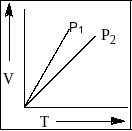
$V$ versus $T$ curves at constant pressure ${P_1}\,and\,{P_2}$ for an ideal gas are shown in the figure below. Which is constant?
(A) ${P_1} > {P_2}$
(B) ${P_1} < {P_2}$
(C) ${P_1} = {P_2}$
(D) none of the above
Answer
 Verified
578.4k+ views
Hint: For ideal gases the pressure, temperature and volume are related to each other by different laws. These laws combine to give one common law known as combined gas law. One can relate these terms with each other in the equation and find out the value which is constant.
Complete step by step answer:
1) First of all we will learn about the combined gas law where we can relate the terms with each other, it can be defined as for a sample of gas, the ratio of the product of the original pressure and volume to the original temperature is constant. It can be written in mathematical formula as,
$\dfrac{{PV}}{T} = K$,
Where, $P$ is pressure, $V$ is volume, $T$ is temperature and $K$ is constant.
The above equation can also be written as, $\dfrac{V}{T} = \dfrac{K}{P}$
2) It can be stated from the above mathematical equation that the ratio of volume and temperature is inversely proportional to the pressure. Thus, in a volume versus temperature graph the slope of the graph is inversely proportional to the pressure of the gas.
3) It can be said that the pressure is more if the slope of volume versus temperature graph is less and pressure is less if the slope of volume versus temperature graph is more.
In the given graph slope of ${P_1} > {P_2}$ . So, the value of ${P_2} > {P_1}$ .
Therefore, ${P_2} > {P_1}$ which shows option ‘B’ as a correct choice.
Note:
The ideal gas law is also known as the general gas equation. All the real gases behave as ideal gas at very low pressure and high temperature. The inversely proportional value should be analyzed with relevant terms and necessary changes should be made in equations like changing the sides. The given slope of the graphs should be observed carefully.
Complete step by step answer:
1) First of all we will learn about the combined gas law where we can relate the terms with each other, it can be defined as for a sample of gas, the ratio of the product of the original pressure and volume to the original temperature is constant. It can be written in mathematical formula as,
$\dfrac{{PV}}{T} = K$,
Where, $P$ is pressure, $V$ is volume, $T$ is temperature and $K$ is constant.
The above equation can also be written as, $\dfrac{V}{T} = \dfrac{K}{P}$
2) It can be stated from the above mathematical equation that the ratio of volume and temperature is inversely proportional to the pressure. Thus, in a volume versus temperature graph the slope of the graph is inversely proportional to the pressure of the gas.
3) It can be said that the pressure is more if the slope of volume versus temperature graph is less and pressure is less if the slope of volume versus temperature graph is more.
In the given graph slope of ${P_1} > {P_2}$ . So, the value of ${P_2} > {P_1}$ .
Therefore, ${P_2} > {P_1}$ which shows option ‘B’ as a correct choice.
Note:
The ideal gas law is also known as the general gas equation. All the real gases behave as ideal gas at very low pressure and high temperature. The inversely proportional value should be analyzed with relevant terms and necessary changes should be made in equations like changing the sides. The given slope of the graphs should be observed carefully.
Recently Updated Pages
Master Class 11 Computer Science: Engaging Questions & Answers for Success

Master Class 11 Business Studies: Engaging Questions & Answers for Success
Master Class 11 Economics: Engaging Questions & Answers for Success
Master Class 11 English: Engaging Questions & Answers for Success
Master Class 11 Maths: Engaging Questions & Answers for Success
Master Class 11 Biology: Engaging Questions & Answers for Success
Trending doubts
One Metric ton is equal to kg A 10000 B 1000 C 100 class 11 physics CBSE
There are 720 permutations of the digits 1 2 3 4 5 class 11 maths CBSE
Discuss the various forms of bacteria class 11 biology CBSE
Draw a diagram of a plant cell and label at least eight class 11 biology CBSE
State the laws of reflection of light
Explain zero factorial class 11 maths CBSE