




Using the Venn diagram shows that $(A - B)$,$(A \cap B)$ and $(B - A)$ are disjoint sets, taking $A = \left\{ {2,4,6,8,10,\left. {12} \right\}} \right.$and $B = \left\{ {3,6,9,12,\left. {15} \right\}} \right.$
Answer
 Verified
494.1k+ views
Hint: First, we have to define what the terms we need to solve the problem are.
Since disjoint means the common values of the two or more than two sets are empty (no values occur)
It was also known as$A \cap B = \phi $. Also, there are two sets given, the set of A has the multiple of two and the set of all B has the multiple of three.
Complete step by step answer:
Let from the given two sets $A = \left\{ {2,4,6,8,10,\left. {12} \right\}} \right.$and $B = \left\{ {3,6,9,12,\left. {15} \right\}} \right.$ first, we need to find the required sets like $(A - B)$ ,$(A \cap B)$and$(B - A)$
First, we will find $(A - B)$(set of A subtracts set of B) which is the subtraction operator into the sets;
It refers to $A = \left\{ {2,4,6,8,10,\left. {12} \right\}} \right.$subtract (common elements comparing to B will be eliminated) the $B = \left\{ {3,6,9,12,\left. {15} \right\}} \right.$ then $(A - B) = \left\{ {2,4,6,8,\left. {10} \right\}} \right.$since A and B have $12$as the common number so that element from A only eliminated;
Similarly in the same way we can prove; $(B - A)$(the common elements of B only need to be eliminated)
Hence $(B - A) = \left\{ {3,9,\left. {15} \right\}} \right.$(since comparing B and A the two common elements are $6$,$12$)
Now for $(A \cap B)$which is the intersection of the two sets; only the common numbers will occur in this set. Hence $(A \cap B) = \left\{ {6,\left. {12} \right\}} \right.$(six and twelve are the only two elements that occur in this set)
Thus, we have all the set values $(A - B) = \left\{ {2,4,6,8,\left. {10} \right\}} \right.$$(B - A) = \left\{ {3,9,\left. {15} \right\}} \right.$$(A \cap B) = \left\{ {6,\left. {12} \right\}} \right.$ Now we will check the intersection of all sets; if it occurs empty then it is disjoint set or not disjoint
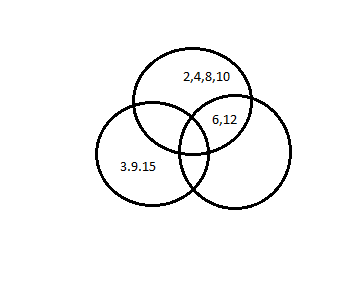
Thus, we see there are no common points or numbers for the three sets $(A - B)$,$(A \cap B)$ and $(B - A)$ hence it is a disjoint set; as we said the intersection of the sets is empty.
Note:
Since $(A - B)$ means the set of all elements of set, A has no common points compared to set B and $(B - A)$ is as similar. Distinct means difference set and disjoint means intersection empty set.
Also empty is said to be a set in set theory.
Since disjoint means the common values of the two or more than two sets are empty (no values occur)
It was also known as$A \cap B = \phi $. Also, there are two sets given, the set of A has the multiple of two and the set of all B has the multiple of three.
Complete step by step answer:
Let from the given two sets $A = \left\{ {2,4,6,8,10,\left. {12} \right\}} \right.$and $B = \left\{ {3,6,9,12,\left. {15} \right\}} \right.$ first, we need to find the required sets like $(A - B)$ ,$(A \cap B)$and$(B - A)$
First, we will find $(A - B)$(set of A subtracts set of B) which is the subtraction operator into the sets;
It refers to $A = \left\{ {2,4,6,8,10,\left. {12} \right\}} \right.$subtract (common elements comparing to B will be eliminated) the $B = \left\{ {3,6,9,12,\left. {15} \right\}} \right.$ then $(A - B) = \left\{ {2,4,6,8,\left. {10} \right\}} \right.$since A and B have $12$as the common number so that element from A only eliminated;
Similarly in the same way we can prove; $(B - A)$(the common elements of B only need to be eliminated)
Hence $(B - A) = \left\{ {3,9,\left. {15} \right\}} \right.$(since comparing B and A the two common elements are $6$,$12$)
Now for $(A \cap B)$which is the intersection of the two sets; only the common numbers will occur in this set. Hence $(A \cap B) = \left\{ {6,\left. {12} \right\}} \right.$(six and twelve are the only two elements that occur in this set)
Thus, we have all the set values $(A - B) = \left\{ {2,4,6,8,\left. {10} \right\}} \right.$$(B - A) = \left\{ {3,9,\left. {15} \right\}} \right.$$(A \cap B) = \left\{ {6,\left. {12} \right\}} \right.$ Now we will check the intersection of all sets; if it occurs empty then it is disjoint set or not disjoint
Thus, we see there are no common points or numbers for the three sets $(A - B)$,$(A \cap B)$ and $(B - A)$ hence it is a disjoint set; as we said the intersection of the sets is empty.
Note:
Since $(A - B)$ means the set of all elements of set, A has no common points compared to set B and $(B - A)$ is as similar. Distinct means difference set and disjoint means intersection empty set.
Also empty is said to be a set in set theory.
Recently Updated Pages
Master Class 11 English: Engaging Questions & Answers for Success

Master Class 11 Maths: Engaging Questions & Answers for Success
Class 11 Question and Answer - Your Ultimate Solutions Guide
Master Class 11 Biology: Engaging Questions & Answers for Success
Master Class 11 Physics: Engaging Questions & Answers for Success
Master Class 11 Accountancy: Engaging Questions & Answers for Success
Trending doubts
Explain the Treaty of Vienna of 1815 class 10 social science CBSE
Who Won 36 Oscar Awards? Record Holder Revealed
What is the median of the first 10 natural numbers class 10 maths CBSE
Why is it 530 pm in india when it is 1200 afternoon class 10 social science CBSE
Why is there a time difference of about 5 hours between class 10 social science CBSE
What is the full form of POSCO class 10 social science CBSE