




Using the periodic table, predict the formulas of compounds which might be formed by the following pairs of elements:
(a) Silicon and bromine
(b) Aluminium and sulphur
Answer
 Verified
617.7k+ views
Hint: To answer this question we should know the atomic number of silicon, bromine, aluminium and sulphur. Understanding the concept of valency may help us to answer this question within no time.
Complete answer:
The number electrons in an atom of a particular element is known as the atomic number of an element.
Valence electrons are the electrons present in the outermost shell of an atom. The valence electrons can easily react with the electrons in the outermost shell of another atom. The valency is the capacity of an atom to make bonds. Capacity to make bond depends on the number of valence electrons.
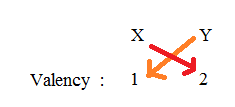
Here, the formula will be ${{X}_{2}}{{Y}_{1}}$.
(a) Silicon and bromine
-Silicon
Atomic number of silicon is 14.
The electronic configuration is $1{{s}^{2}}2{{s}^{2}}2{{p}^{6}}3{{s}^{2}}3{{p}^{2}}$.
Therefore, the valence electron is 4.
The silicon atom prefers to gain or lose 4 electrons to make stable compounds. Thus, it is tetravalent.
-Bromine
Atomic number of bromine is 35.
The electronic configuration is $1{{s}^{2}}2{{s}^{2}}2{{p}^{6}}3{{s}^{2}}3{{p}^{6}}4{{s}^{2}}3{{d}^{10}}4{{p}^{5}}$.
Therefore, the valence electron is 5.
The bromine atom prefers to gain an electron rather than losing 5 electrons to make a stable compound. . Thus, it is monovalent.
Hence, the compound forms will be $SiB{{r}_{4}}$.
(b) Aluminium and sulphur
-Aluminium
Atomic number of silicon is 13.
The electronic configuration is $1{{s}^{2}}2{{s}^{2}}2{{p}^{6}}3{{s}^{2}}3{{p}^{3}}$.
Therefore, the valence electron is 3.
The aluminium atom prefers to lose 3 electrons rather than losing 3 electrons to make a stable compound. Thus, it is trivalent.
-Sulphur
Atomic number of bromine is 16.
The electronic configuration is $1{{s}^{2}}2{{s}^{2}}2{{p}^{6}}3{{s}^{2}}3{{p}^{4}}$.
Therefore, the valence electron is 5.
The sulphur atom prefers to gain 2 electrons to make a stable compound as it is easy to gain 2 electrons rather than losing four. Thus, it is monovalent.
Thus, the compound forms $A{{l}_{2}}{{S}_{3}}$.
Note: Depending upon the valency of an element forms bond with another element. The elements would like to attain stable configuration either by losing or gaining electrons. In this case it prefers to spend less energy in order to attain the stable configuration. Therefore, valency is important to understand.
Complete answer:
The number electrons in an atom of a particular element is known as the atomic number of an element.
Valence electrons are the electrons present in the outermost shell of an atom. The valence electrons can easily react with the electrons in the outermost shell of another atom. The valency is the capacity of an atom to make bonds. Capacity to make bond depends on the number of valence electrons.
Here, the formula will be ${{X}_{2}}{{Y}_{1}}$.
(a) Silicon and bromine
-Silicon
Atomic number of silicon is 14.
The electronic configuration is $1{{s}^{2}}2{{s}^{2}}2{{p}^{6}}3{{s}^{2}}3{{p}^{2}}$.
Therefore, the valence electron is 4.
The silicon atom prefers to gain or lose 4 electrons to make stable compounds. Thus, it is tetravalent.
-Bromine
Atomic number of bromine is 35.
The electronic configuration is $1{{s}^{2}}2{{s}^{2}}2{{p}^{6}}3{{s}^{2}}3{{p}^{6}}4{{s}^{2}}3{{d}^{10}}4{{p}^{5}}$.
Therefore, the valence electron is 5.
The bromine atom prefers to gain an electron rather than losing 5 electrons to make a stable compound. . Thus, it is monovalent.
Hence, the compound forms will be $SiB{{r}_{4}}$.
(b) Aluminium and sulphur
-Aluminium
Atomic number of silicon is 13.
The electronic configuration is $1{{s}^{2}}2{{s}^{2}}2{{p}^{6}}3{{s}^{2}}3{{p}^{3}}$.
Therefore, the valence electron is 3.
The aluminium atom prefers to lose 3 electrons rather than losing 3 electrons to make a stable compound. Thus, it is trivalent.
-Sulphur
Atomic number of bromine is 16.
The electronic configuration is $1{{s}^{2}}2{{s}^{2}}2{{p}^{6}}3{{s}^{2}}3{{p}^{4}}$.
Therefore, the valence electron is 5.
The sulphur atom prefers to gain 2 electrons to make a stable compound as it is easy to gain 2 electrons rather than losing four. Thus, it is monovalent.
Thus, the compound forms $A{{l}_{2}}{{S}_{3}}$.
Note: Depending upon the valency of an element forms bond with another element. The elements would like to attain stable configuration either by losing or gaining electrons. In this case it prefers to spend less energy in order to attain the stable configuration. Therefore, valency is important to understand.
Recently Updated Pages
Basicity of sulphurous acid and sulphuric acid are

Master Class 11 English: Engaging Questions & Answers for Success
Master Class 11 Physics: Engaging Questions & Answers for Success
Master Class 11 Computer Science: Engaging Questions & Answers for Success
Master Class 11 Chemistry: Engaging Questions & Answers for Success
Master Class 11 Social Science: Engaging Questions & Answers for Success
Trending doubts
Difference Between Prokaryotic Cells and Eukaryotic Cells
Two of the body parts which do not appear in MRI are class 11 biology CBSE
One Metric ton is equal to kg A 10000 B 1000 C 100 class 11 physics CBSE
10 examples of friction in our daily life
Draw a diagram of nephron and explain its structur class 11 biology CBSE
What will happen if the mucus is not secreted by the class 11 biology CBSE