




Using the mirror formula, explain why a convex mirror always produces a virtual image.
Answer
 Verified
497.7k+ views
Hint: First we will make a rough diagram of a convex mirror. Here we will use the concept of convex mirror property and nature to solve the problem. Then we will use the mirror formula. After some arrangement using sign convection we can find the image produced in a convex mirror is always virtual.
Complete answer:
As per the problem using the mirror formula we have to explain the reason behind the formation of virtual images in case of a convex mirror.
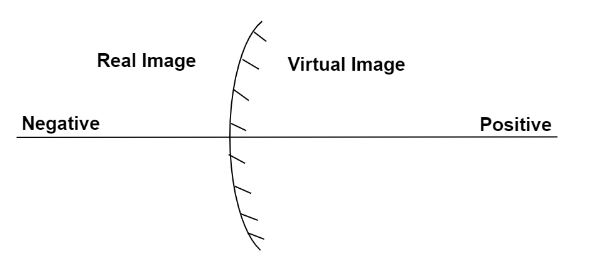
From the figure and using mirror formula we can say,
$\dfrac{1}{v} + \dfrac{1}{u} = \dfrac{1}{f}$
After rearranging the equation we will get,
$\dfrac{1}{v} = \dfrac{1}{f} - \dfrac{1}{u}$
Where, $u$ is the distance of the object from the mirror and it is the real image of the object. Hence according to sign convention the distance is taken as negative as given in the diagram.
Now the mirror equation will be,
$\dfrac{1}{v} = \dfrac{1}{f} + \dfrac{1}{u}$
Hence the addition of two positive numbers will always be positive hence the image will line in the positive side of the convex mirror. This implies that the image distance will always be positive as in the case of the convex mirror and the image is always positive on the other side of the object, or we can say the image will form behind the mirror.
Therefore it is proved that the image formed in the case of a convex mirror is a virtual image.
Note: Remember that the convex mirror is also known as a diverging mirror as it diverges the light rays that strike on the reflecting surface of the convex mirror. Also keep in mind that the image formed in this case is virtual, erect and diminished in nature irrespective of the distance between the object and the mirror.
Complete answer:
As per the problem using the mirror formula we have to explain the reason behind the formation of virtual images in case of a convex mirror.
From the figure and using mirror formula we can say,
$\dfrac{1}{v} + \dfrac{1}{u} = \dfrac{1}{f}$
After rearranging the equation we will get,
$\dfrac{1}{v} = \dfrac{1}{f} - \dfrac{1}{u}$
Where, $u$ is the distance of the object from the mirror and it is the real image of the object. Hence according to sign convention the distance is taken as negative as given in the diagram.
Now the mirror equation will be,
$\dfrac{1}{v} = \dfrac{1}{f} + \dfrac{1}{u}$
Hence the addition of two positive numbers will always be positive hence the image will line in the positive side of the convex mirror. This implies that the image distance will always be positive as in the case of the convex mirror and the image is always positive on the other side of the object, or we can say the image will form behind the mirror.
Therefore it is proved that the image formed in the case of a convex mirror is a virtual image.
Note: Remember that the convex mirror is also known as a diverging mirror as it diverges the light rays that strike on the reflecting surface of the convex mirror. Also keep in mind that the image formed in this case is virtual, erect and diminished in nature irrespective of the distance between the object and the mirror.
Recently Updated Pages
Three beakers labelled as A B and C each containing 25 mL of water were taken A small amount of NaOH anhydrous CuSO4 and NaCl were added to the beakers A B and C respectively It was observed that there was an increase in the temperature of the solutions contained in beakers A and B whereas in case of beaker C the temperature of the solution falls Which one of the following statements isarecorrect i In beakers A and B exothermic process has occurred ii In beakers A and B endothermic process has occurred iii In beaker C exothermic process has occurred iv In beaker C endothermic process has occurred

Master Class 10 Social Science: Engaging Questions & Answers for Success
Master Class 10 Science: Engaging Questions & Answers for Success
Master Class 10 Maths: Engaging Questions & Answers for Success
Master Class 10 General Knowledge: Engaging Questions & Answers for Success
Master Class 10 Computer Science: Engaging Questions & Answers for Success
Three beakers labelled as A B and C each containing 25 mL of water were taken A small amount of NaOH anhydrous CuSO4 and NaCl were added to the beakers A B and C respectively It was observed that there was an increase in the temperature of the solutions contained in beakers A and B whereas in case of beaker C the temperature of the solution falls Which one of the following statements isarecorrect i In beakers A and B exothermic process has occurred ii In beakers A and B endothermic process has occurred iii In beaker C exothermic process has occurred iv In beaker C endothermic process has occurred
Master Class 10 Social Science: Engaging Questions & Answers for Success
Master Class 10 Science: Engaging Questions & Answers for Success
Trending doubts
Explain the Treaty of Vienna of 1815 class 10 social science CBSE
In cricket, how many legal balls are there in a standard over?
Why is there a time difference of about 5 hours between class 10 social science CBSE
Who Won 36 Oscar Awards? Record Holder Revealed
What is the median of the first 10 natural numbers class 10 maths CBSE
What is deficiency disease class 10 biology CBSE