



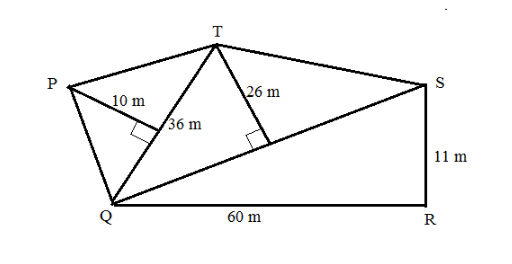
Using the information given in the figure, find the area of the plot PQRST.
Answer
 Verified
578.4k+ views
Hint: In this question, we need to determine the area of the complete figure such that it includes three triangles. For this, we will use Pythagoras theorem along with the formula for the area of the triangle.
Complete step-by-step answer:
From the triangle QRS, we can see that angle R is at 90 degrees and so, it is a right angled triangle.
Following the Pythagoras theorem, we can write the sum of the squares of the base and the perpendicular side of the triangle as equals to the square of the length of the hypotenuse side. Mathematically, $ {\left( {hypotenuse} \right)^2} = {\left( {base} \right)^2} + {\left( {height} \right)^2} $
So, for the triangle QRS, we can write
$
\Rightarrow {(QS)^2} = {(QR)^2} + {(RS)^2} \\
= {(60)^2} + {(11)^2} \\
= 3600 + 121 \\
= 3721 \\
QS = 61{\text{ cm}} \\
$
Now, the area of the whole figure PQRST can be written as the summation of the area of the triangles PQT, triangle QTS and triangle QRS.
Half of the product of the base and the height of the triangle is the area of the triangle. Mathematically, $ A = \dfrac{1}{2} \times b \times h $ .
In the triangle PQT, the length of the base is 36 meters and the length of the height is 10 meters. Hence, the area of the triangle PQT is given as:
$
\Rightarrow {A_{PQT}} = \dfrac{1}{2} \times b \times h \\
= \dfrac{1}{2} \times 36 \times 10 \\
= 36 \times 5 \\
= 180{\text{ }}{{\text{m}}^2} - - - - (i) \\
$
Similarly, for the triangle QTS, the length of the base is 61 meters and the length of the height is 26 meters. Hence, the area of the triangle QST is given as:
$
\Rightarrow {A_{QST}} = \dfrac{1}{2} \times b \times h \\
= \dfrac{1}{2} \times 61 \times 26 \\
= 61 \times 13 \\
= 793{\text{ }}{{\text{m}}^2} - - - - (ii) \\
$
Again, for the triangle QRS, the length of the base is 60 meters and the length of the height is 11 meters. Hence, the area of the triangle QRS is given as:
$
\Rightarrow {A_{QRS}} = \dfrac{1}{2} \times b \times h \\
= \dfrac{1}{2} \times 60 \times 11 \\
= 30 \times 11 \\
= 330{\text{ }}{{\text{m}}^2} - - - - (iii) \\
$
Now, the area of the total figure is given as the summation of the equations (i), (ii) and (iii).
$
\Rightarrow A = {A_{PQT}} + {A_{QTS}} + {A_{QRS}} \\
= 180 + 793 + 330 \\
= 1303{\text{ }}{{\text{m}}^2} \\
$
Hence, the area of the given figure is 1303 square meters.
Note: In these types of questions, students need to divide the total area in small sections in which we can apply the predefined mathematical formulae for the calculation of the area and then, add them all to get the final answer.
Complete step-by-step answer:
From the triangle QRS, we can see that angle R is at 90 degrees and so, it is a right angled triangle.
Following the Pythagoras theorem, we can write the sum of the squares of the base and the perpendicular side of the triangle as equals to the square of the length of the hypotenuse side. Mathematically, $ {\left( {hypotenuse} \right)^2} = {\left( {base} \right)^2} + {\left( {height} \right)^2} $
So, for the triangle QRS, we can write
$
\Rightarrow {(QS)^2} = {(QR)^2} + {(RS)^2} \\
= {(60)^2} + {(11)^2} \\
= 3600 + 121 \\
= 3721 \\
QS = 61{\text{ cm}} \\
$
Now, the area of the whole figure PQRST can be written as the summation of the area of the triangles PQT, triangle QTS and triangle QRS.
Half of the product of the base and the height of the triangle is the area of the triangle. Mathematically, $ A = \dfrac{1}{2} \times b \times h $ .
In the triangle PQT, the length of the base is 36 meters and the length of the height is 10 meters. Hence, the area of the triangle PQT is given as:
$
\Rightarrow {A_{PQT}} = \dfrac{1}{2} \times b \times h \\
= \dfrac{1}{2} \times 36 \times 10 \\
= 36 \times 5 \\
= 180{\text{ }}{{\text{m}}^2} - - - - (i) \\
$
Similarly, for the triangle QTS, the length of the base is 61 meters and the length of the height is 26 meters. Hence, the area of the triangle QST is given as:
$
\Rightarrow {A_{QST}} = \dfrac{1}{2} \times b \times h \\
= \dfrac{1}{2} \times 61 \times 26 \\
= 61 \times 13 \\
= 793{\text{ }}{{\text{m}}^2} - - - - (ii) \\
$
Again, for the triangle QRS, the length of the base is 60 meters and the length of the height is 11 meters. Hence, the area of the triangle QRS is given as:
$
\Rightarrow {A_{QRS}} = \dfrac{1}{2} \times b \times h \\
= \dfrac{1}{2} \times 60 \times 11 \\
= 30 \times 11 \\
= 330{\text{ }}{{\text{m}}^2} - - - - (iii) \\
$
Now, the area of the total figure is given as the summation of the equations (i), (ii) and (iii).
$
\Rightarrow A = {A_{PQT}} + {A_{QTS}} + {A_{QRS}} \\
= 180 + 793 + 330 \\
= 1303{\text{ }}{{\text{m}}^2} \\
$
Hence, the area of the given figure is 1303 square meters.
Note: In these types of questions, students need to divide the total area in small sections in which we can apply the predefined mathematical formulae for the calculation of the area and then, add them all to get the final answer.
Recently Updated Pages
Master Class 9 General Knowledge: Engaging Questions & Answers for Success

Master Class 9 Social Science: Engaging Questions & Answers for Success
Master Class 9 English: Engaging Questions & Answers for Success
Master Class 9 Maths: Engaging Questions & Answers for Success
Master Class 9 Science: Engaging Questions & Answers for Success
Class 9 Question and Answer - Your Ultimate Solutions Guide
Trending doubts
Difference Between Plant Cell and Animal Cell
Fill the blanks with the suitable prepositions 1 The class 9 english CBSE
Who is eligible for RTE class 9 social science CBSE
Which places in India experience sunrise first and class 9 social science CBSE
What is pollution? How many types of pollution? Define it
Name 10 Living and Non living things class 9 biology CBSE